Hoi An, Vietnam

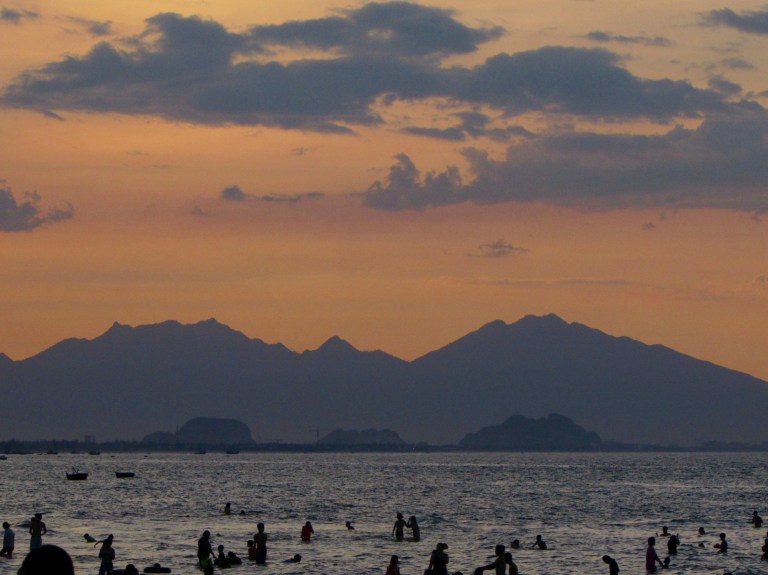
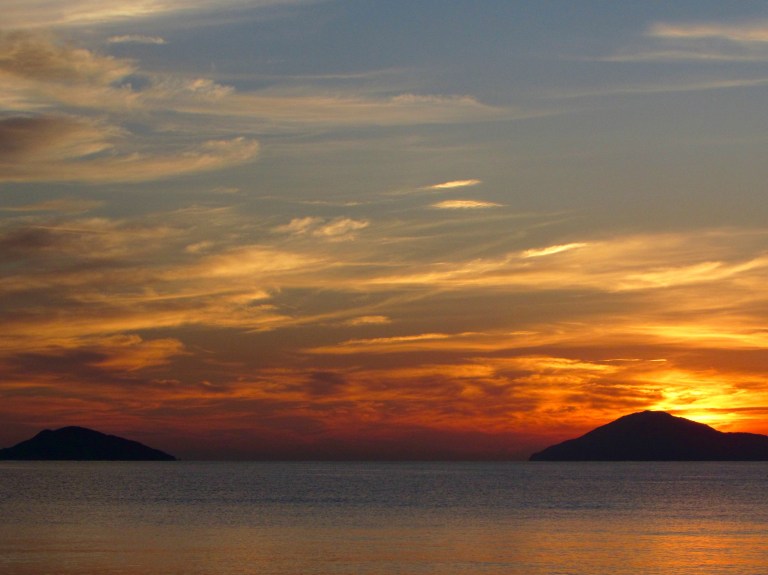
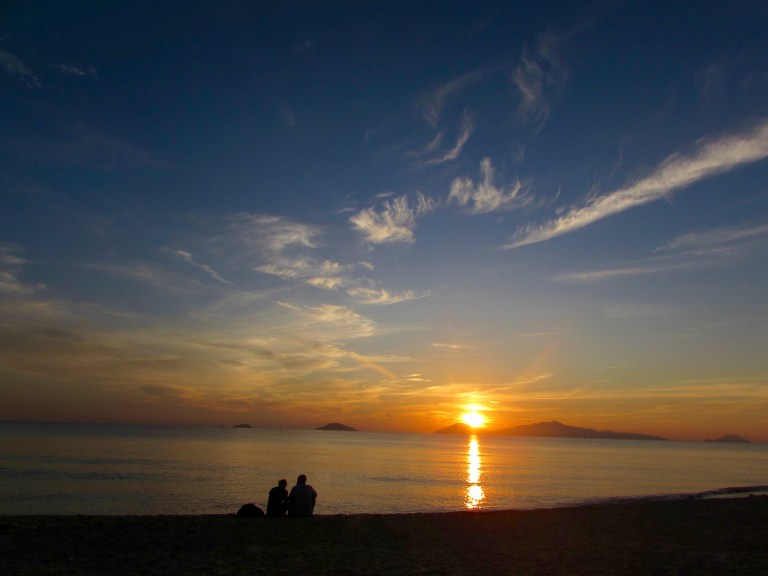
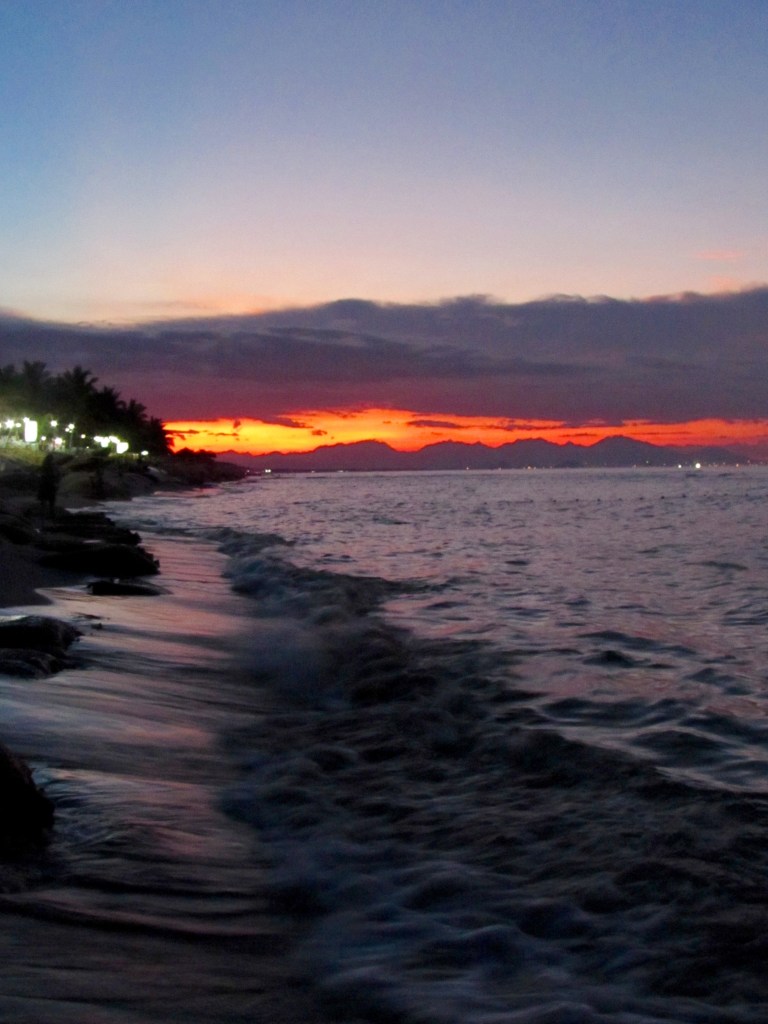
As we dipped our feet into the warm ocean waters, taking in the last remaining traces of sunset, the sky before us caught fire. Deep oranges and reds sat hovering over the mountain-lined horizon, contained by a thick plume of dark and smoky clouds. We were barely two hours into our time in Hoi An, an ancient trading town along the coast of Central Vietnam, and were already beginning to discover the many charms it had to offer, chief among them beautiful scenery. To our delight, the fiery sky remained unchanged for the entirety of our time on the beach, but this didn’t stop us from looking up every few minutes to remind ourselves of where we were or what surrounded us. And so began the theme of our six days in Vietnam. It was never a matter of seeking out new things but rather making sure not to miss them. The sights and tastes and experiences were there, all we had to do was just walk out the door.
IMG_0684
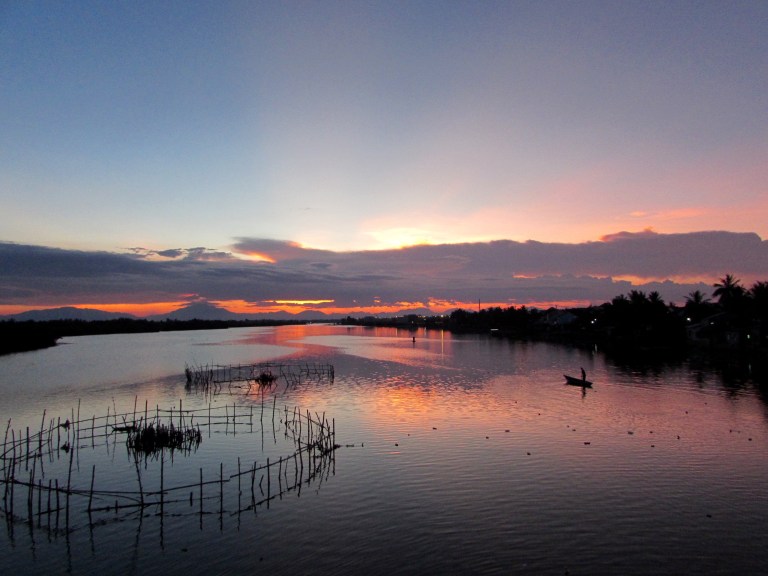
View along the ride to Cua Dai beach
IMG_0691
Sunset on the beach

Long before coming on the trip we had designated our first full day in Hoi An as an unequivocal beach day. While we were aware of the abundance of cultural activities to do around the town and the limited nature of our itinerary, we were also aware of the novelty of being on the tropical shores of Vietnam and that, we deemed, deserved spending at least one day entirely sea or sand bound.

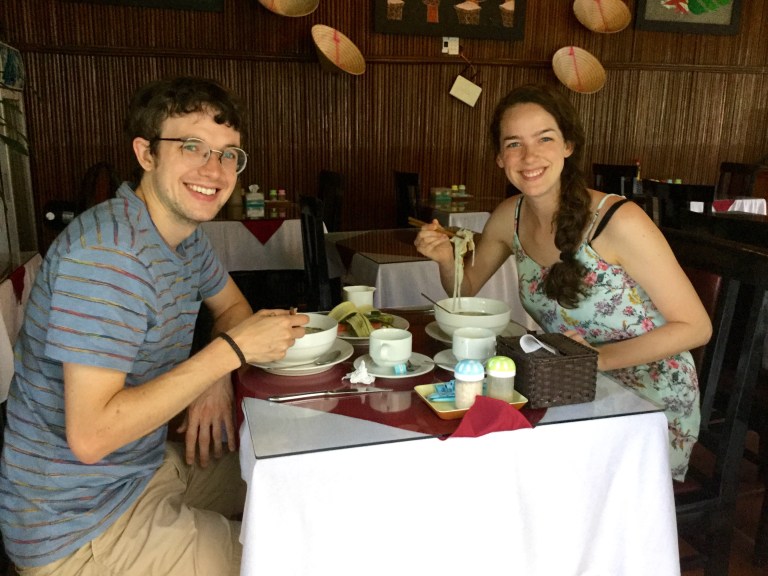
Our day, like all the rest, began with a free breakfast at our guesthouse, Loc Phat Hoi An Homestay, one of the most accommodating places we’ve ever had the fortune of staying at. Pho, a spicy beef noodle soup, was the dish of choice on the menu and we slurped up two delicious bowls of it before renting a couple of bikes and peddling off towards An Bang Beach, our first and only destination for the day.
IMG_0366
Enjoying a hot bowl of Pho for breakfast

I’m not sure how one could feel eager to do absolutely nothing for an entire day, but that’s exactly how we felt as we parked our bikes at An Bang and began the short walk to the beach. As we approached it, we weren’t met with the view of an expansive blue ocean as we had expected but instead with a canopy of grass umbrellas, each with a pair of cushioned loungers neatly situated underneath, stretching across the sand as far as the eye could see. The umbrellas, we had read, belonged to one of the many restaurants looming overhead and we braced ourselves for what would surely be an onslaught of sales pitches to choose one over the other. Before our feet even touched the sand, shouts of “free chairs” filled the air, serving as lures meant to startle us into unwittingly committing to a certain set of loungers and therefore into getting all of our food and drinks from that particular restaurant for the rest of the day. However annoying the attention being thrust on us was, it seemed like a small price to pay for the comfort of cushioned seats and shade on an already hot day and we chose two loungers at random, thus beginning our day of nothingness.

IMG_0706
Biking to An Bang

As we sat in our loungers, the pleasant but unfamiliar feeling that comes with having no agenda or real sense of time in a place where the feeling is mutual overcame us. Our obliviousness to the rate at which the day was passing first became evident as we ordered two beers only later to find out that it was barely 10:00 a.m. For some reason, perhaps due to the fact that the sun was more overhead than before, we had assumed it was closer to noon. In any case, we savored the beers, especially the first few sips, knowing that the cold and refreshing nature of them would be quickly erased by the now sweltering midday heat.

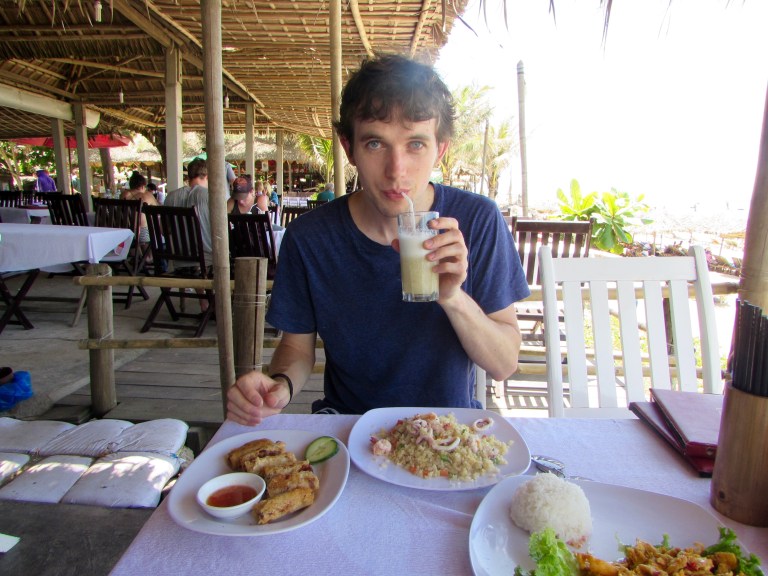
As the beers warmed, our pace of drinking them quickened and, by the time we had finished, our appetites had grown and we abandoned our comfortable seats to fulfill the oath that had secured them for us in the first place. After painstakingly climbing the six stairs to take us from the beach to the restaurant, we sat down and rewarded our effort with an assortment of dishes, one of which was Vietnamese spring rolls, kicking off a six-day love affair with the crispy treat that was a far cry from any version we had had before.
IMG_0804
Lunch break
IMG_0796
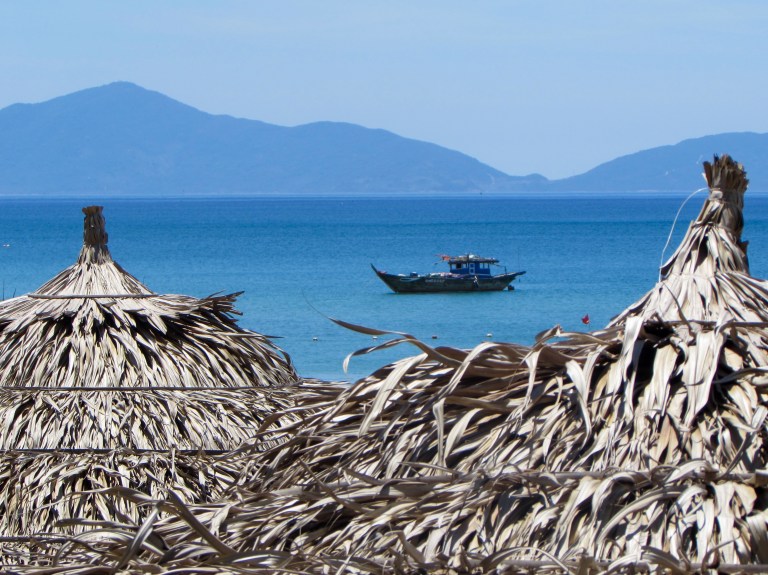
View from the restaurant

The trajectory of our day after lunch stayed pretty much aligned with our pre-lunch activities of either sitting or swimming. By this point in the day, the latter of the two became more difficult as any trip to the bath-like waters of the ocean required a frantic sprint across the now scorching beach, igniting a series of “oohs” and “aahs” until our feet finally hit the refreshingly cool touch of the wet sand. In spite of this, we still went often and had even purchased some goggles to explore whatever life existed under the surface.
IMG_0827
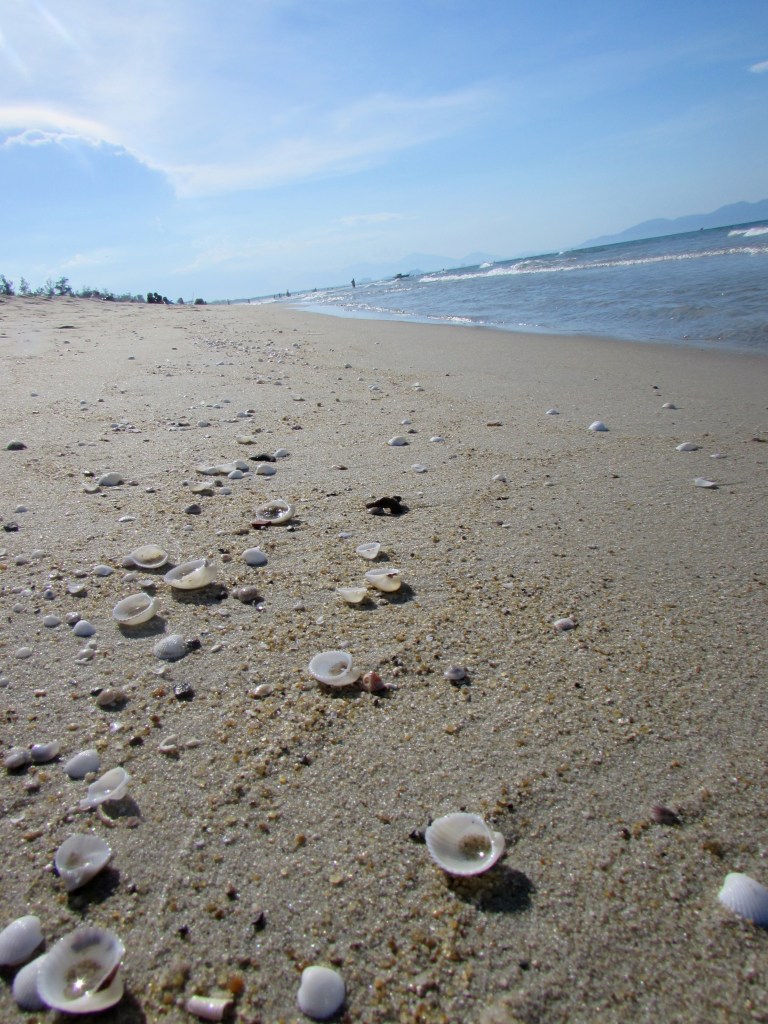
Seashells along the beach

To our delight, there was plenty, most notably the scattered legions of jellyfish that had somehow managed to slip through the fleet of fishing boats sitting off in the distance. Unsure of whether they stung or not, we kept our distance aside from the occasional poke of their squishy caps with our fingers. It wasn’t until later when we unknowingly swam into a small crowd of them (they were sneakily transparent) that we realized they were, in fact, not the stinging type. Apart from the jellyfish, we also saw starfish, rainbow shrimp and even small colonies of hermit crabs, who, in this particular case, failed to live up to their name as there were hundreds of them clustered together on the sea floor.

IMG_0735
One of the many jellyfish we encountered

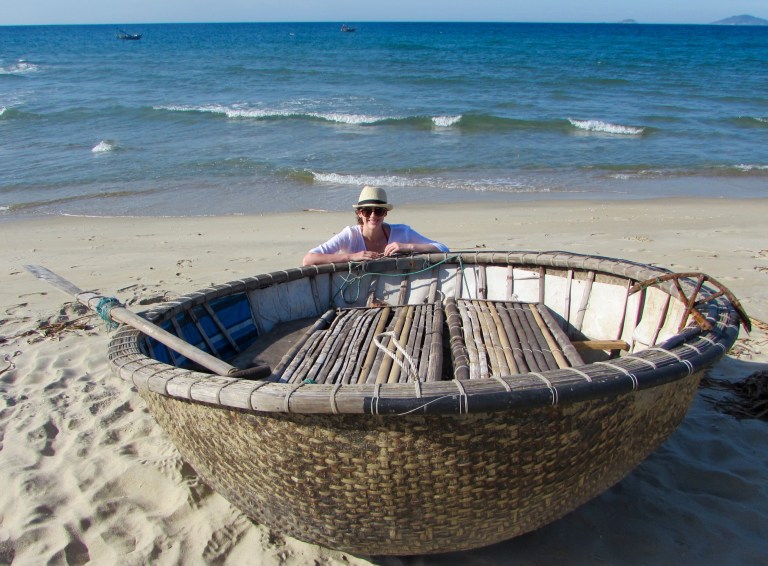
The longer we were in the ocean, the more tempting it became to return to the shade of our loungers. And, usually after a half hour or so, we did exactly that, plopping our bodies down on their cushioned surface. While we sat, the rest of the afternoon slipped away as we took in the scenery around us. Looking out, our gaze couldn’t help but be drawn first to the mountains and islands in the distance, jutting out from the perfectly straight line separating sea from sky. A bit further in, boats bobbed on the otherwise open sea and heads and bodies eventually joined them, black silhouettes evenly spaced from one another so as to create the illusion that the ocean was theirs. Waves would move around them, washing ashore in their mesmerizingly endless fashion. On the beach, between the sea and the shade of umbrellas, not a soul was to be found, only fisherman’s boats which resembled a giant overturned tortoise shells or the occasional sandal or T-shirt that was thrust aside as its owner madly dashed from one heat haven to the other.
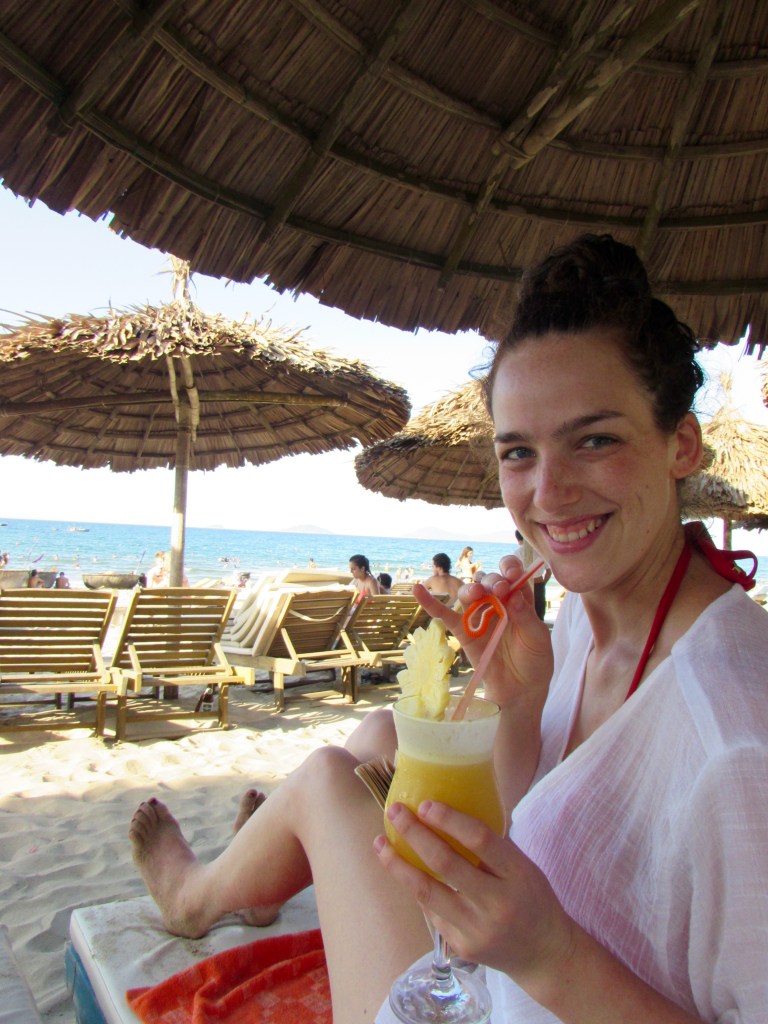
IMG_0860
Cocktails on the beach
IMG_0845
One of the beach bound tortoise-shell boats

For most of the day, this view remained relatively unchanged until the late afternoon when local Hoi Aners began arriving to the beach and the quiet wash of the waves became inaudible under the shouts and shrieks of children celebrating the end of another school day. It was strange for us to think of it being a normal day for them as well as imagine their lifestyle, a full day of work or school followed by a quick dip in the ocean.
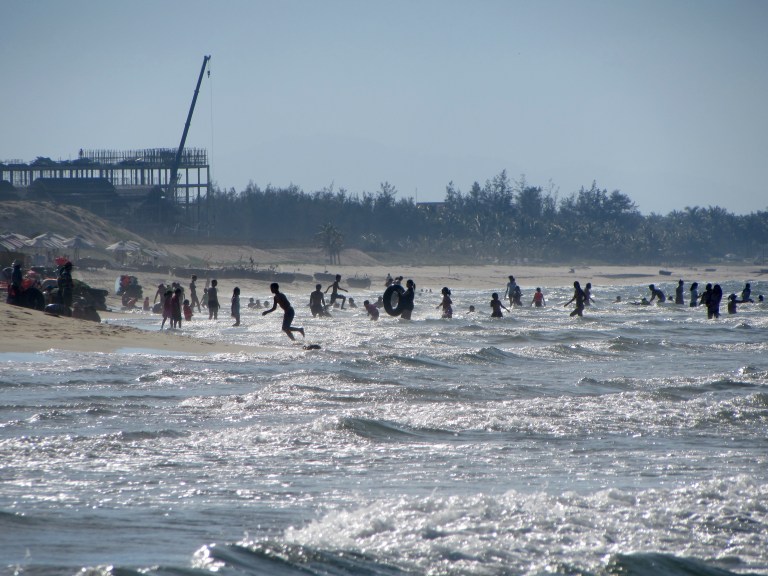
IMG_0851
Locals arriving on the scene
IMG_0883
Most people just wore their clothes into the water

That night, the sun set in as equally a spectacular fashion as the night before and we sat and watched as the sky was transformed into a canvas of colors. Wisps of clouds, which ran across it like brushstrokes, seemed to change color by the minute as the sun crept further into the horizon. As beautiful as it was, the colors, like the crowds, didn’t last long and began to fade as darkness set in and, with our enjoyably long day coming to an end as well, we grabbed a bite to eat before biking back to our guesthouse.

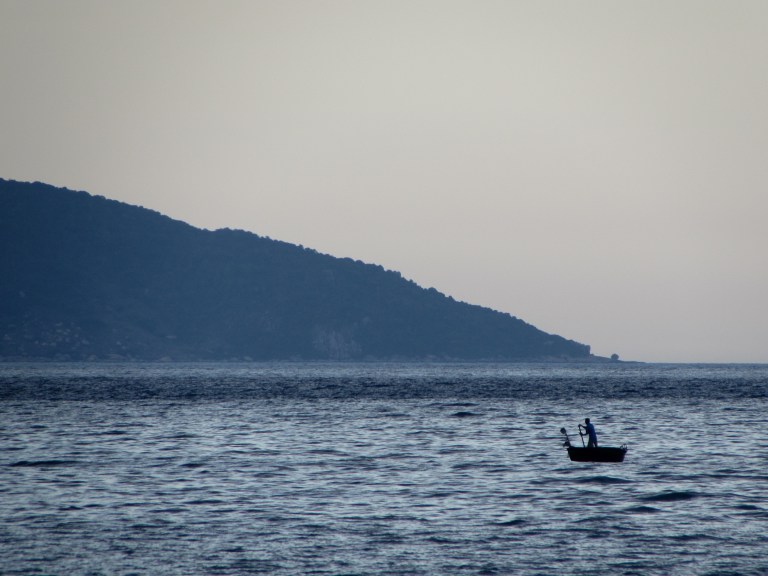
IMG_0875
Just before sunset
IMG_0899
A fisherman taking his boat out for a night on the sea
IMG_0906
Still busy at sunset

With our beach day now behind us and eager for a taste of Hoi An’s historic side, we decided to spend our third day exploring its old town, a cluster of centuries-old buildings sitting along the banks of the Thu Bon River. After a pleasant 30-minute walk from our guesthouse, we arrived at the outskirts of the town and entered it through the “new market,” which, like most other parts of the town, resembled nothing close to what you would describe as new, starting with the people who occupied it.

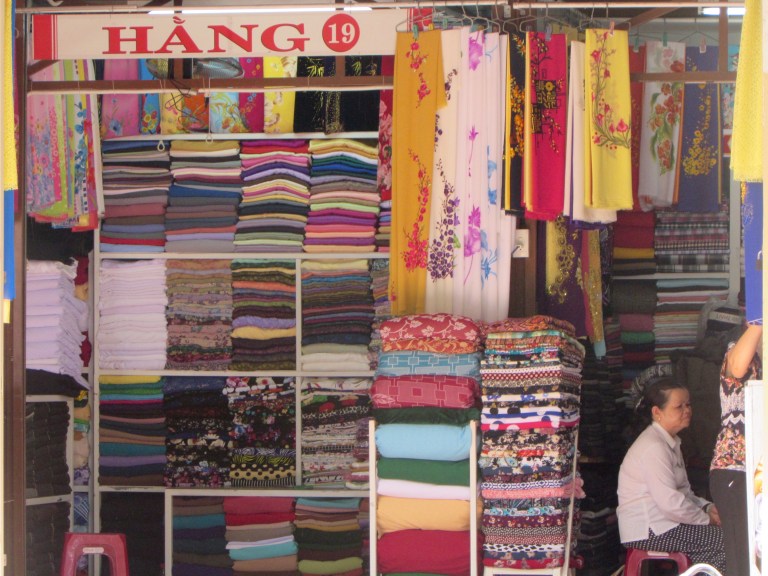
IMG_0949
Window shopping on the way to the old town
IMG_0948
One of the many tailor shops we passed along the way

Old women, crouching under the shadow of their pyramid hats, lined the outer edges of the market, a rainbow of vegetables neatly contained in baskets spread out before them. Overhead, tourists and locals shuffled through each other in a manner that suggested that they were either unaware of the other’s existence or else didn’t care to acknowledge it. Baskets of chickens and ducks, slabs of meat, and even the occasional bucket of fish filled the spaces in between, leaving a hodgepodge of odors, none of which were in the least bit pleasant, lingering in the air. All of this, along with a temperature rapidly approaching 100 degrees, made for quite an uncomfortable atmosphere for 8:30 in the morning and we pushed through the market rather quickly, emerging into the immensely more charming lanes of the old town.
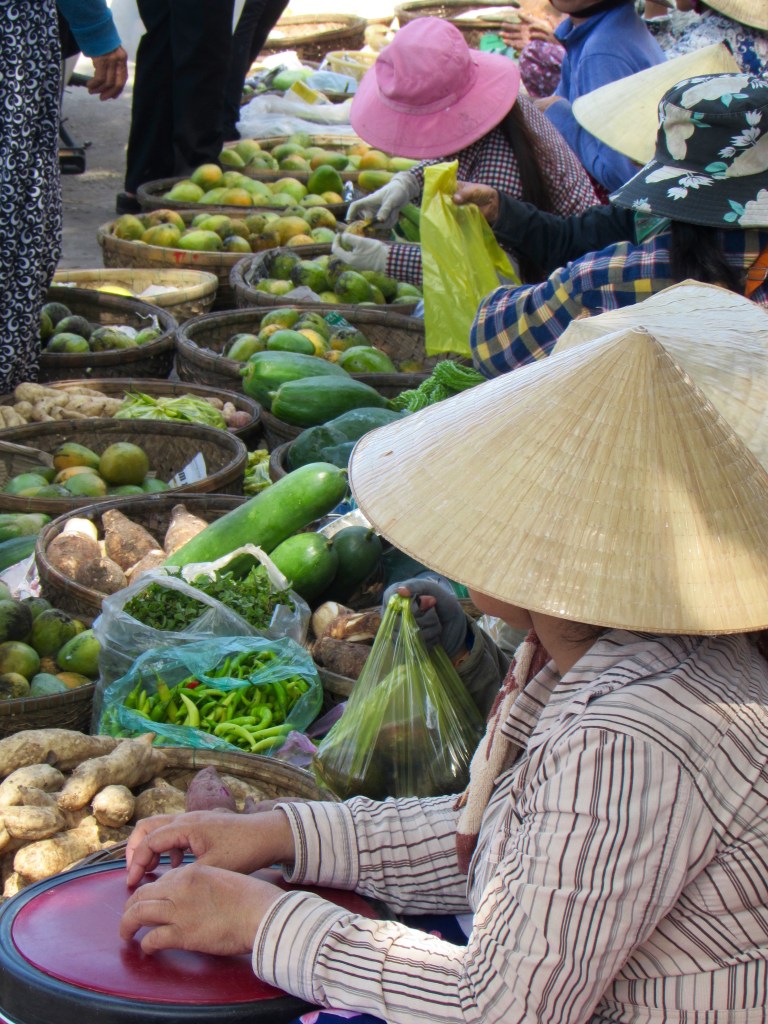
IMG_0960
Vendors selling their produce

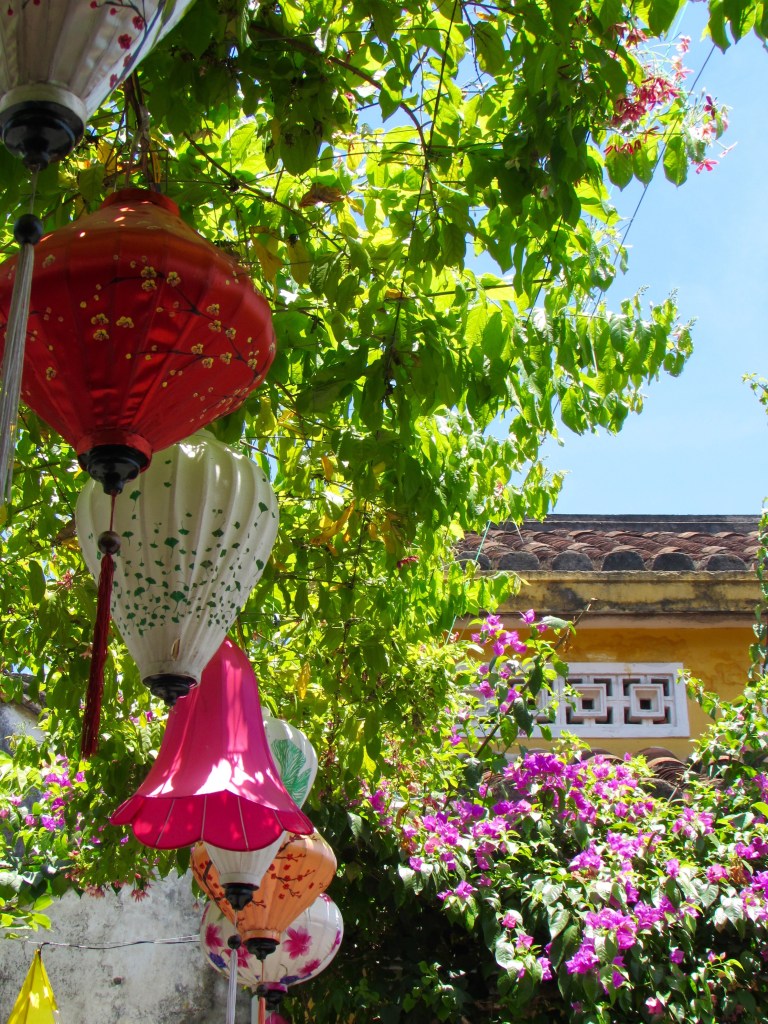
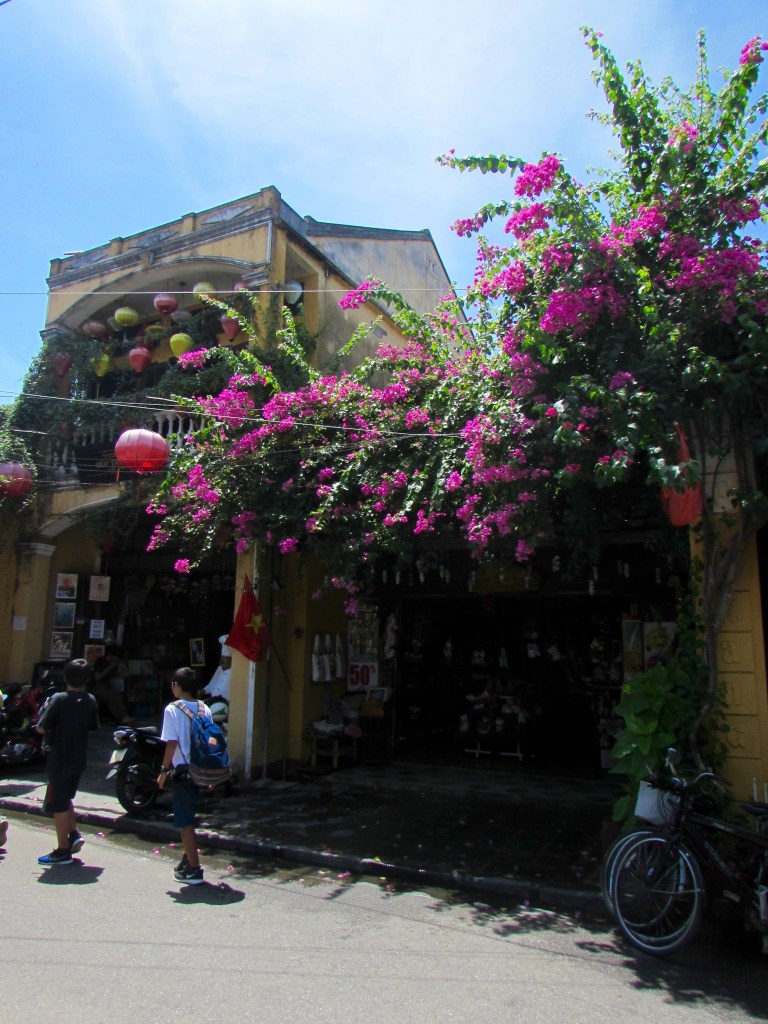
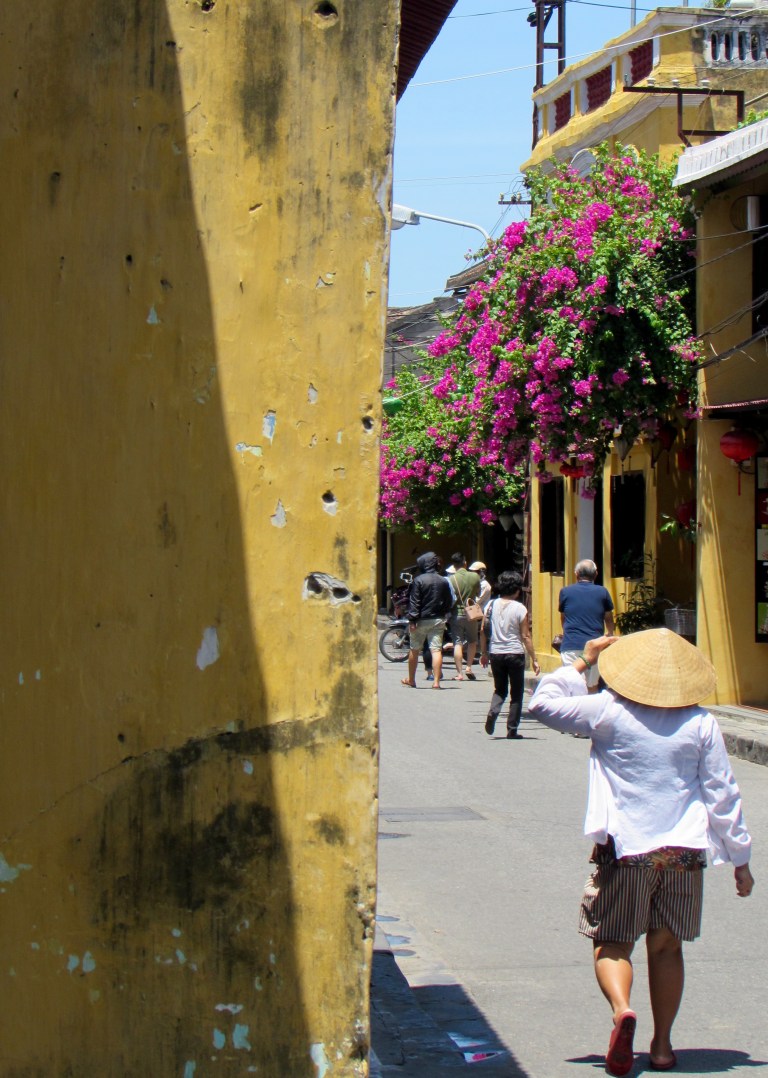
As we began exploring the town, the views stayed delightfully consistent. Two-storied houses and shops, stained in a mustard yellow, lined the lanes, their exteriors showing the effects of time with worn wooden panels hanging from their windows and long, streaky water marks running through their paint like age lines on a tree trunk. From their roofs, long locks of disheveled plants hung down, a mangled mane of vines and flowers exploding out of the clay tiles. Above the street, a web of wires and cables, from which dangled a colorful assortment of lanterns, stretched from one building to the next. The town looked every bit its age, but that was the point. When you stepped into it, you stepped back in time. Sure the interiors of the different buildings were redecorated and filled with souvenir trinkets and tailor shops, but if you could look past that, it wasn’t hard to imagine what life was like there centuries ago.
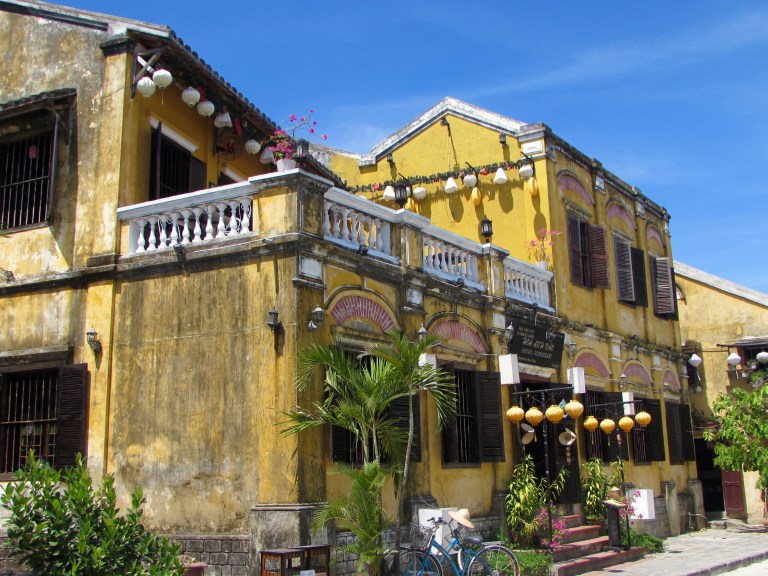
IMG_1116
One of the more elaborate yellow-washed buildings in the town
IMG_1102
Rooftop flowers providing a rare escape from the sun
IMG_1076
Lanterns hanging above the street

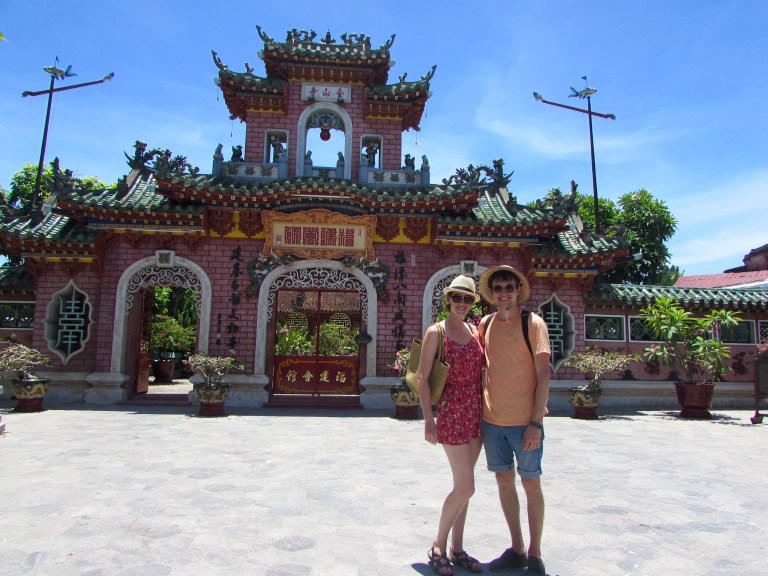
As we wandered further into the town, we began to notice one of the few unpleasant things about it: a complete lack of shade. This was particularly problematic because, at 9:00 in the morning, we were barely into our day and already the fully harnessed power of the sun was beating down on our heads. At first we tried to beat the heat, slogging through the streets like a couple of snails with a trail of sweat in our wake, but, after about a half hour of this, we decided there was no beating it and opted instead to go inside one of the many buildings bookending the lanes to escape the sun. Among the abundance of options, we chose the Fujian Assembly Hall to serve as our oasis and happily entered into its moderately cooler, but abundantly less sunny interior.
IMG_1055
Outside the front gate of Fujian Assembly Hall

All around Hoi An, there were assembly halls like the one we were entering, all of which were dedicated to different nationalities. Like the town itself, they were remnants of the bygone trading days, when merchants from all corners of the globe would set their sails for Hoi An to do business with the Vietnamese. As we stood in the same halls that a Chinese person undoubtedly stood in centuries ago, we couldn’t help but think just how different our journeys had been to get there. What would they have thought of us getting into a big, metal tube thousands of miles away, shooting off into the sky, and landing safely near the town just a few hours later?

IMG_1041
Some of the decorations inside the hall
IMG_1017
View of the gate through the trees in its courtyard

After touring the hall, we ventured back out into the streets refreshed and ready to continue our exploration of the town. For the rest of the day, we made sure to take frequent breaks in the shady interior of a shop, and, when we did happen to be out in the sun and feeling sorry for ourselves, we would just have to look around at the local women to instantly feel better about our circumstances.

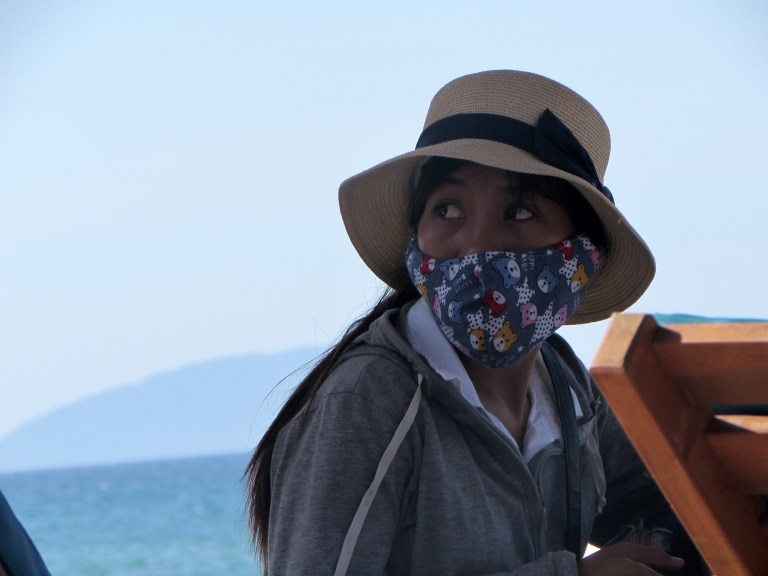
Most of them, to our shock, looked dressed for a blizzard, wearing jeans, two or sometimes three sweaters zipped up to their necks, gloves, big hats, and even face masks. We had also seen it on the beach the day before and, curious as to why someone would put themselves through that, we inquired about it and were told that Vietnamese society prefers women to have light skin, which we thought was a rather ambitious beauty standard for a tropical country. In any sense, it put into perspective any sort of misery we were feeling due to the heat and kept our complaining to a minimum.
IMG_0813
A woman we had seen the day before on the beach

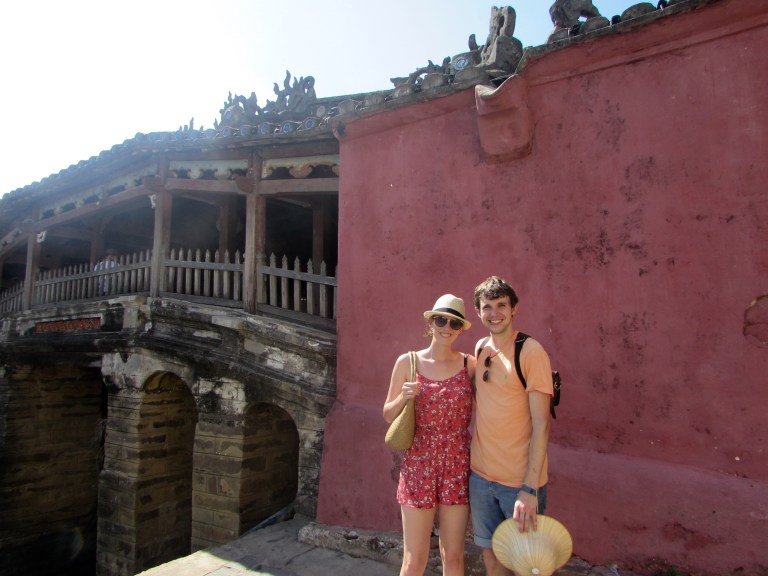
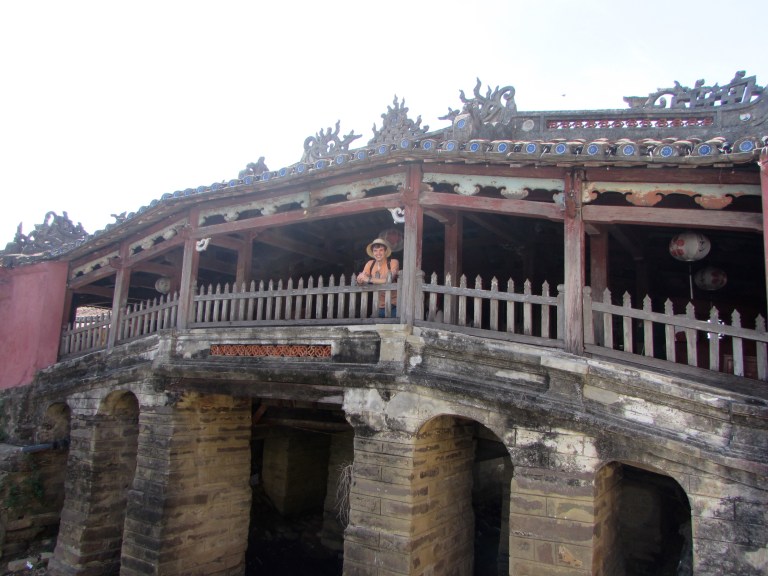
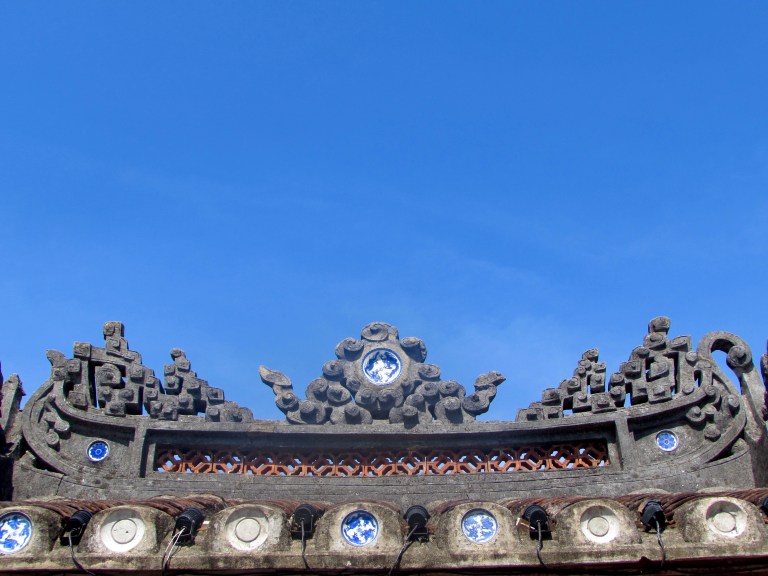
As the afternoon rolled around, we finally hit the edge of the town, marked by a 16th-century Japanese bridge, which looked in every sense the way a centuries-old structure should. The wood of its handrails, cracked and bare, had long since seen the refurbishing touch of a paintbrush, the porcelain that decorated its roof was either chipped or missing entirely, and the red paint covering its exterior was faded. But, like everything else in the town we had seen up to that point, it worked, which was the allure of Hoi An.
IMG_1126
On the Japanese bridge
IMG_1143
The roof with some of its plates missing
IMG_1165
Outside the bridge before beginning our walk back

Despite being a very old place, it was neither in disrepair nor did you get the feeling of over-preservation as you walked through it. Everything fit so well together, even the different influences in architecture didn’t seem to clash. The faded red of the Japanese bridge didn’t look at all out of place in between the mustard yellow buildings, whose endless run along the lanes would be broken up by an occasional sky blue or teal storefront. It all worked, the age, the colors and we enjoyed every bit of it. As the day wore on though, we decided to leave the town for another day and head to the beach to take in another sunset.
IMG_1089
A typical scene in the town

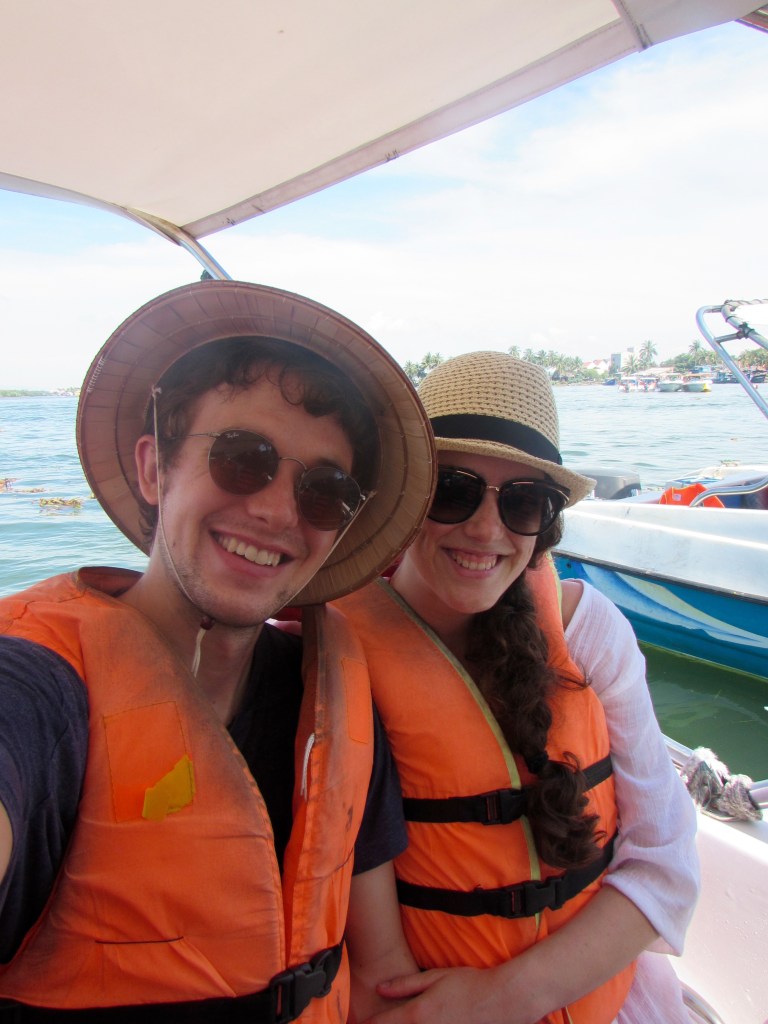
We would pick up our fourth day in Hoi An where the third one had left off, near the ocean. For a majority of the day, we passed the time either in, around, or on the ocean. Our first stop of the day was Cham Island, which we would have to take a speedboat to get to. The ride there, while bumpy, was enjoyable and, after about twenty minutes, our feet were back on solid ground and our tour guide, who vastly overestimated his own English skills, began taking us around the island that he called home.
IMG_1192
On the boat getting ready to head to Cham Island
IMG_1198
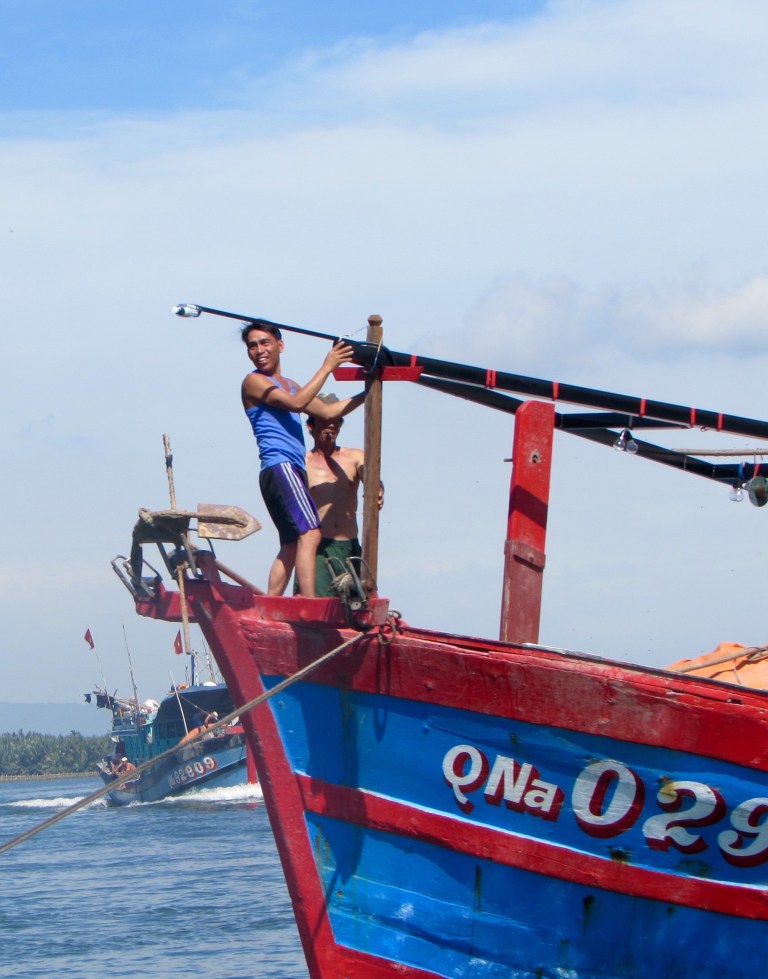
One of the many fishing boats we passed along the way

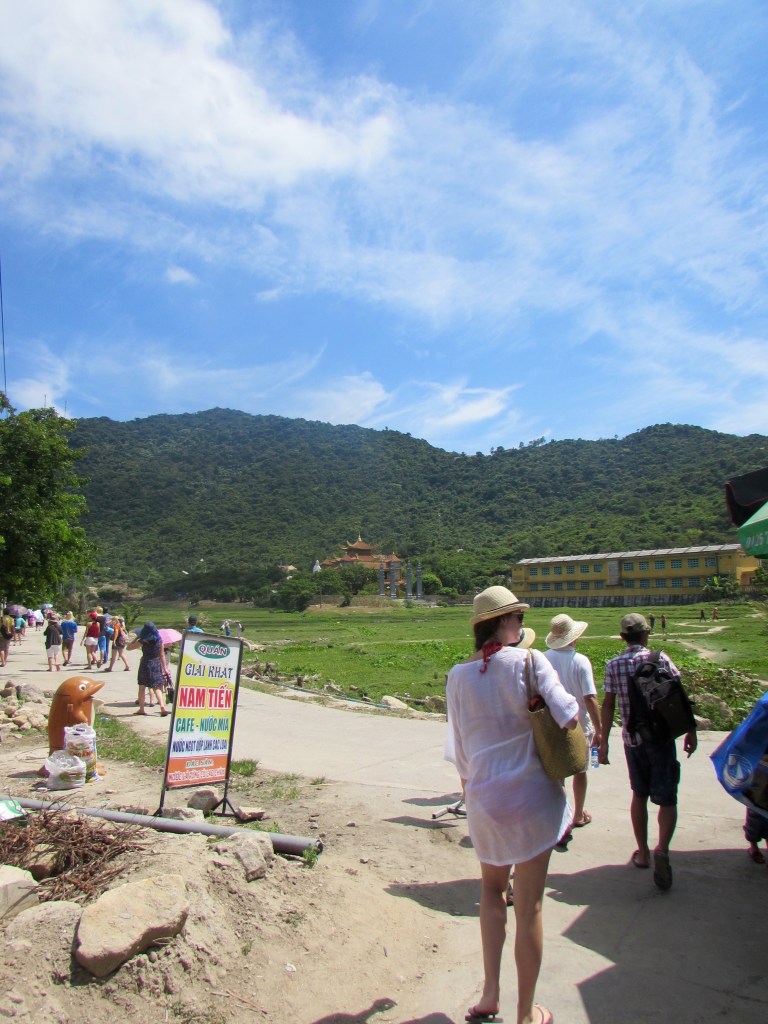
One of the consequences of going on a tour, and the reason why we don’t take them unless we absolutely have to, is that the guide decides what you see and how long you see it. Often times, their ideas about these two things are vastly different from our own and this time was no exception. We were there for beaches and snorkeling, but upon arriving we were instead paraded around the island’s interior, making a stop at the village temple, going by the schoolhouse and eventually going through the village itself, which had long known the advantages of tourism as the streets were practically lined with vendors selling treats and trinkets. We appreciated the tour for what it was though, being grateful for the small pieces of information we were able to gather about the island we were inhabiting for the day.
IMG_1212
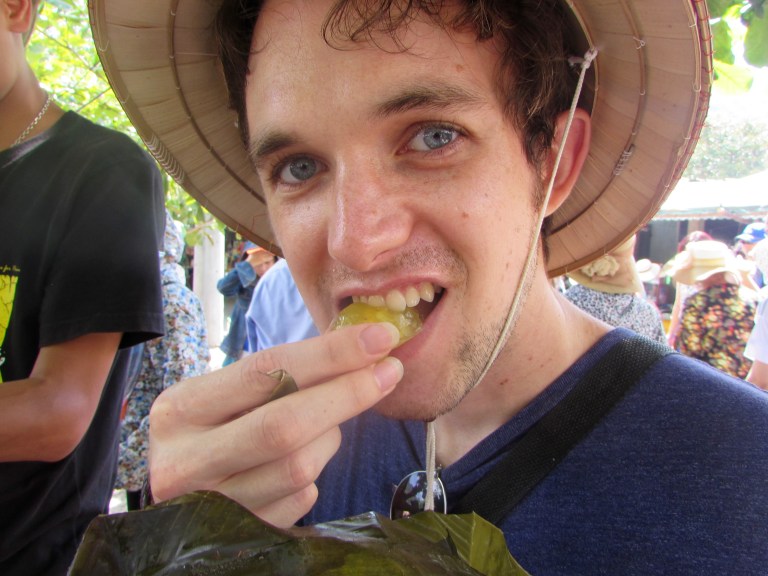
Trying a sweet green bean treat on the island
IMG_1215
Heading inland
IMG_1241
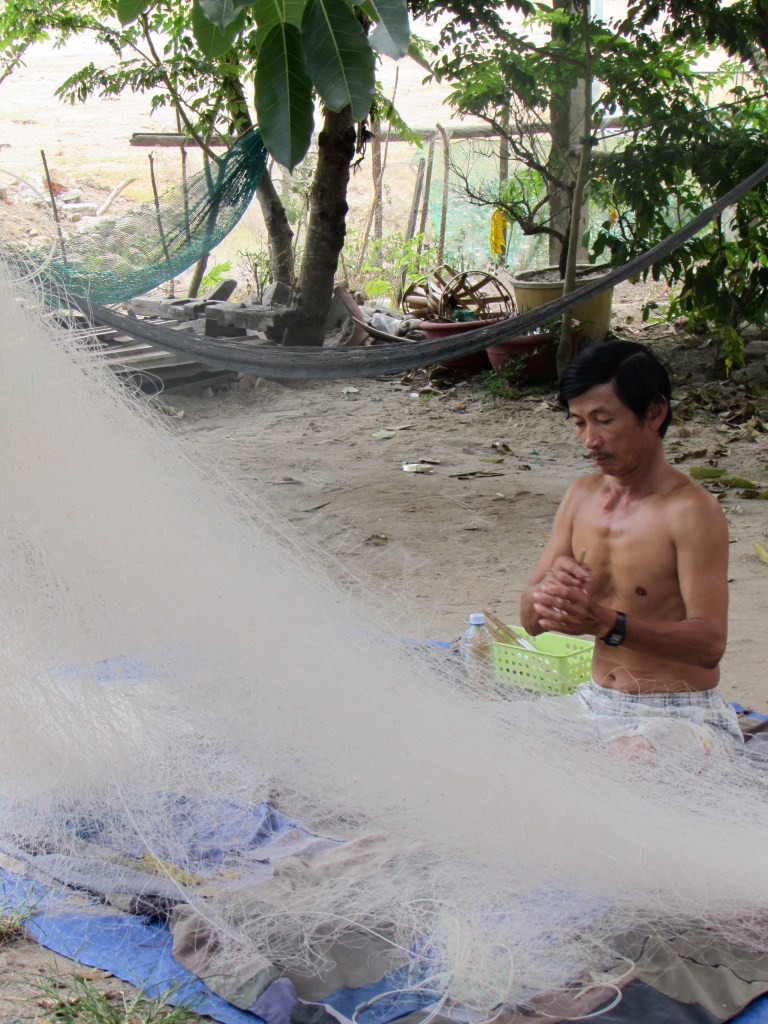
A villager making a fishing net

As we began walking back to the boat, our tour guide sought us out (we were the only English speakers on the tour) to tell us a joke he seemed particularly proud of. As we mentioned earlier, his English was elementary at best and, because of this, we were only able to understand a few words of it. We gathered that it had something to do with two chickens comparing their breasts with those of humans with the punchline having something to do with claws. Confused, we asked him to repeat it again and, after the third time, we nervously laughed in a manner that wasn’t fooling anyone. That was the last time he talked with us for the rest of the tour.

After getting back to the boat, our next stop was to go snorkeling, the thing we had been most looking forward to on the tour. Ever since we had gone Boracay two years earlier, we had been anticipating doing it again and were giddy to finally be doing so. As we pulled up to the snorkeling area, our tour guide plopped a bag of goggles and breathing tubes on the back of the boat and set us free to explore. As we dug through the bag of snorkeling gear we were appalled by the fact everything had some degree of mold growing on it and we pulled out the least affected pieces we could find and wearily strapped them on.

Our worries about the mold were soon forgotten though as we jumped into the water and peered beneath the surface of the ocean. Fish of all sizes and colors swam around each other, dipping in and out of the numerous holes and crevasses strewn across the sea floor. Coral stretched up towards the surface like mountains to the sky, swaying in the currents in a similar fashion as trees in the wind. Slivers of light shone down through the water, running over the entire scene like a system of veins. It was like dipping our faces into an entirely different world. Every now and then we would poke our heads out of the water and were amazed each time at how normal the surface looked, giving no hint at the entire ecosystem that existed just a few feet below it.

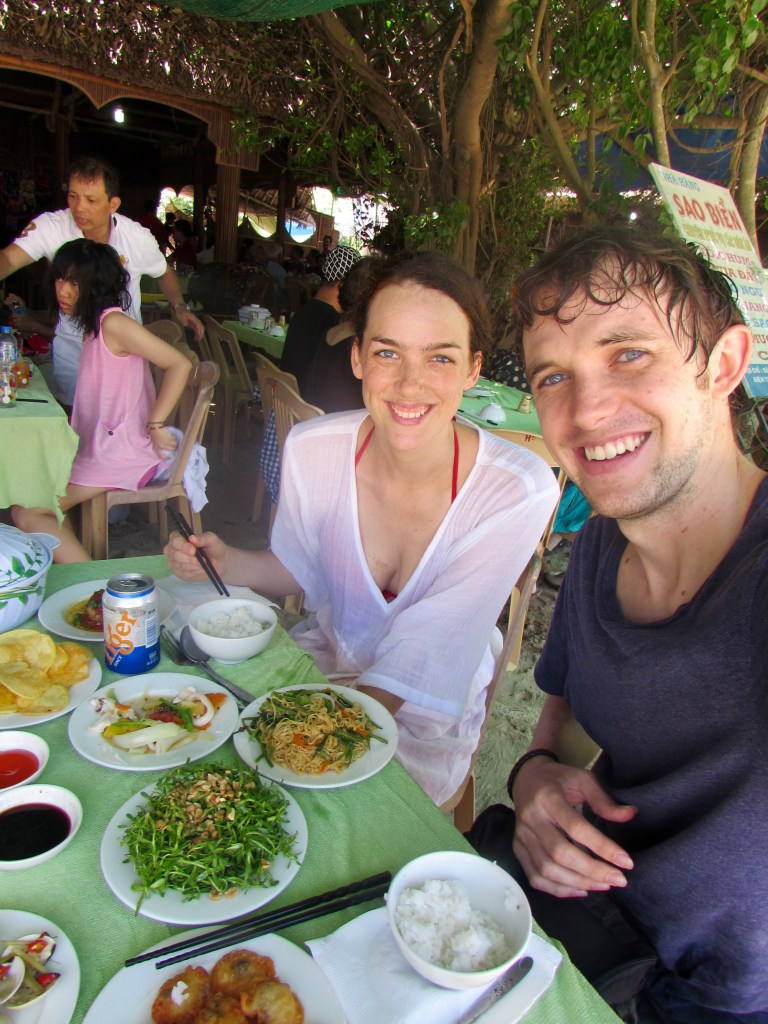
After about thirty minutes we were summoned back to the boat where we boarded and promptly set off towards the island’s main beach to have lunch, which consisted of a wildly inappropriate amount of food. Plate after plate after plate of meat and vegetables and fried snacks were laid out before us and, not wanting to waste any of it, we shamefully emptied the contents of each plate into our stomachs until there was nothing left. Uncomfortably full, we lumbered to the beach where we wasted away our bloated misery on a couple of shade-covered loungers until we were called to the boat to head back to Hoi An.
IMG_1262
Our lunch…if you can believe it, there’s more food outside of the frame!

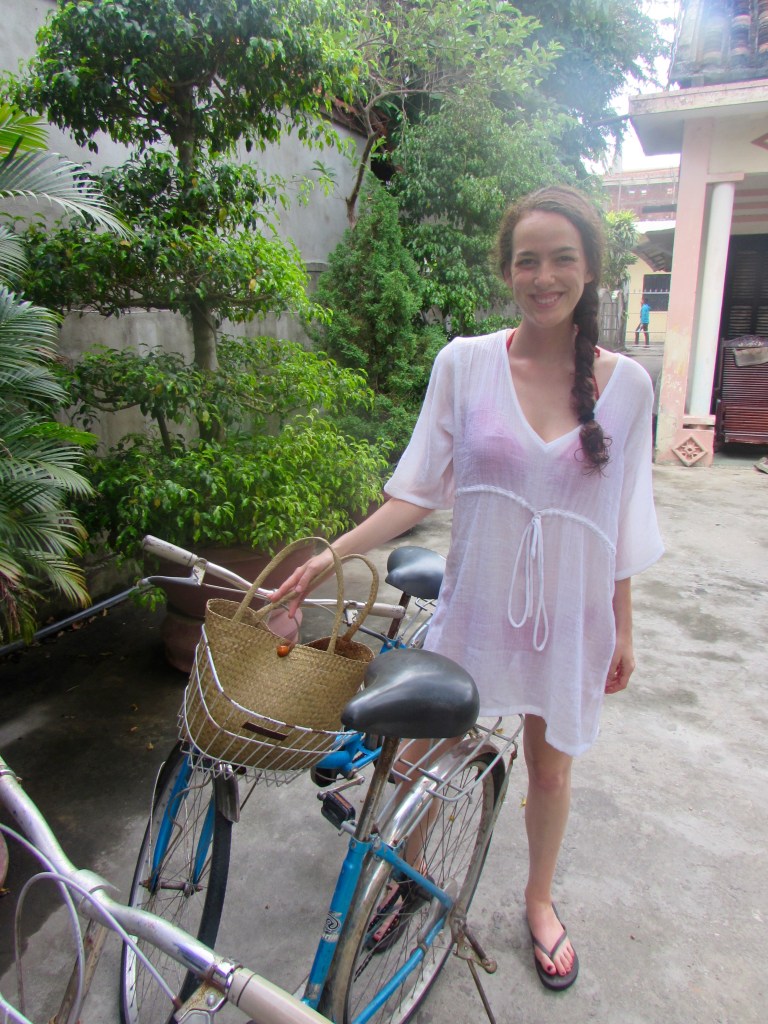
We got back to our guesthouse around 2:00 and immediately grabbed a couple of bikes to head to the beach to spend the rest of our day. We decided this time to try a less touristy beach than the others we had been to and were pleasantly surprised that the perks (a lounger and umbrella in exchange for ordering food or drinks) remained the same along with the added bonus of relative seclusion.
IMG_1270
Getting ready to bike to the beach

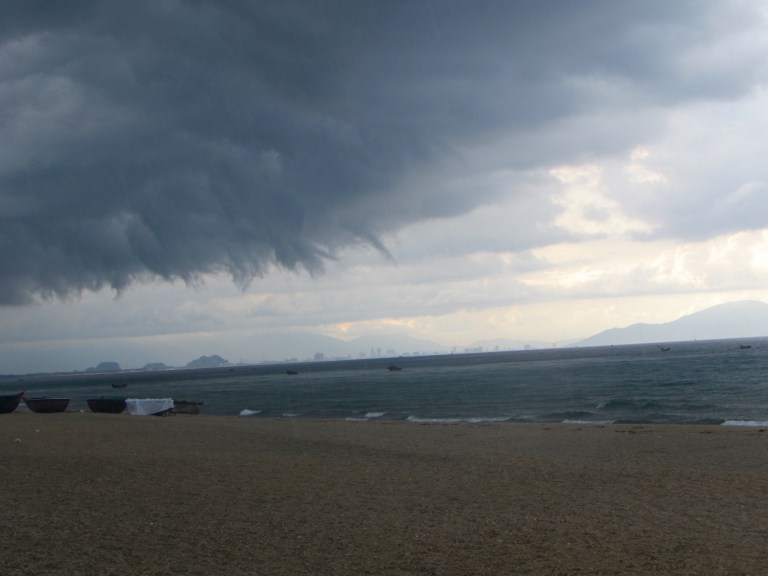
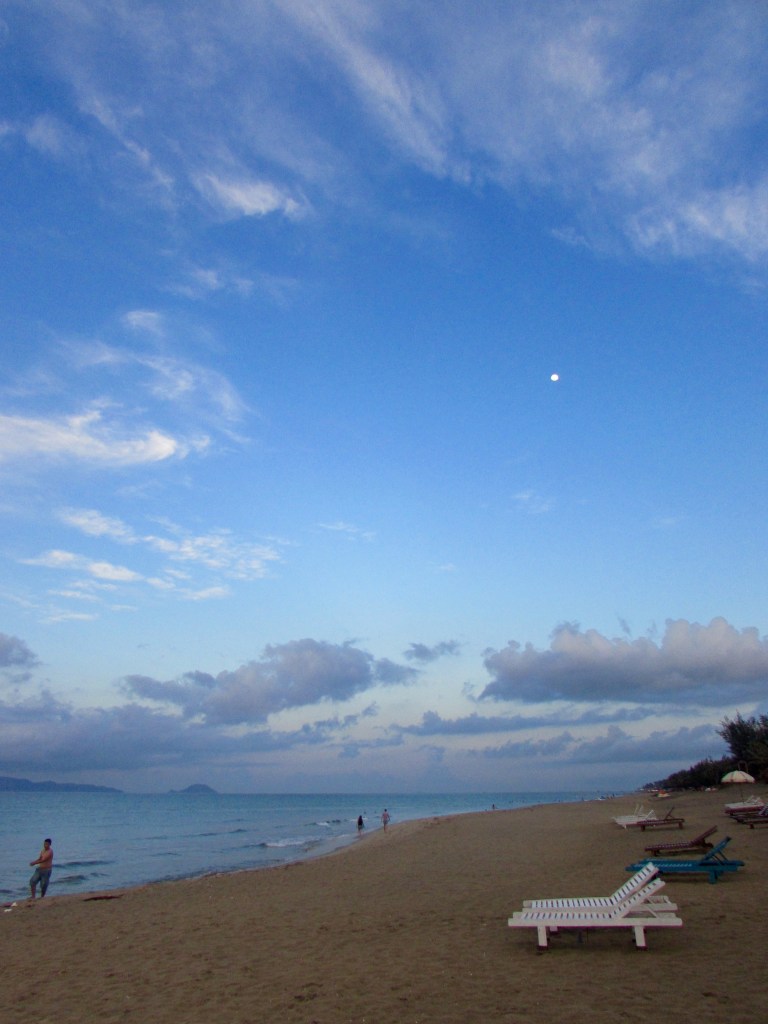
After arriving we noticed the sky darkening around us and became worried that an ensuing thunderstorm would force us back to the guesthouse earlier than we had wanted to. We expressed this concern to the woman working at the bar and were assured that the storm would only last a few moments. This would have been believable had the crisp blue skies stretching across the horizon not been overtaken by an expanse of dark, gray clouds stretching as far as the eye could see in a matter of minutes. Nonetheless, we decided to wait around and see what would happen, retreating to our loungers as the sky opened up. Sure enough, after about a ten minute wait the rain stopped and our view once again consisted of sunny blue skies. We should have known better given our experience with thunderstorms in the tropics: intense but short-lived.
IMG_1280
The storm rolling in
IMG_1284
The sky ten minutes later, clear and blue as promised

The rest of the afternoon and evening was perfect with a mixture of cocktails, dips in the ocean, and lazing around on the beach. As the sun began to set, we hopped back on our bikes and began to look for a good restaurant along the beach, of which there were many. We chose one at random and spent the rest of the night picking at seafood and watching as the last remaining light was sucked under the mountains and the sky and ocean became synonymous in the black of night. With one more full day ahead of us, we headed back to our guesthouse to get some rest before our early rise the next day.

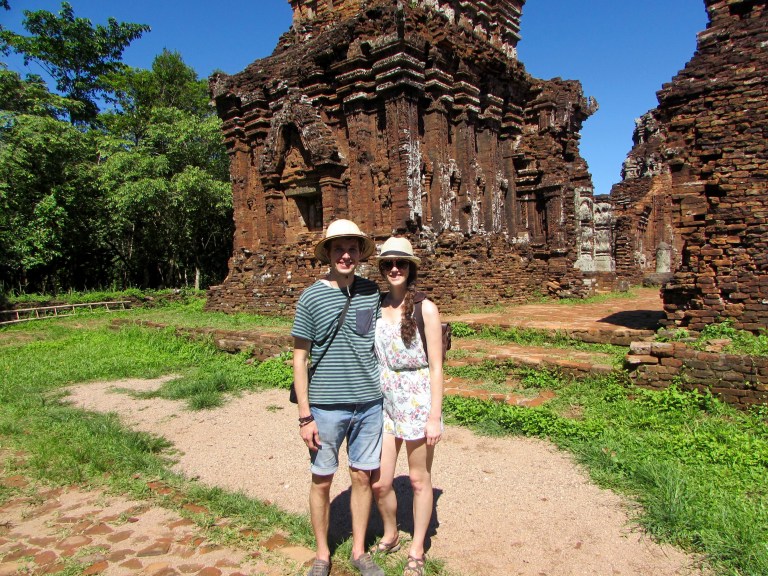
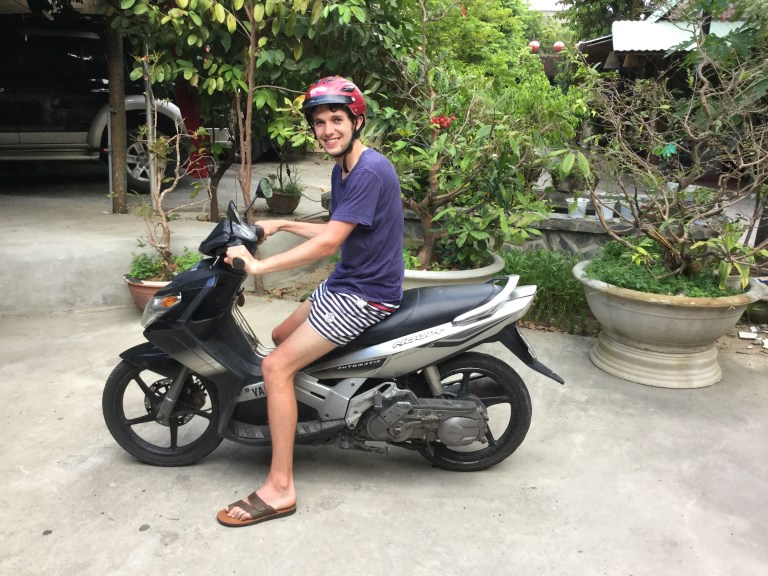
The agenda for our last full day in Hoi An was a long one and like most other days we had spent there, aimed to be a blend of both cultural and coastal activities, the first of which was a trip to the ancient Cham ruins of My Son (pronounced “mee-sohn”). We had read that walking around the ruins was akin to exploring the inside of an oven, which after 4 days in Vietnam was entirely believable. We also read that the sight is swarmed with people around midday once all of the tourist buses roll in. So, wanting to avoid both of these as much as possible, we woke up at 5 a.m., started up our motorbike and were on our way.
IMG_0379
Our motorbike

To find our way there we followed a surprisingly clear hand-drawn map from one of the workers at our guesthouse. Despite its clarity, the simplicity of it made us constantly question if we were going in the right direction or had missed our road. So, every few miles, we would stop and ask a local shopkeeper or passerby, who were always friendly even at 6:00 in the morning, how to get to My Son. At one point we were sure we had gotten ourselves completely lost and pulled over to ask a fruit vendor for directions and our gazes were shamefully guided to the giant sign right above our heads that read “My Son” with a big yellow arrow pointing us in the right direction. The motorbike couldn’t have taken us away faster.

You would think that feeling completely lost in the Vietnamese countryside while cruising around at 40 m.p.h. on a vehicle that you’ve only driven once before in your life in a country that has no observable traffic laws would be a bad thing, but it really wasn’t. In fact, it was one of our favorite things we did in Vietnam. The sense of adventure we got riding around and taking in vistas of expansive fields, mountainous skylines and small villages just beginning their day all while other motorists and even a truck with pig feet hanging out of it whizzed by us was incomparable to any other experience we’ve had in our travels. It was uniquely enjoyable and, after 35 miles and nearly an hour and a half on the road, it was almost disappointing as we rolled up to the gates of My Son and parked our bike.

At this point, it was still only 6:30 in the morning and the park had just opened. No other motorbikes were parked in the garage nor cars or buses in the parking lot. We seemingly were the first ones there, other than the workers who sleepily greeted us as we bought our tickets and made our way towards the ruins.

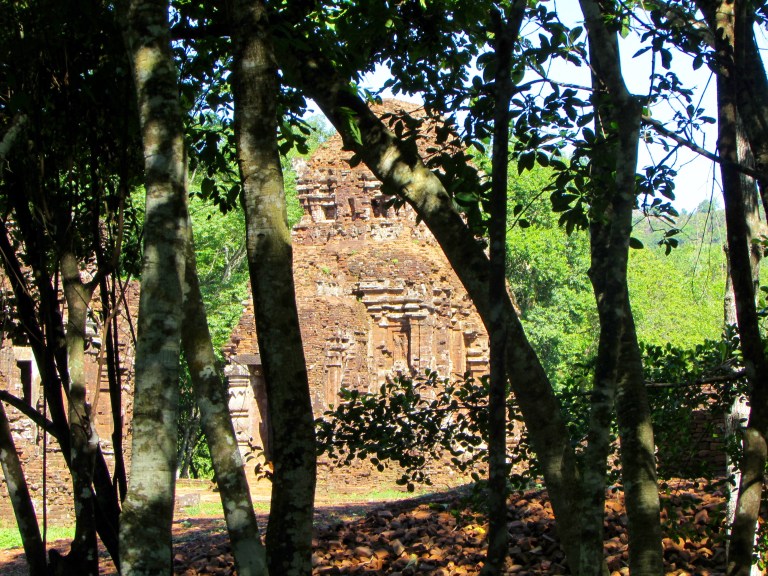
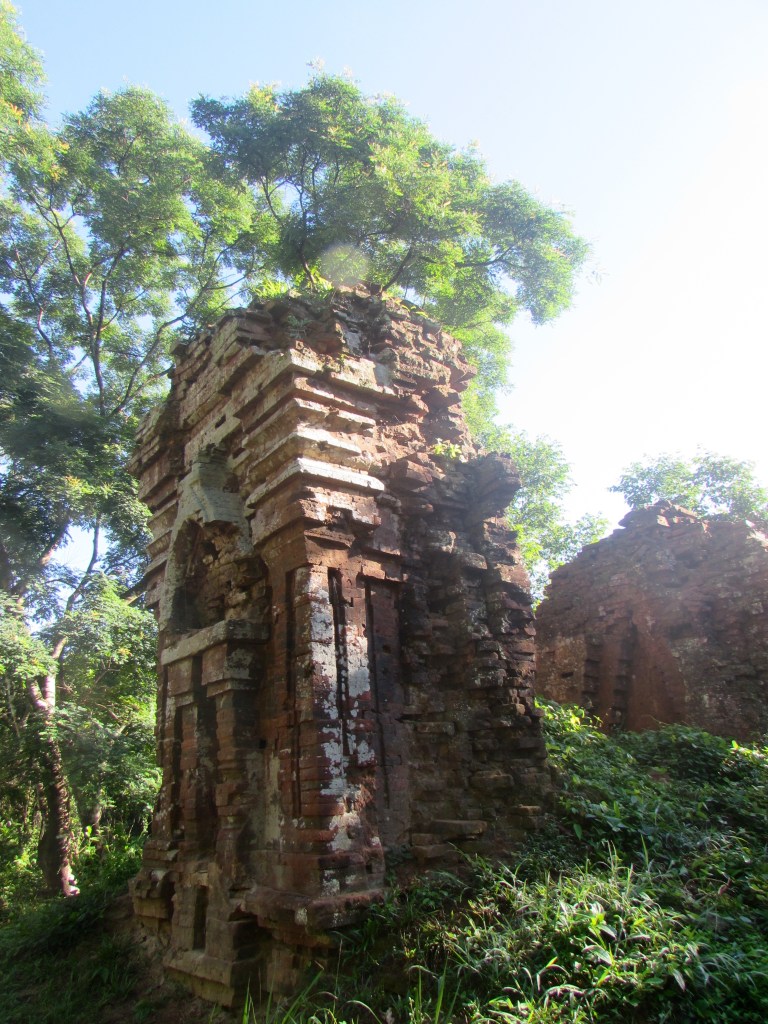
We entered the grounds through a dense expanse of trees, whose browns and greens dominated the scenery as far as the eye could see. After about ten minutes of meandering through this, we spotted a speck of orange off in the distance and began walking towards it. As we did, a half-standing tower slowly materialized before us and we soon found ourselves at the first of what would be eight different sights of ruins. Some were small, consisting of just one or two buildings like the one we were at now, others were sprawling, but each deserved at least some degree of contemplation of their role in the society that built them and what the lives of those people were like.
IMG_1446
View through the jungle of one of the temples
IMG_1305
The first temple we came across
IMG_1383
Finding some much needed shade

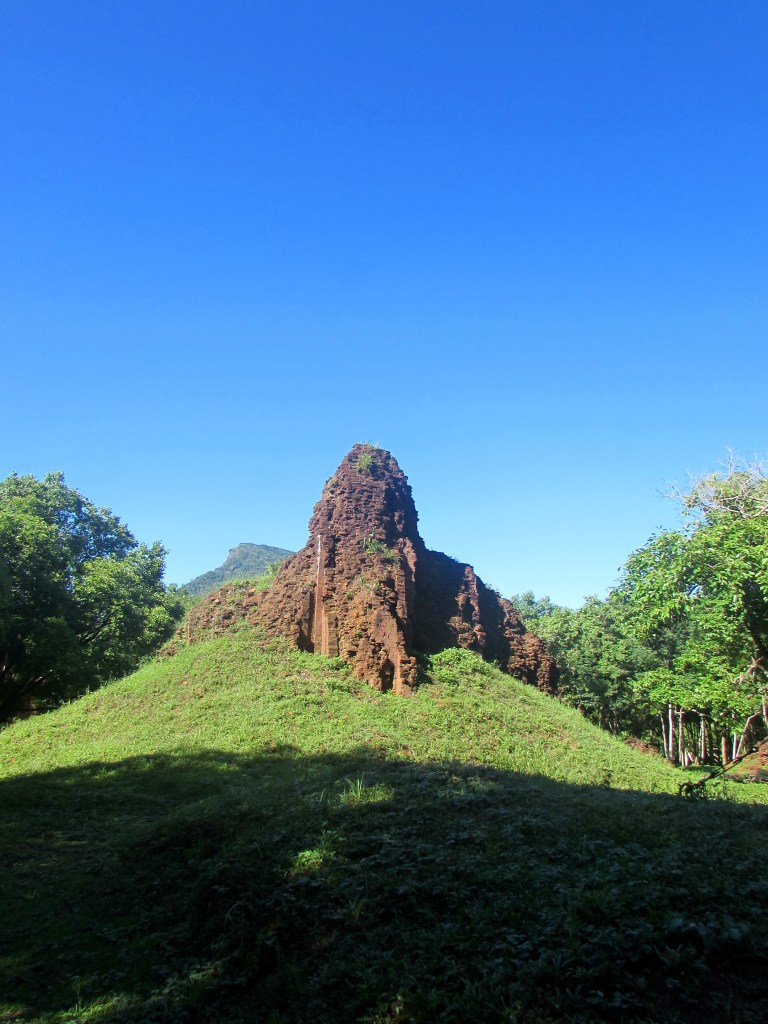
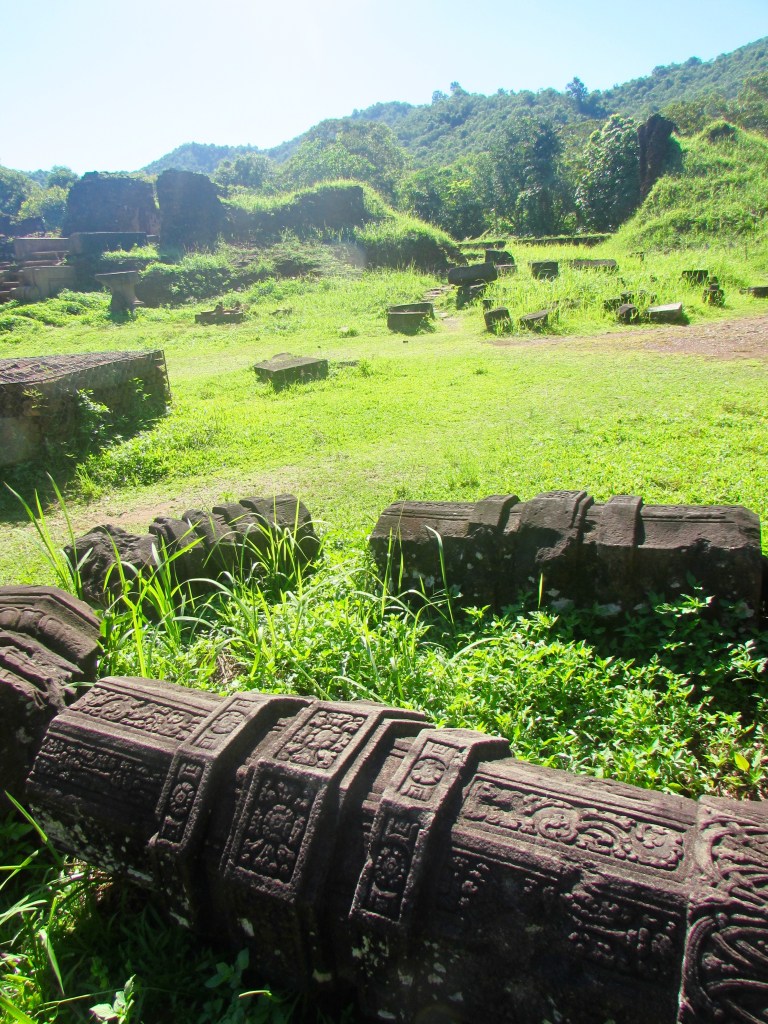
As we bounced around from sight to sight, we began to notice the relationship My Son had with the jungle around it. After centuries of existing side by side, it was almost as if the jungle had decided to reclaim what was once it’s own. Hills of grassy earth climbed up the walls of the different structures, almost making it look like they hadn’t been built but rather grew out of the earth like the trees around them. It was difficult to imagine one without the other.
IMG_1345
One of the temples appearing to have grown out of the ground
IMG_1404
One of the more ruined sights we came across
IMG_1456
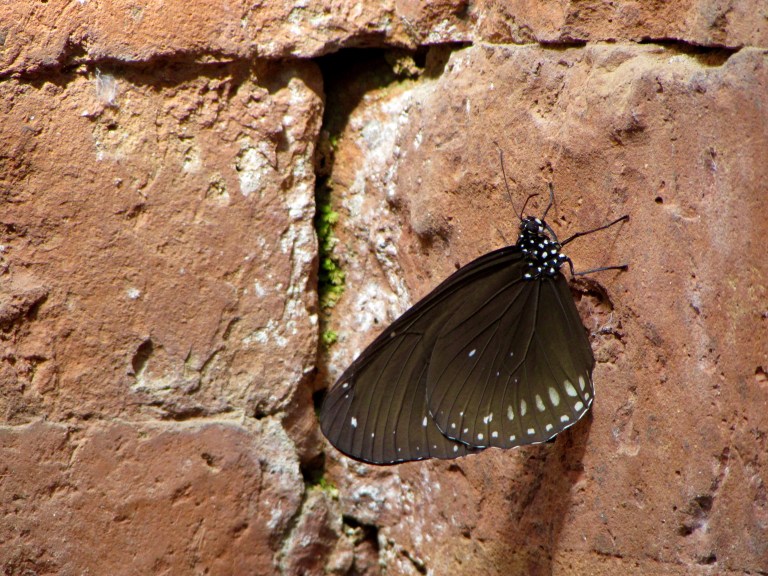
Butterflies were everywhere around the ruins, this particular one we found resting inside one of the temples

Of the many incredible things we saw at My Son though, there was one unsettling one that was present in almost every sight that we visited. Giant craters, so big that one could easily confuse them for small hills, littered the landscape, remnants of the Vietnam War when the ruins were used as a hideout for the Viet Cong. Because of this, the sight was heavily bombed and many of the buildings that once stood were lost forever. It wasn’t until a My Son historian wrote a letter to the US President at the time, urging him to stop the attack, that the bombs finally ceased falling, but the damage had already been done and it was still very much visible fifty years later as we walked through the ruins. Maps and signs pointed to piles of bricks that were identified as once towering buildings and the ones that were still standing were often half-reduced to rubble. It was the first time we felt truly ashamed to be Americans.

Even with the bomb craters, it was very difficult to imagine a war taking place there or anywhere else in Vietnam for that matter. And this is for two people with admittedly very large imaginations. We would see black and white photos hung in shops of helicopters on the horizon and soldiers on the ground, but the Vietnam we saw and experienced was a world apart from this. We didn’t think about this too often though as there were many other things demanding our attention, all of which were much more pleasant than the thought of war.
IMG_1371
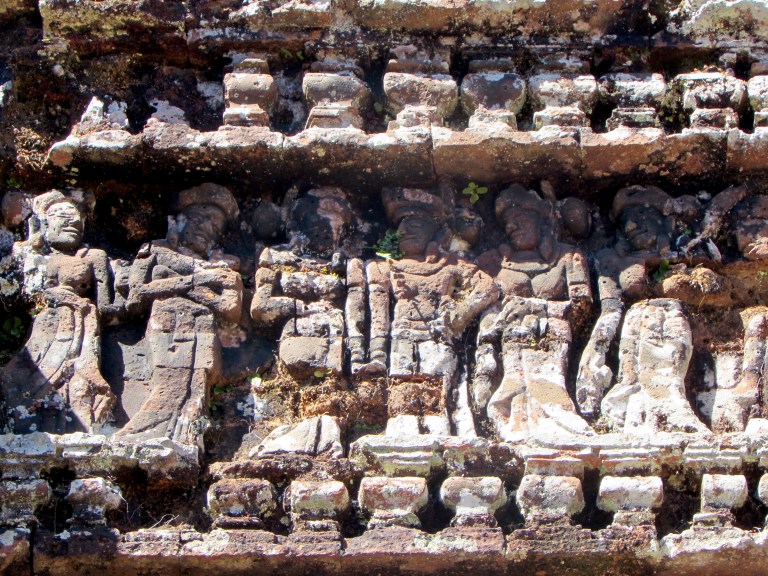
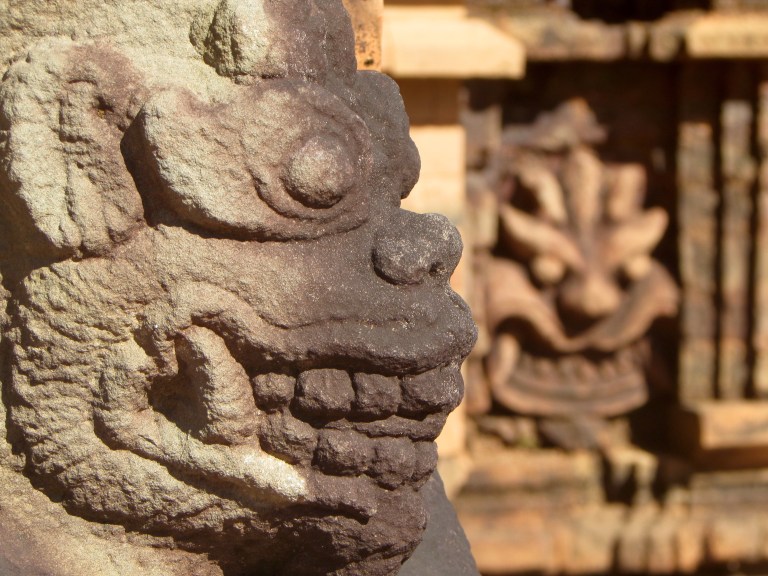
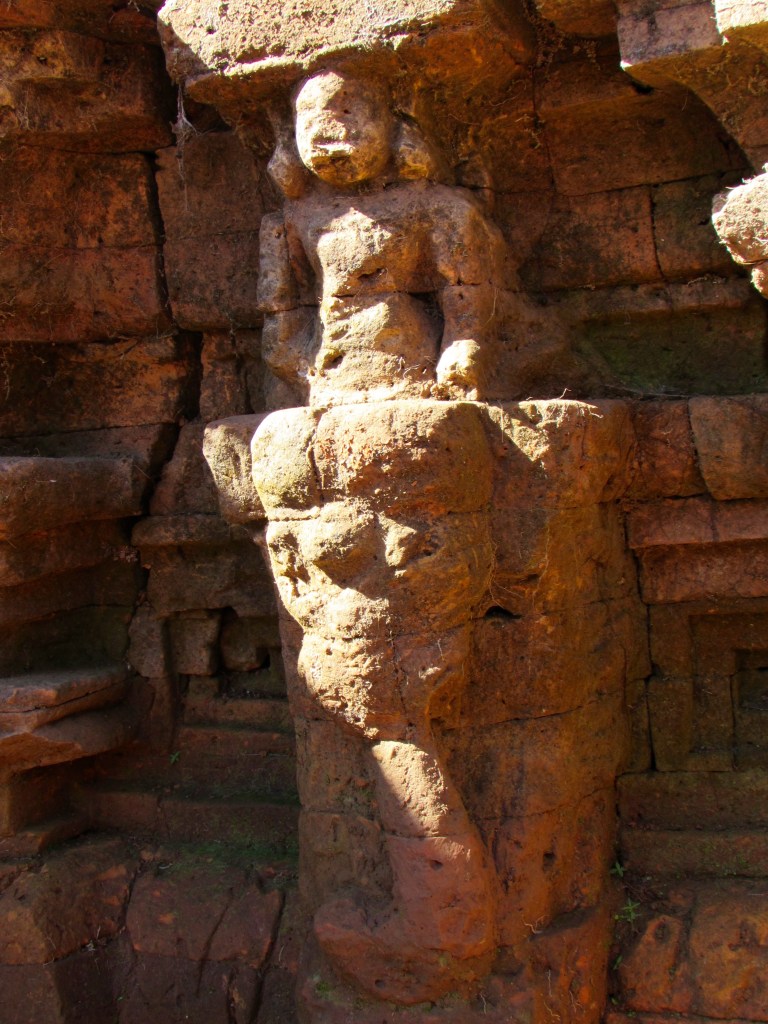
There were a lot of interesting carvings in the buildings too
IMG_1441
Carvings of elephants were abundant
IMG_1478
A depiction of the Cham people
IMG_1466
Shiva, the god My Son was dedicated to
IMG_1530
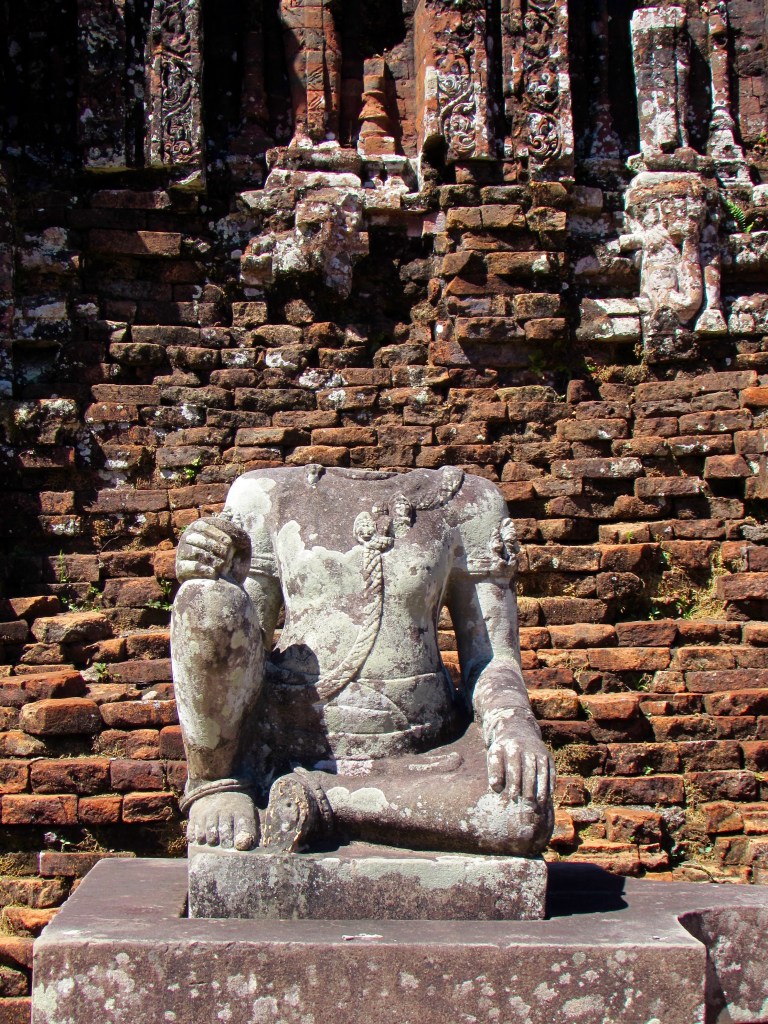
A headless statue outside one of the main temples

After wandering around the ruins until about eleven o’clock, the valley they sat in began to fill with heat and tour groups and we decided that it was a good time to leave. So, we made our way back to our motorbike, hopped on, and began the return journey to Hoi An.
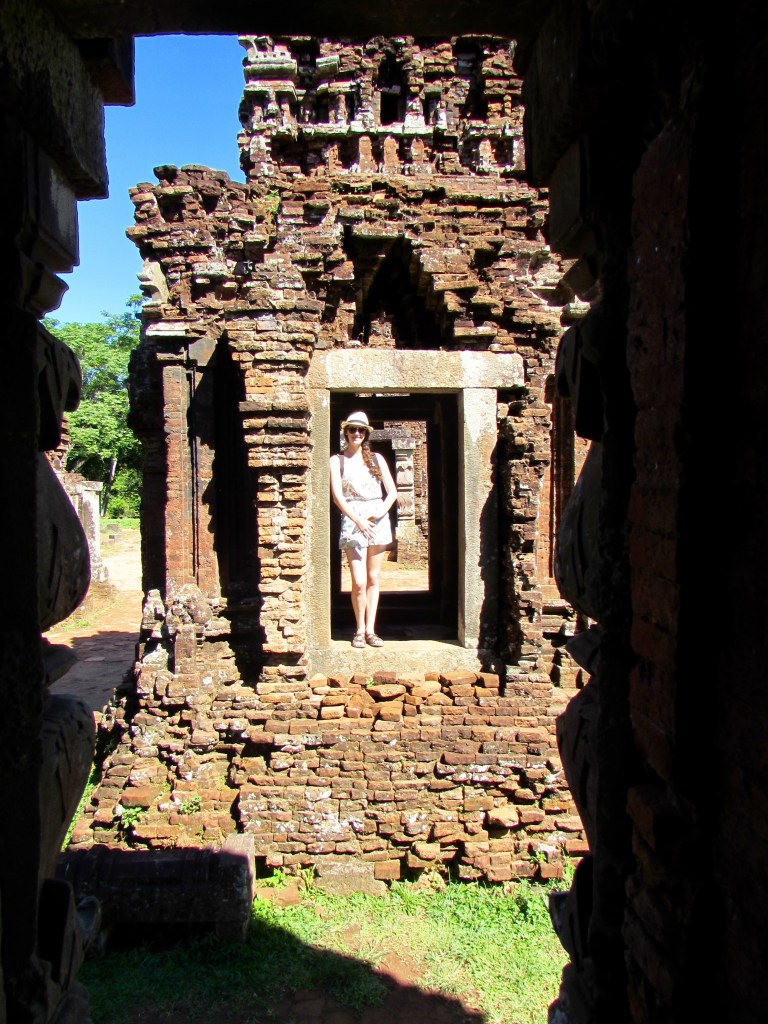
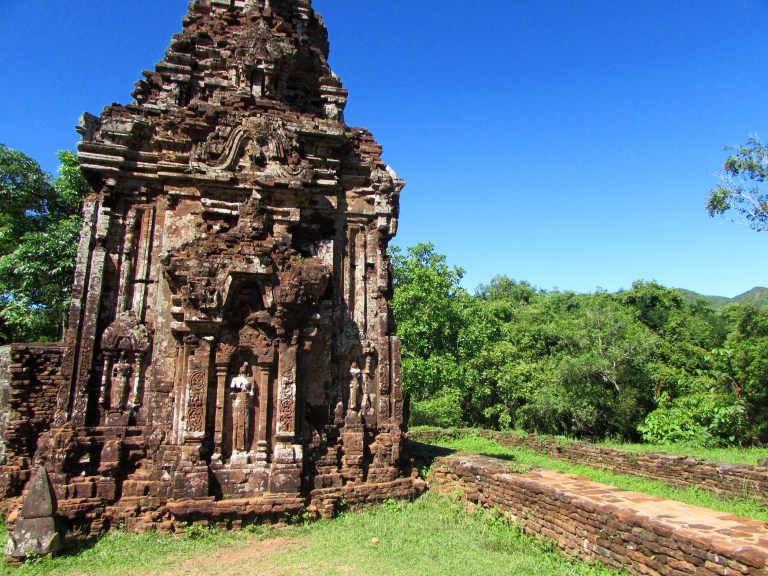
IMG_1473
Exploring the inside of one of the buildings
IMG_1498
A leaning tower
IMG_1525
At our last sight before leaving

Apparently following a map backwards is much more difficult than forwards because the frequency with which we got completely lost (not just thinking we were lost) was exponentially higher than the journey to My Son.  During one of these times, while we were knowingly driving in circles waiting for some familiar landmark to reveal itself, we noticed that our ride was getting increasingly bumpier despite the smooth road we were riding on. Panicked and determined to ignore the obvious, which was that we had a flat tire, we slowly crept along the road in hopes that the problem would fix itself (it didn’t). Just before losing all hope, we heard a shout from the opposite side of the road and looked over to find, to our relief, a man waving us in the direction of his home which doubled as a garage. After pulling up, he pointed us in the direction of some chairs, and, several minutes and $2.50 later, we were back on the road. Cheap and friendly are two things you can always count on in Southeast Asia.
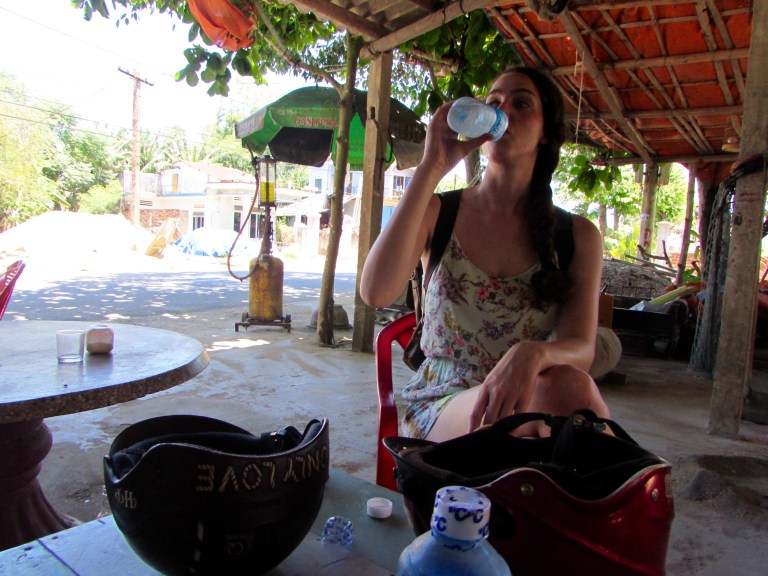
IMG_1554
Cooling off while waiting for our motorbike to get fixed

After getting back, we made a quick run to the beach before hanging up our motorbike keys for good and heading into the old town on foot to catch their monthly celebration of the full moon. The town, like most everything else experienced in both the light of day and dark of night, took on an entirely different form. The yellows that dominated the city during the day now gave way to the red and white glow of lanterns hanging along and above the lanes which were significantly more crowded and filled with life now that the sun was no longer looming overhead.

IMG_1575
The old town at night

As the sun slipped completely under the horizon, the moon, which oddly enough wasn’t full, showed up for its own party and we headed to the riverside where everyone in the town had begun to gravitate towards. After arriving, it didn’t take long for us to figure out how exactly they celebrated the festival.

All along the river, little girls and old women carrying lit candles in paper lanterns impressively maneuvered their way through the crowds asking people if they’d like to buy one. If you did, you were given a big hook that you could use to place the lantern in the river and make a wish. We bought two, happily placed them in the river and excitedly watched as they floated into a pile of other lanterns and were then rowed over by a boat. We weren’t sure how the rules applied, but we imagined that meant that our wishes would go unanswered. Destruction by boat wasn’t the worst fate though as some, after being placed in the water, proceeded to catch on fire and become reduced to smoldering piles of ashes. Hopefully no one wished for world peace.

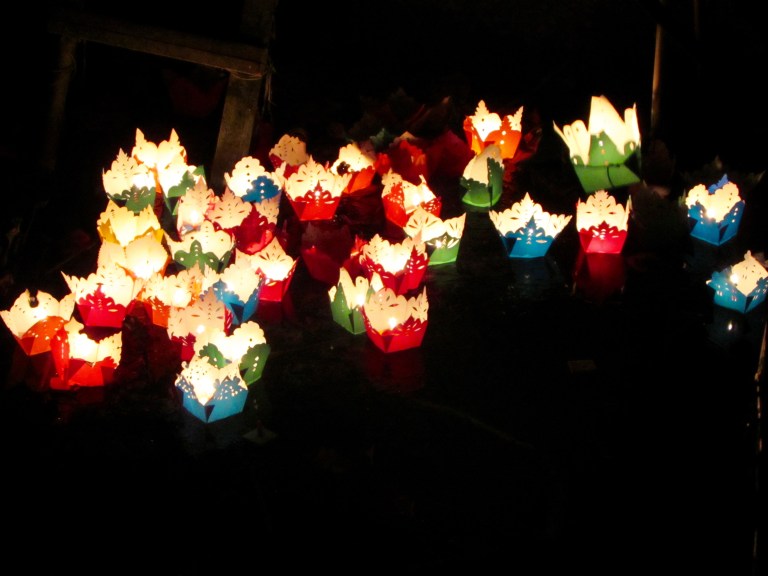
IMG_1581
The girl we bought our lanterns from
IMG_1619
A group of lanterns collecting in the river

Most of the lanterns did what they were meant to though and floated along the river unobstructed, illuminating the water in the same way as the stars do the sky. Despite the bustling crowds around us, it was an incredibly peaceful experience as we watched the different-colored lanterns slowly float off into the distance. It was so peaceful in fact, that, as we watched them, we were reminded of how tired we had grown and began the long walk back to our guesthouse.
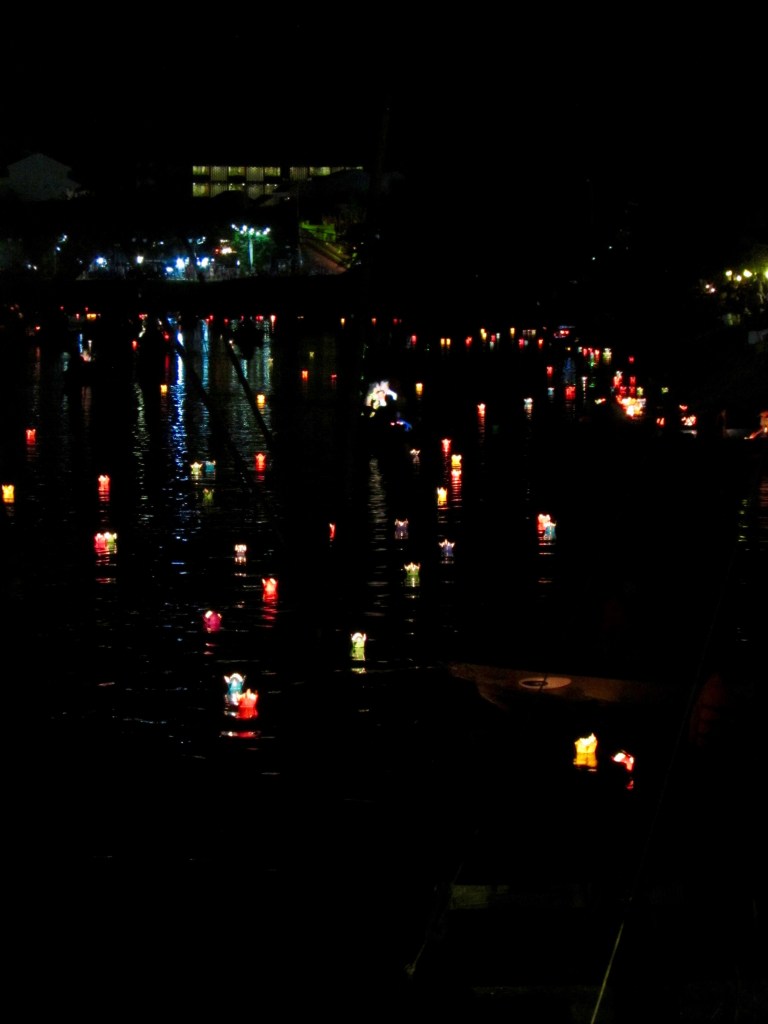
IMG_1612
Lanterns floating off down the river

Our last day in Hoi An wasn’t as much a day as it was a morning. We had an early flight leaving at 9:00 so, wanting to make the most of what little time we had left, we decided to get up at 4:30 a.m. to catch the sunrise. After rolling out of bed and suppressing the protests from our bodies about being up at such a time, we grabbed our bikes and cruised through the eerily quiet streets towards the beach. As we pulled up to it, we found a seat and watched the scenery unfold around us. If some pictures are worth a thousand words than this was a moment worth a thousand pictures. Hopefully three will do.
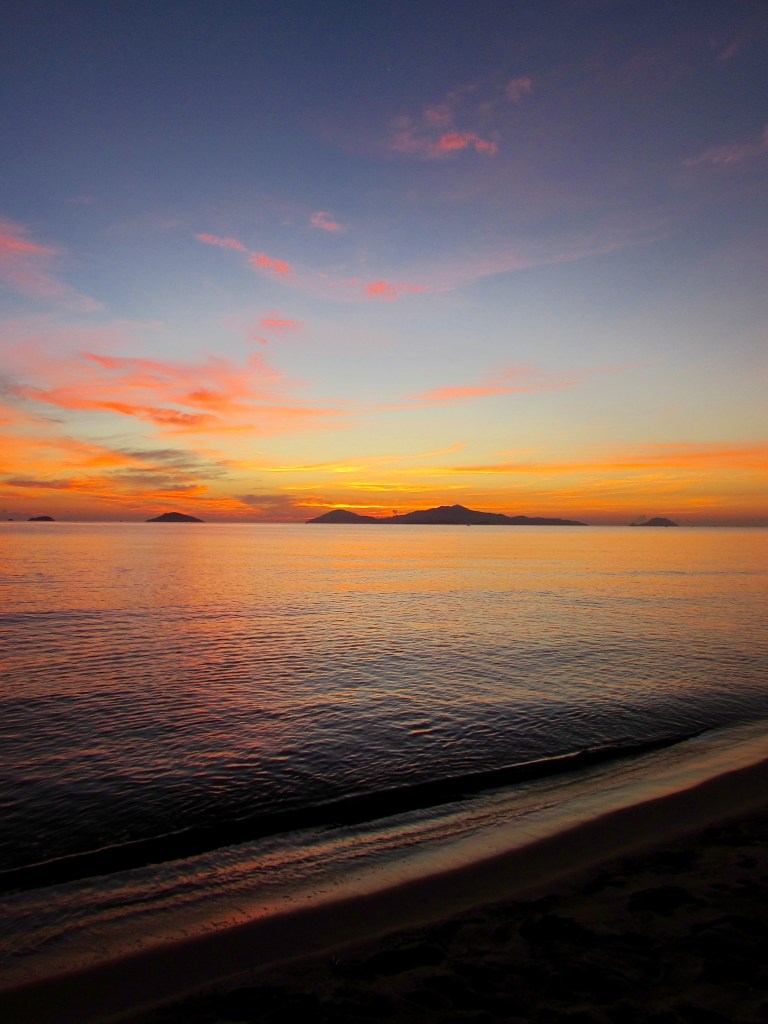
IMG_1666
The view of the sunrise as we pulled up to the beach
IMG_1683
The clouds in the sky made the scene even more beautiful
IMG_1694
A difficult view to say goodbye to

Once the sun had fully come up and the yellows and pinks and oranges that had occupied the sky just moments before turned to a uniform blue, we hopped back on our bikes to head back to the guesthouse in hopes of catching one last breakfast before our taxi arrived. To our delight, we made it back in plenty of time and, with a full belly of beef noodles, we sadly got into the taxi and bid farewell to Hoi An.
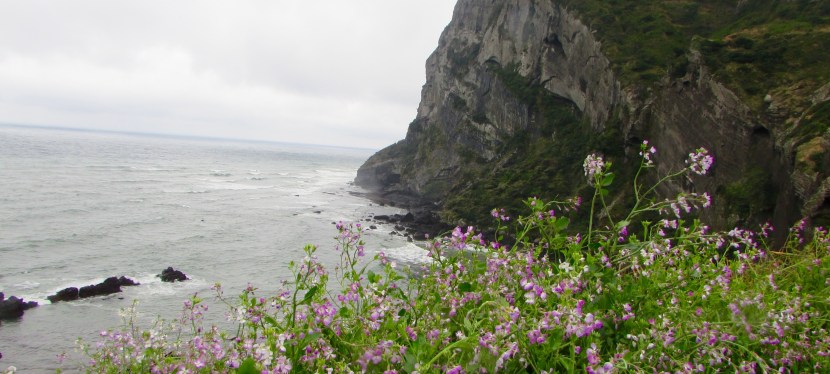
Jeju Island

Although we’ve never been to the tropical shores of Hawaii, we now have the pleasure of saying that we’ve been to the “Hawaii of the East,” the often used tag line to describe South Korea’s Jeju island, where we spent the entirety of our time on the Asian peninsula.

The island, we assumed, got the nickname due to its natural wonders, warm waters and the fact that it was the honeymoon destination for practically all Korean newlyweds. Going in early April, we worried about whether we would have enough to do in our five days there without the prospect of wasting one of those away sitting on a beach. We would find just how misguided this fear was though as we sat in our hostel, Jeju Hiking Inn, for the entirety of our first day, confined to our rooms due to an incessant downpour taking place outside.

With time to kill, we began planning out our days on the island and the lines of our notebook quickly filled up with must-dos and must-sees. The problem of finding enough things to do was now one of finding a way to fit everything in. Little by little, we dwindled the list down to one that consisted mostly of outdoor activities and went to bed content that our time on the island would be spent in the best way possible: hiking around its UNESCO recognized natural landscape.
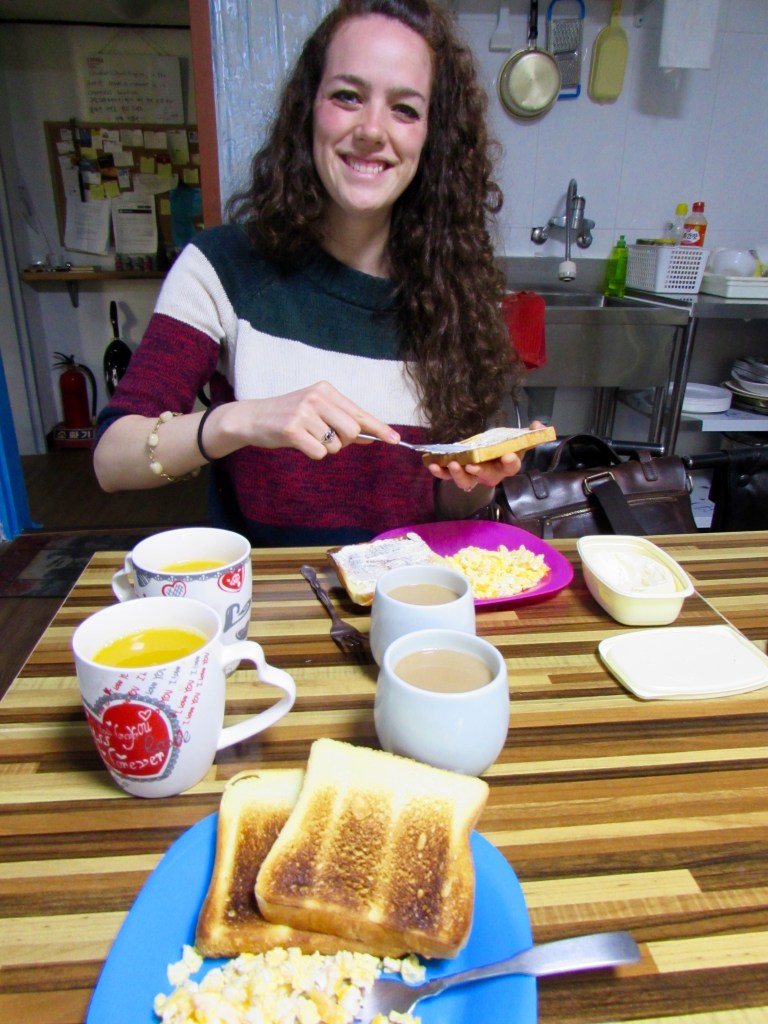
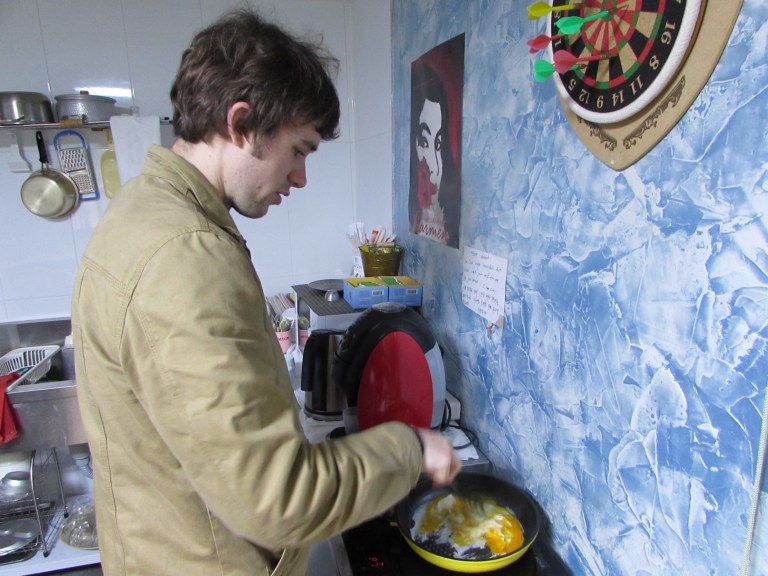
The next morning, we eagerly sprung out of bed and scurried down to the kitchen for our breakfast of toast and eggs. The hostel’s owner spotted us eating and, in his naturally friendly way, used his severely broken English to ask about our plans for the day and then offered to drive us to the bus stop. It’s amazing how much can be communicated with the word “okay” when accompanied with a series of hand gestures and head nods. After driving us there and dropping us off, we hopped on the bus and took off toward our first destination: the Seonsang Ilchubong volcano crater.

IMG_9235
Frying eggs at the hostel.
IMG_9237
Breakfast time!

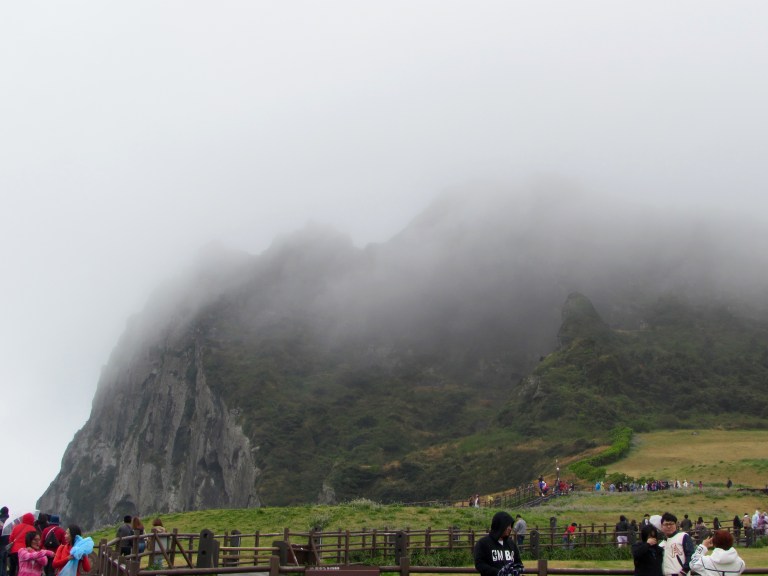
Throughout the ride there we sleepily looked through the foggy windows at a consistently gray and wet landscape and wondered if the sun would ever be coming out during our time on the island. While it would eventually make an appearance, it wouldn’t be anytime soon, a fact we came to terms with as the bus rolled up to the crater and we got our first glimpse of it. While the base was partially visible behind the blurring effects of the mist, the top was completely hidden behind a veil of fog. Not wanting to sulk too much in our weather misfortunes, we decided not to curse the fog, but rather enjoy it and the mystical effect it created as we ascended the crater.

IMG_8664
The view of the crater as we walked up to it.

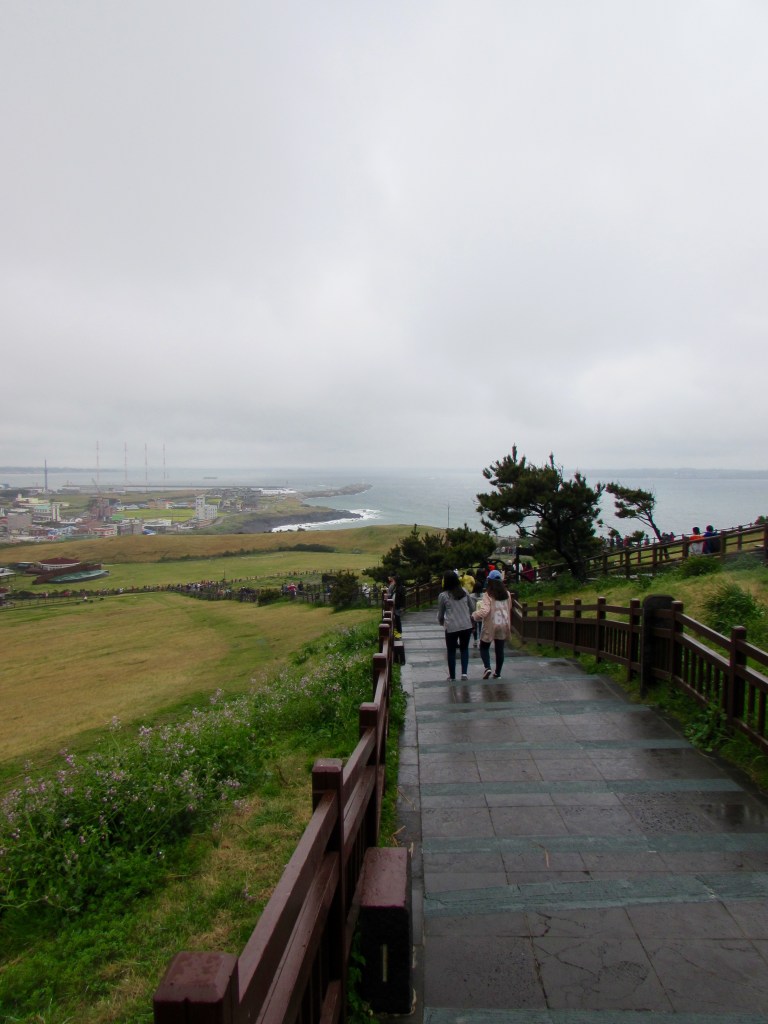
On our way up, we were never quite sure where exactly the top was so we climbed until we couldn’t anymore and it was at this point that we found ourselves on a wooden observation deck with nothing to observe. The signs and outlooks pointed towards the volcano crater, but all we could see was the by now all-too-familiar fog, rolling across our line of vision without actually going anywhere. We stayed to see if it would clear up, but the fog clung stubbornly to the crater so we decided to give up our wait and move on to what we hoped would be less-obscured sights. On our descent, to our surprise and delight, the blanket of fog covering the landscape below us began to be pulled away and lying underneath were sweeping views of the ocean and shore. At the sight of this, we quickened our lumbering pace as the prospects of the day now seemed endless with the world now in clearer focus.

IMG_8692
The fog beginning to recede on our way down.
IMG_8729
Finding our way down to the ocean.

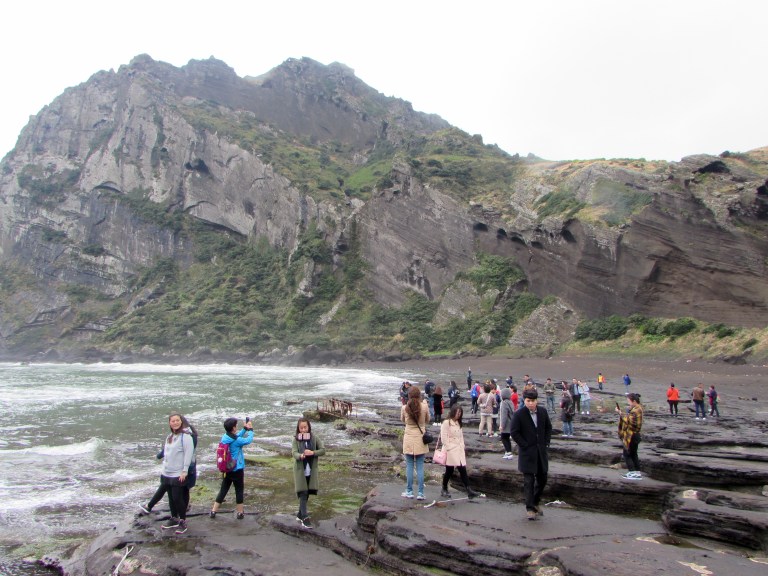
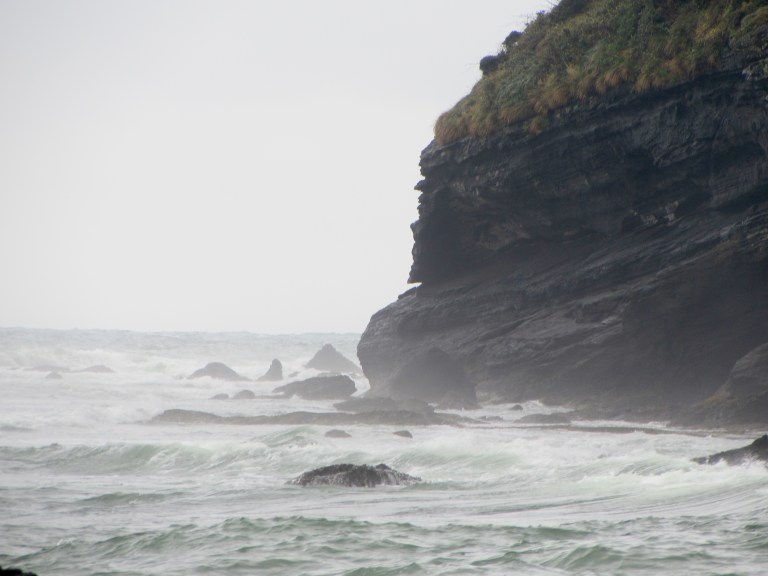
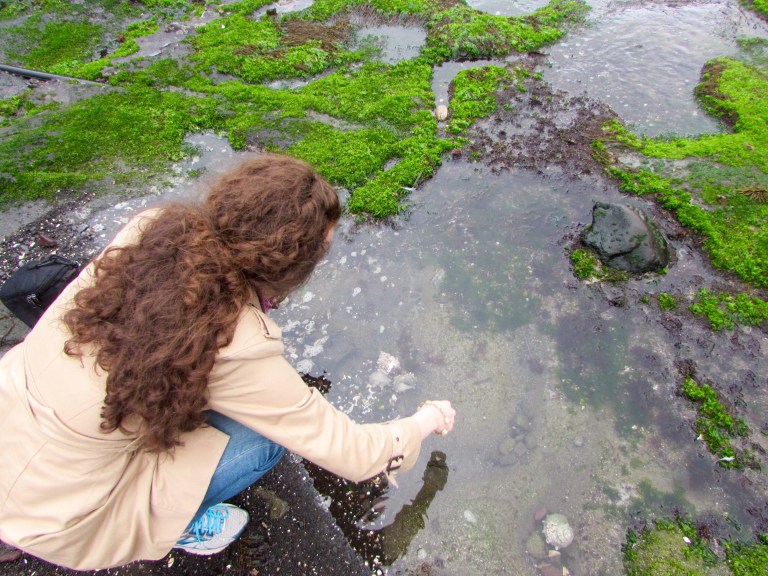
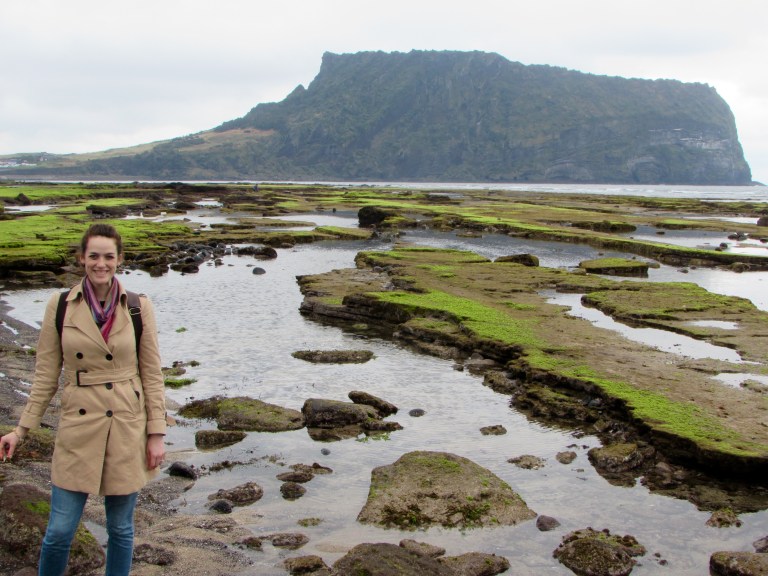
Our first order of business after getting to the base was to find a way to get down to the ocean, which ended up being rather easy and one of the more beautiful places we’d happen upon on the island. The one thing that struck us most once we got down was the color black. It dominated practically every plane of vision we could find, whether it be the rocks scattered across the shore, the sand of the beach, the volcano crater standing formidably in the distance or even the water at times if you looked at it a certain way. Unlike most other things around it though, the water took on many other colors apart from the ubiquitous black. Sometimes, it would be an ominous shade of turquoise, nearer to the sky it would seem almost gray, but mostly it would stay within the range of a foamy white as the ocean was violent that day, swaying and cresting into waves that would crash over the black rocks, creating a beautiful contrast. We explored the different nooks and crannies of the shore finding seashells, crabs, sea anemones and the like along the way. After walking around for a while we came to the painful conclusion that, while the scenery would never get old, the day would and, with a couple of worthy-looking shells in tow, we left that section of the coast in search for another called Seopjikoji.

IMG_8758
Finally at the ocean.
IMG_8775
Watching the waves crash into the crater.
IMG_8770
Exploring tide pools.
IMG_8782
Enjoying the scenery.

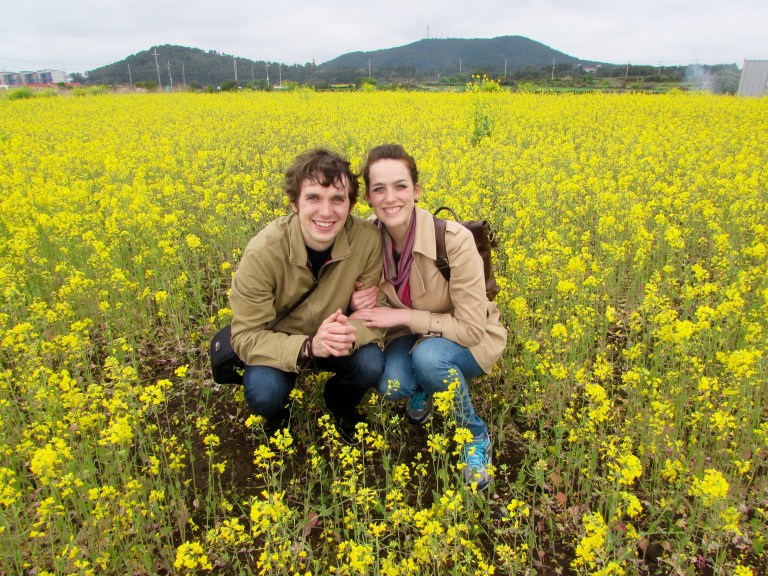
The walk to Seopjikoji was extremely enjoyable. The rain and fog had all but disappeared leaving a cloudy and gray sky behind, which was all the same to us as it made the different colors of the island more vibrant by comparison. Among these colors, the ones that caught our attention the most were those of the rapeseed flowers, whose petals blanketed the ground from which they grew in a bright yellow. We had seen them out of our window on the bus, but to experience them in person along our hike was another matter entirely. After walking through them for a short while and taking plenty of pictures (that later all looked the same), we continued our walk along the coast.

IMG_8885
One of the many fields of rapeseed flowers we’d come across.

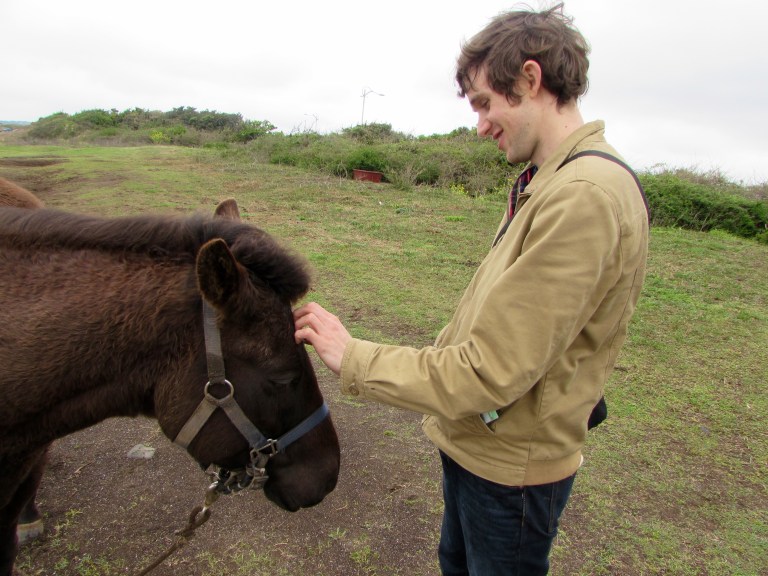
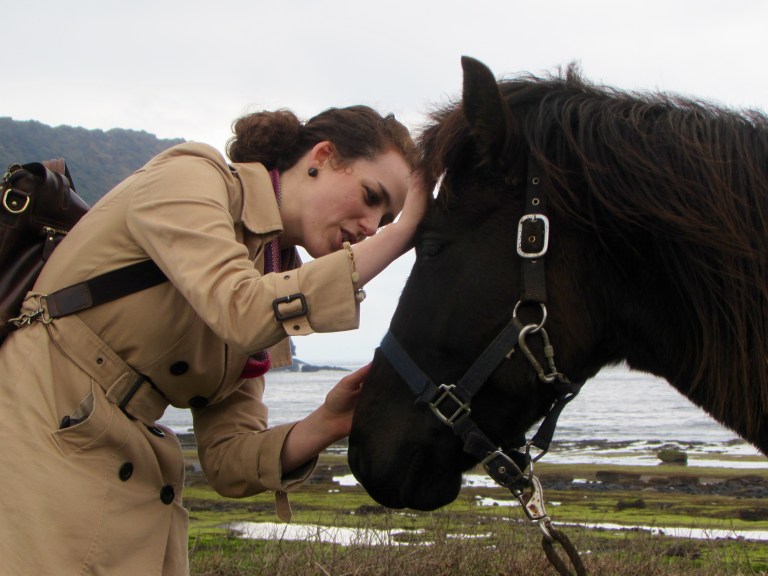
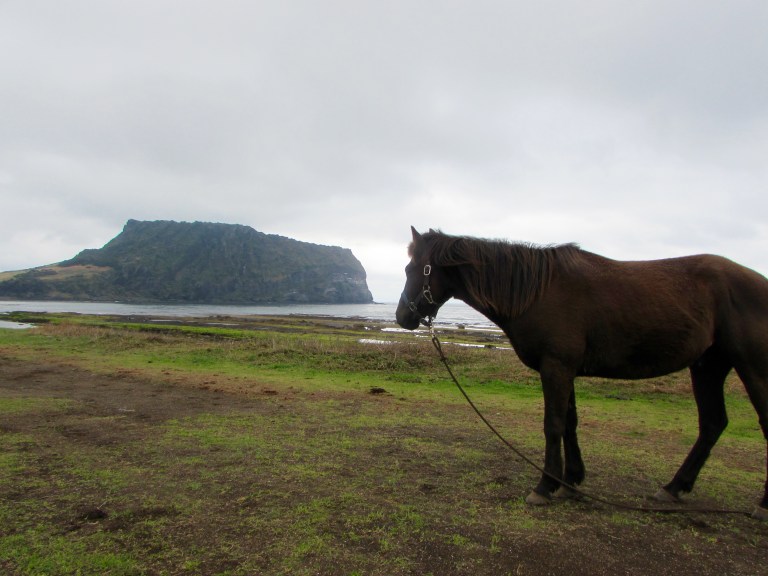
Finding the rest of our way from the rapeseed field wasn’t too difficult, we just had to be moving away from the volcano crater. So, as long as it was shrinking on the horizon behind us, we knew we were going the right way. With the crater at our backs, we worked our way along the coast. As we walked over the crest of one particular hill, we noticed a brown, four-legged speck in the distance that promptly began making its way towards us. As it got nearer, we made it out to be a horse whose steady gallop didn’t stop until he was standing face to face with us. With a clear understanding of where it’s food supply came from, it sniffed around our jackets and pants pockets, leaving strings of gooey slobber behind. It quickly lost interest though as it realized we had nothing to offer apart from a few strokes of its mane. So, we parted ways, the horse clearly unshaken by our departure as it stood on the hill waiting for the next passerby.

IMG_8865
Walking along the coast towards Seopjikoji.
IMG_8838
Making a new friend.
IMG_8842
Saying goodbye.
IMG_8844
Waiting for a more food-friendly passerby.

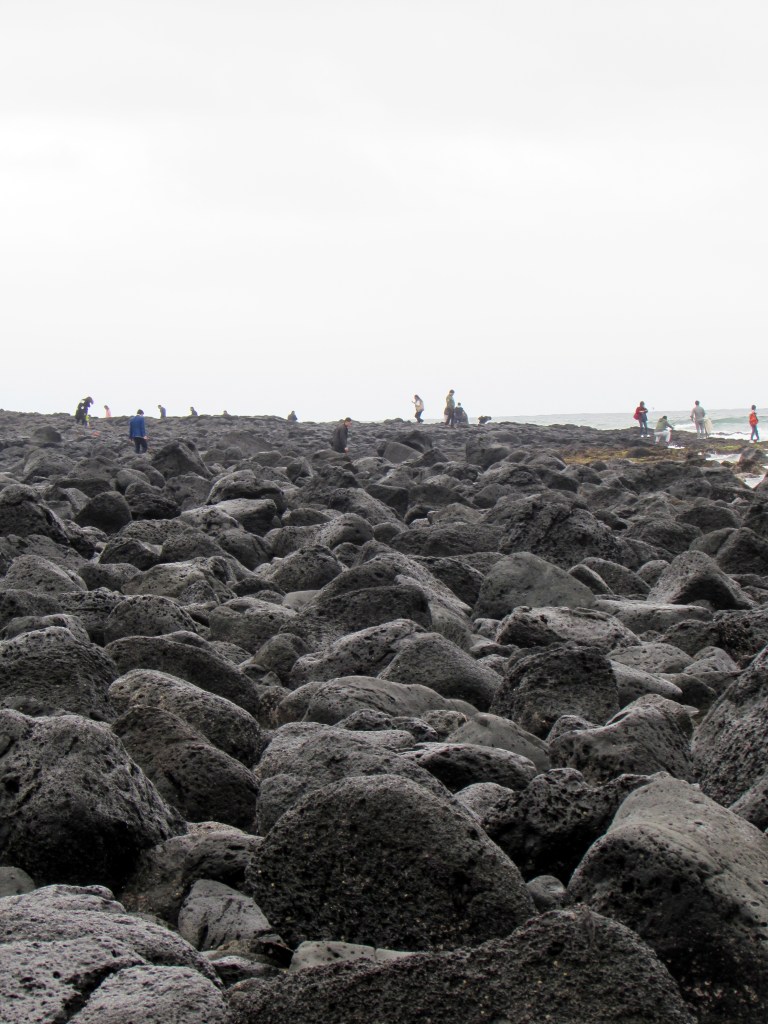
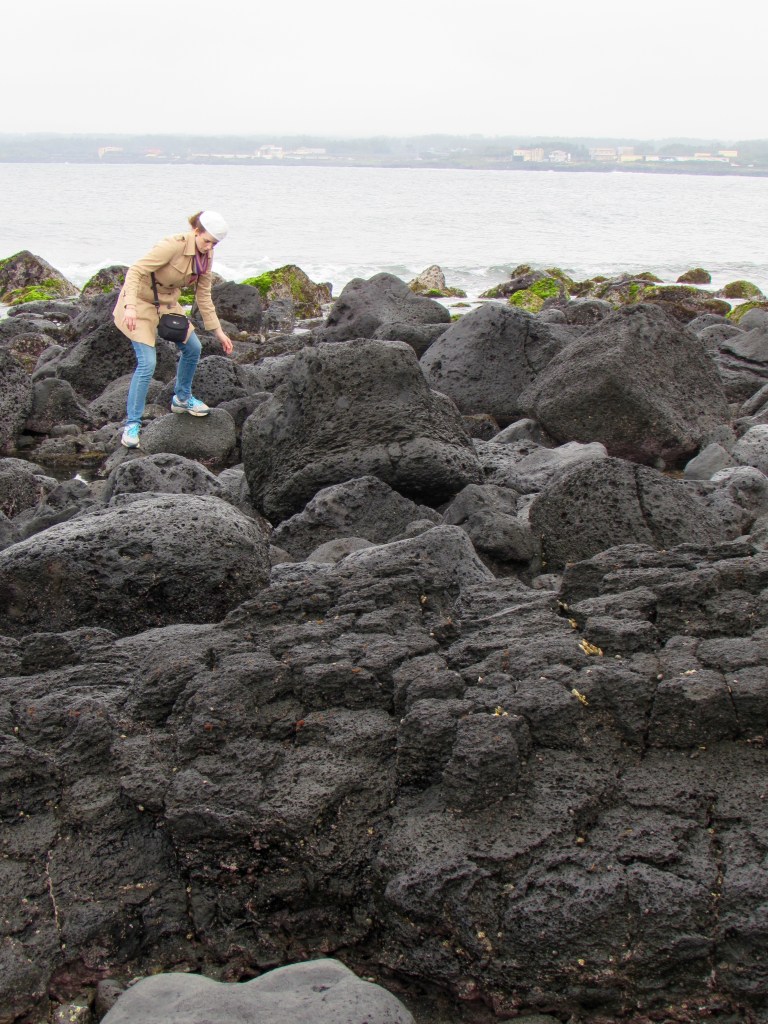
We walked for another hour or so, cutting inland until we came across a large brown sign pointing us towards a peninsula and notifying us that we had finally reached Seopjikoji. We weren’t sure what awaited us there, but we had read that it had some of the most beautiful scenery on the island so we anxiously pushed on towards it despite the aching protests from our tiring legs. The first noteworthy sight we came across after winding around the tip was an expansive field of black lava rocks. As we looked out at the field, colorful dots that we made out to be people through squinted eyes poked out of the rocks in the distance and we began making our way towards them, awkwardly stumbling down into the field one rock at a time.

IMG_8912
Field of lava rocks.
IMG_8923
Stumbling our way across it.

In front of us as we walked, crabs scampered into dark crevasses at the sound of our heavy feet. If they had been spiders, we may have avoided the rock field altogether, but for some reason crabs don’t seem to demand the same level of fear despite looking almost as equally sinister as their arachnid counterparts. After maintaining a constant balancing act across the field for one hundred yards or so, the rumblings of our long empty stomachs persuaded us to leave the rocky terrain in search of some food.

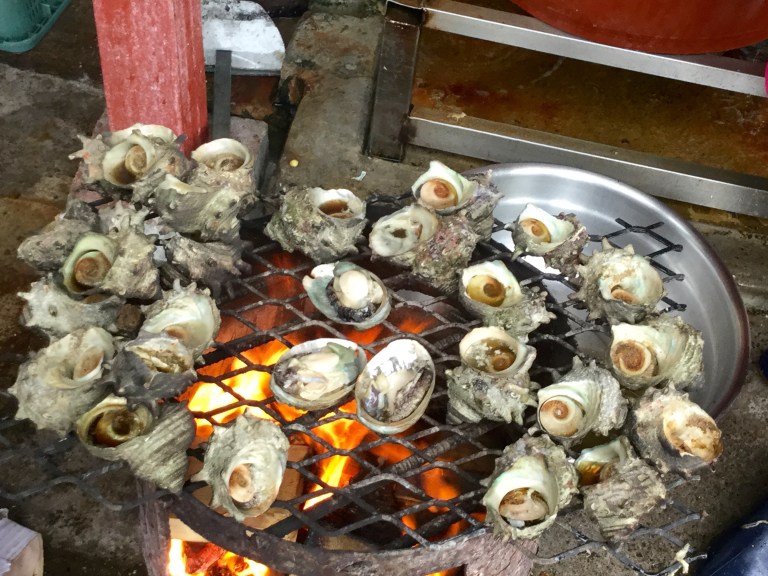
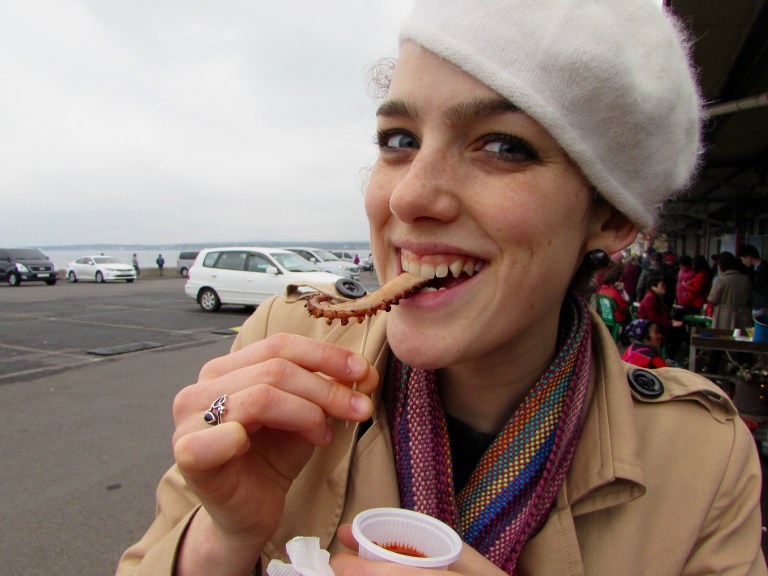
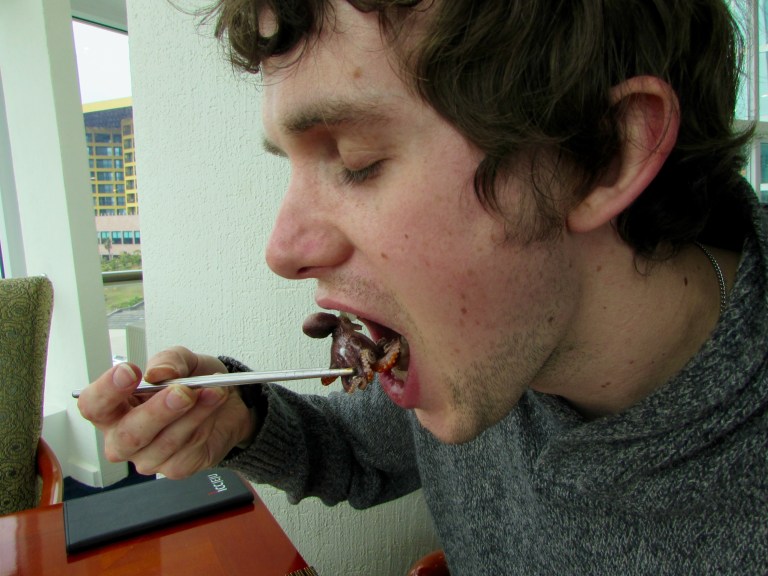
After climbing back up to solid ground, our noses picked up an alluring aroma of grilled seafood and we followed it to a shoreside food stand where octopus, squid, sea cucumber and abalones were being grilled up and dished out to tame the appetites of hungry hikers. We examined the different options closely and found the price of the abalones and sea cucumbers to be too steep for their abundance and their cooking process, which consisted of the stall attendants plopping them down on the fiery grill alive and writhing in pain, too cruel. So we made the financial and ethical choice of the squid and octopus which was neatly cut up into convenient bite-size pieces and handed over to us in an equally convenient to-go bag. Lunch in hand, we found a nice spot to sit overlooking the ocean and dug in, feeling slightly guilty eating the invertebrates so close to their home.

IMG_0230
Abalones on the grill.
IMG_8929
Enjoying some octopus with Sriracha.

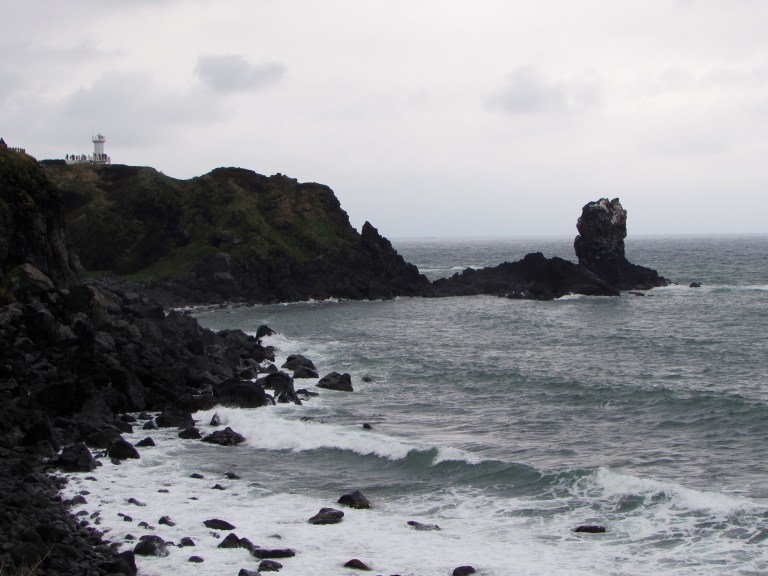
With our stomachs now moderately full we continued our walk around the peninsula, all the while the scenery remained unchanged: white waves crashing into the black rocks, grass-covered hills rolling off into the distance, the crater lying flat on the ocean. In other words, the perfect accompaniment for a walk through the countryside. With nowhere to be, we walked on and on until the light gray that had dominated the sky all day began to darken and we sought out a bus to take us back to Seogwipo (the city our hostel was in) for some rest before what would be another busy day.

IMG_8940
The view along the rest of our hike around the peninsula.
IMG_8966
The crater in the distance.
IMG_8959
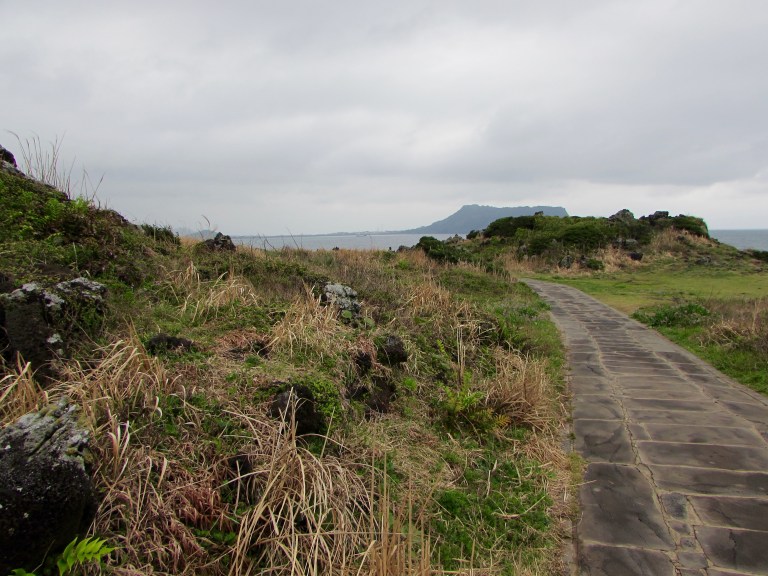
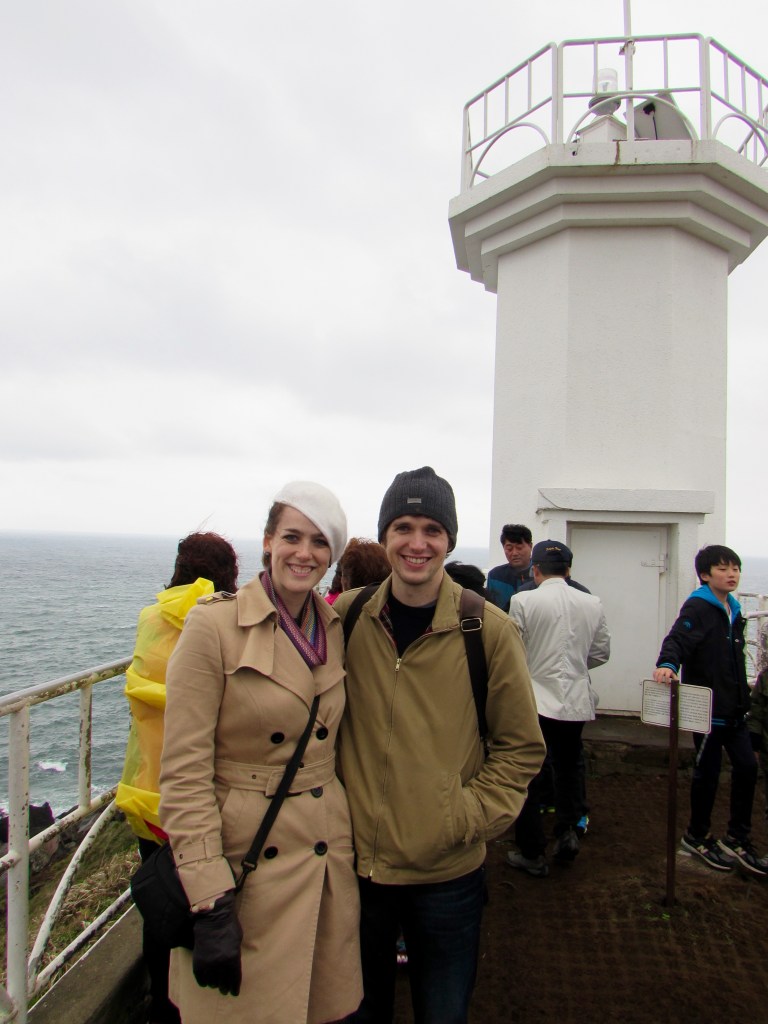
In front of the lighthouse on the peninsula.

Our third day on the island started much like the previous one had right down to the car ride from the hostel’s owner to our first destination. The only difference was that on that particular morning we weren’t heading to a bus stop but rather to the Jeongbang waterfall. On our ride there, we were bewildered to look out the window and find not the gray-tinted landscape we had become accustomed to during our short time on the island but instead at a blue and sunny sky. For a day that would be spent almost entirely on the ocean, we were extremely grateful for this fortunate turn in the forecast and began taking advantage of it almost immediately with the waterfall.

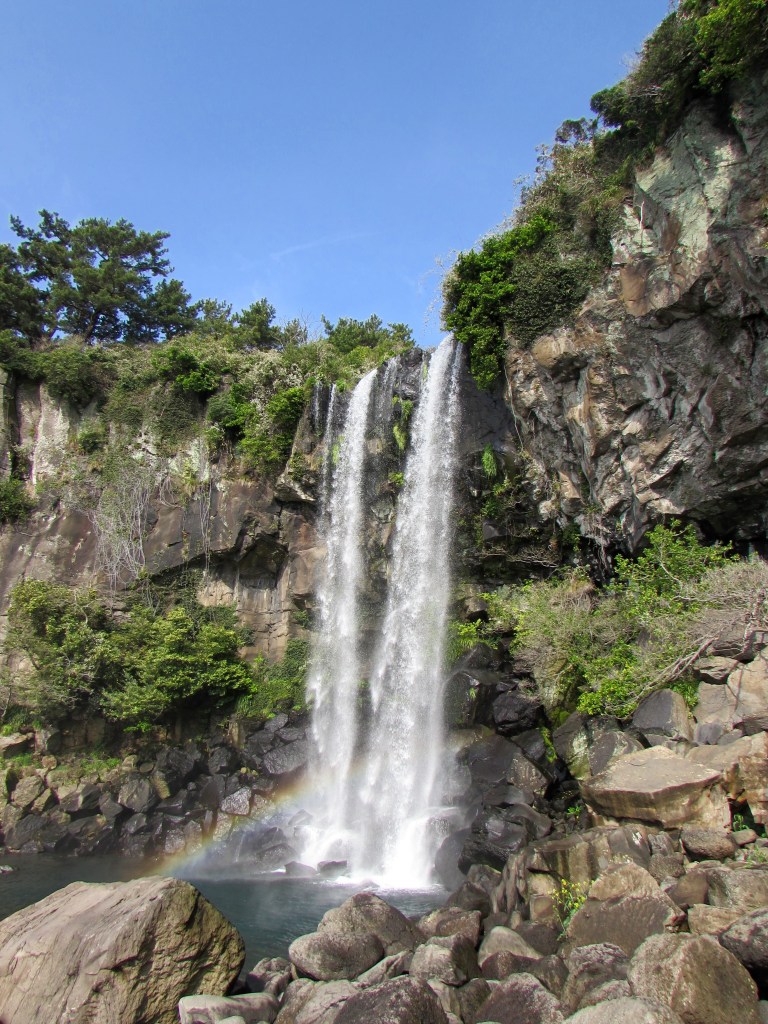
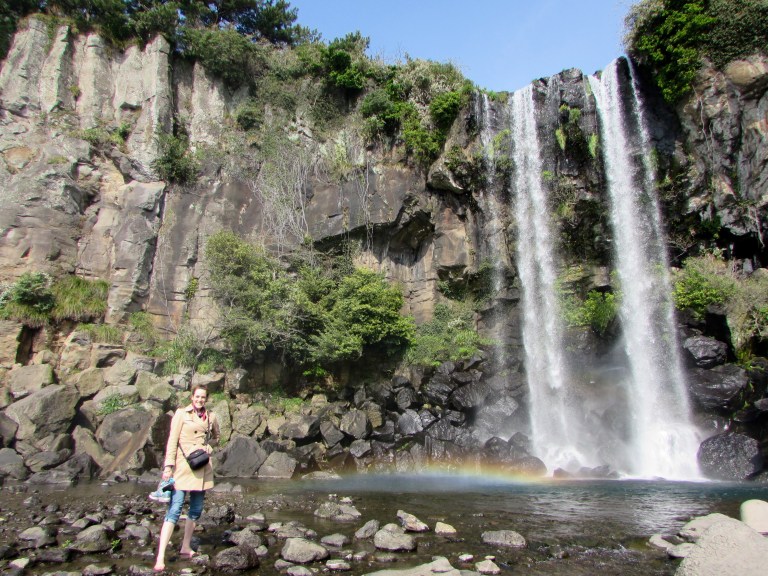
The sound of the falls, booming and ceaseless, reached us well before the view of it did, serving as a guide down the steep path towards its rocky base. At the bottom, necks jerked back, we stared up at the waterfall as it tirelessly crashed over the edge of the island and into the ocean. The sunlight, now unobscured by clouds, illuminated the water and and everything around it, including most spectacularly the mist spraying off the violent collision between the plunging water and the rocks, creating a faint rainbow that hovered over the ground. Every angle was a good angle and, after exploring them all, we chose what we deemed to be the best one, a secluded rock across the outgoing flow from the falls, to sit and enjoy the scenery.

IMG_9023
Jeongbang Waterfall
IMG_9027
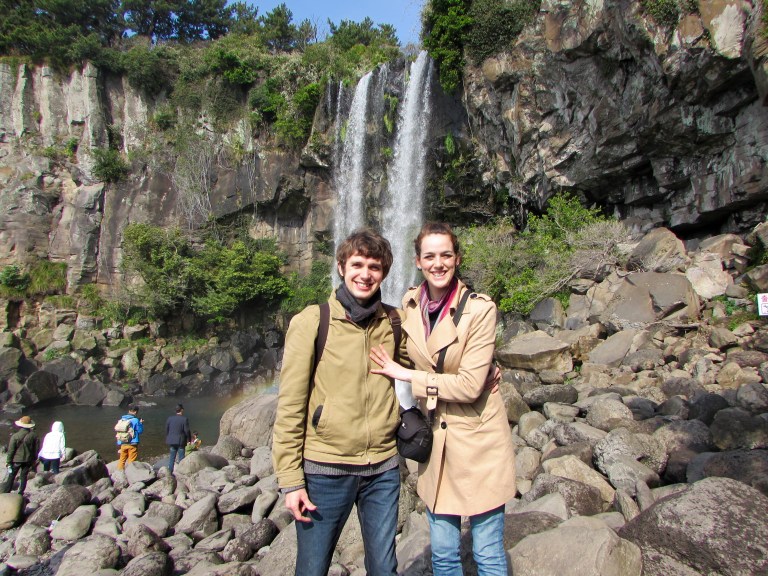
In front of the waterfall.

Getting to the rock proved to require some amount of effort as, before we could plop down on it, we had to take off our shoes, roll up our pants legs and maneuver across the cold slippery rocks that served as a dividing line between the waterfall and the ocean. The effort, minimal and enjoyable, paid dividends once on the rock as the tranquility of the spot was unparalleled. No one else had crossed the stream and, while the crowds on the other side of it were still visible, their rumblings were muted by the roar of the falls. So we sat, taking it all in until the urgency of our agenda forced to cross back over. Once on the other side, we were alarmed to find that a wave of Korean pubescence had crashed down from the hills above, flooding the surrounding area with shrieks and shouts. At the sight and sound of this, we hastened our exit from the park and began making our way towards the Jungmun Daepo stone columns.

IMG_9050
Walking across the slippery rocks.

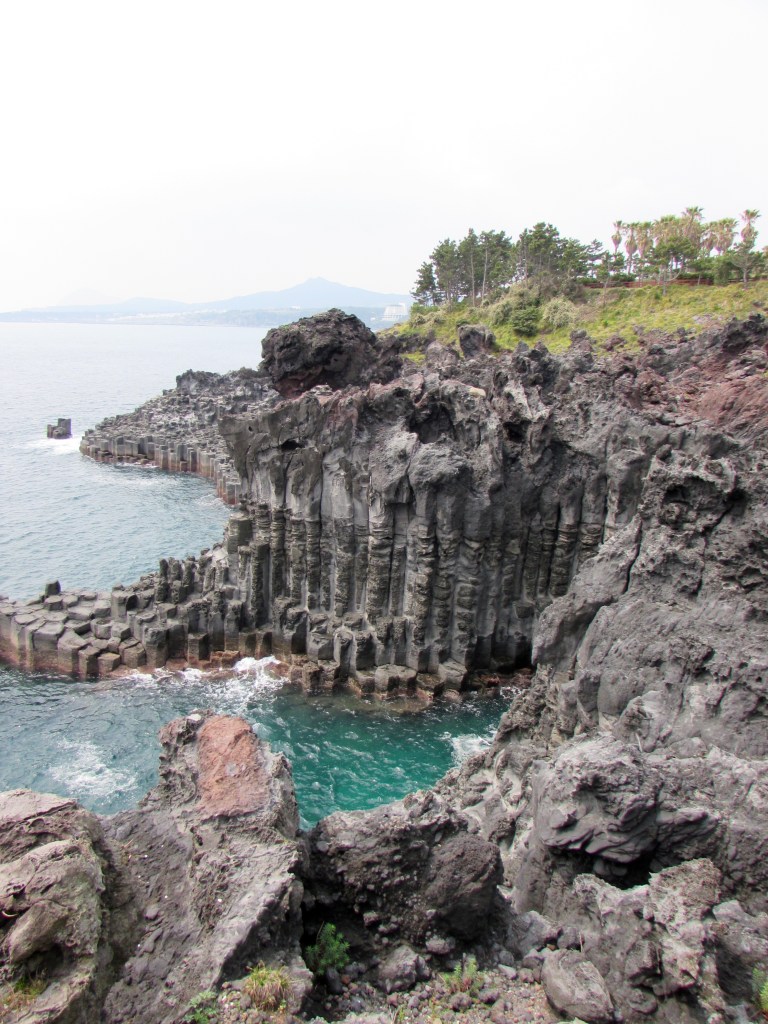
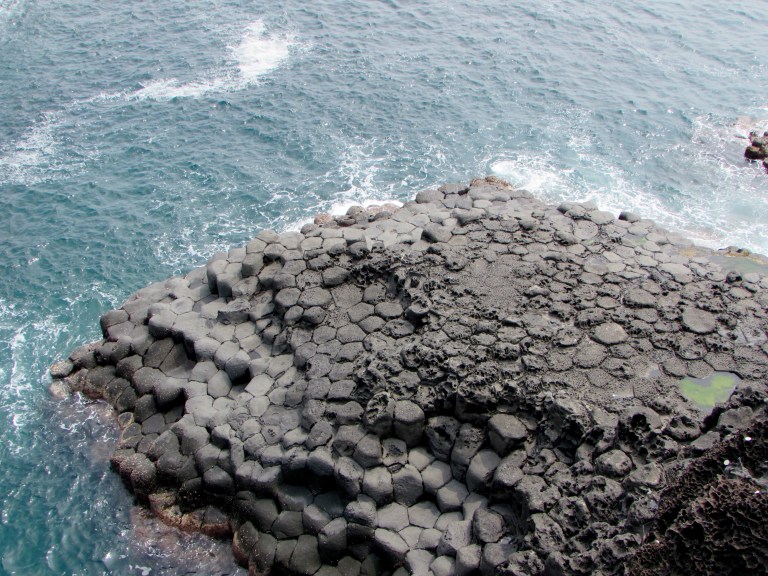
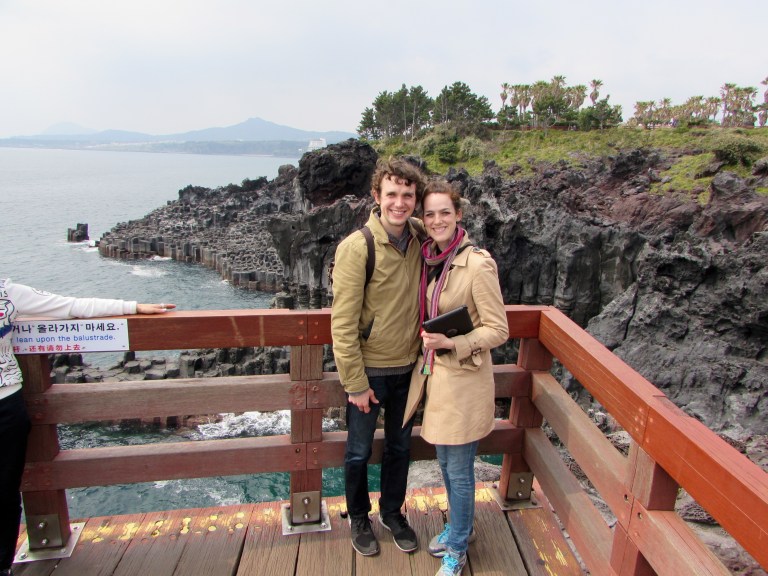
We never were quite clear on how the columns formed despite multiple signs informing us of the exact, albeit highly scientific, process, but they were interesting to look at all the same. Hexagonal and varying in height, they fit together snugly so that if you looked at them from above they would give an appearance of a flattened soccer ball. Staring at them from level ground, they looked like a stone forest growing out of the almost glowing turquoise waters beneath. We bounced around from one outlook deck to another, waiting for the scenery to change (it didn’t), so we just stayed at one and appreciated the stillness of it. As we looked out, our enjoyment of the scenery slowly began to diminish with each passing tour group and, after an elderly Asian man poked Ryan in the chest and called him “monkey, monkey” to the amusement of his friends, we decided it was time to go.

IMG_9095
The stone columns.
IMG_9126
The view from above.
IMG_9141
One last picture before moving on.

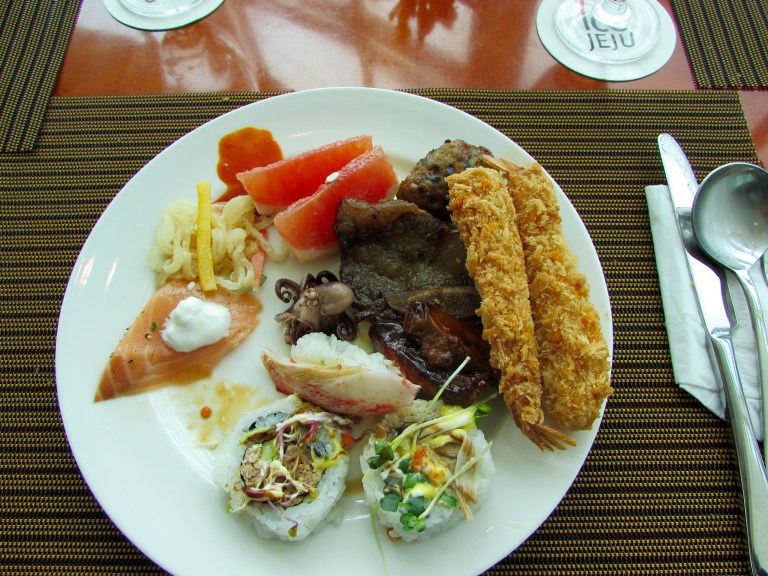
Before heading back to our hostel, we decided to look for a place to get lunch since we were in the hub of Korean honeymoon resorts and assumed the options would be abundant. We ended up settling on a buffet overlooking the ocean due to the fact that it served a lot of the food we had wanted to try on Jeju: black pork, the candy-like tangerines native to the island, seafood in various forms, and abalones, albeit in soup form, but abalones nonetheless. We were so anxious to try the latter because we had seen them being sold all over the island by shrunken old women in diver’s suits at the heart-dropping rate of ten dollars per shell (they were one hearty bite at best), so we were happy to get to try them without compromising our financial morals. Since we got to the buffet so late in the afternoon, we only had about 45 minutes to eat so we unashamedly stuffed our faces for the entirety of the time allotted to us, washing everything down with a tall glass of beer before paying our bill and waddling out of the restaurant.

IMG_9155
Our buffet lunch.
IMG_9157
“Don’t eat me!”

Wanting to walk off the ungodly amount of food we just inhaled, we found a beach nearby to stroll along. As we walked, we were surprised to find not one, but four of the aforementioned abalone shells washed ashore, alive and kicking. Not quite in the entrepreneurial mood, we tossed the shells (forty dollars worth of them) back into the ocean and hopped on a bus to take us back to Seogwipo.

IMG_9163
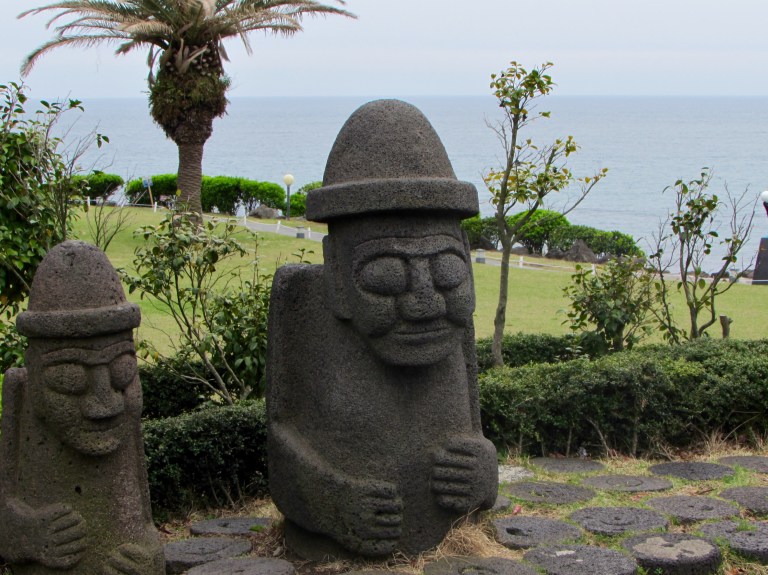
Some grandfather stones – ancient protectors of the island – near the beach.

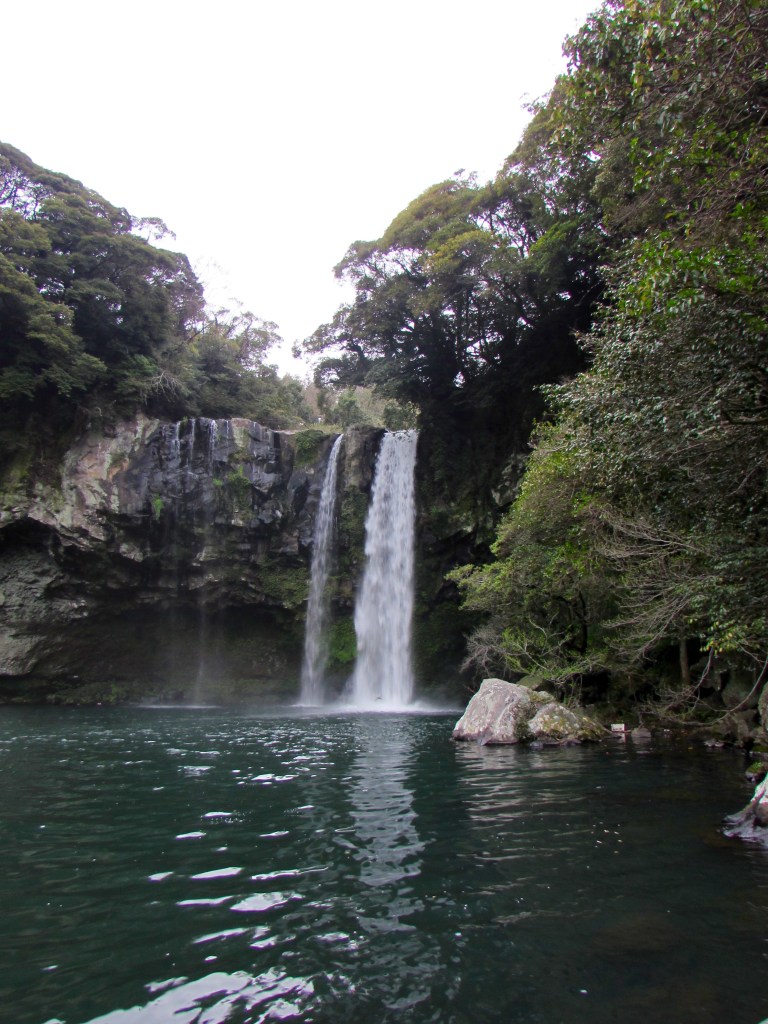
Once back, and with a little daylight left to spare, we went to the nearby Cheongjiyeon Waterfall (not to be confused of course with the Cheong-JE-yeon falls further west). If you haven’t noticed by now, Jeju was not lacking in its supply of long and confusing names, perhaps another reason it was given the title “Hawaii of the East.” Cheongjiyeon, as it turned out, wasn’t too different from the first waterfall we saw that day. Instead of rainbows, oceans, and blue skies, the setting was a dim, misty forest, but, other than that, it was essentially water violently falling over a cliff into the rocks below. The familiarity of the scene in no way diminished our enjoyment of it though for, while the concepts of nature–mountains, rainstorms, forests, etc.–are extremely familiar, to witness the power and size of them in person is always an experience worthy of admiration. So, again we sat, bookending our day perched on a rock and gazing out at the mesmerizing endlessness of the waterfall.

IMG_9193
Our second waterfall of the day.

Our fourth and last full day on the island, sadly, was a combination of misfortune and missed opportunities. Our agenda was full with plans to hike up Mt. Halla, the island’s central peak and tallest mountain in Korea, visit the world’s longest lava tubes that ran under the island, and, if time, go to the Jeju Folklore and Natural Museum to learn a little about the island we had inhabited for the better part of a week. To our disappointment, none of these would come to fruition.

After hiking up the mountain for nearly two hours the skies opened and, with the scenery now blurred by the haze of a rainstorm, we decided to turn back before reaching the peak. The lava tubes, perfect for a rainy day, were closed due to the fact that it was the first Wednesday of the month…silly us. And, to top things off, by the time we had exasperated both of these options, the museum was nearing closing time. In a desperate attempt to salvage the day, we randomly hopped off the bus back to Seogwipo to search for a beach in the illusion that it could still be enjoyable in a downpour…it wasn’t.

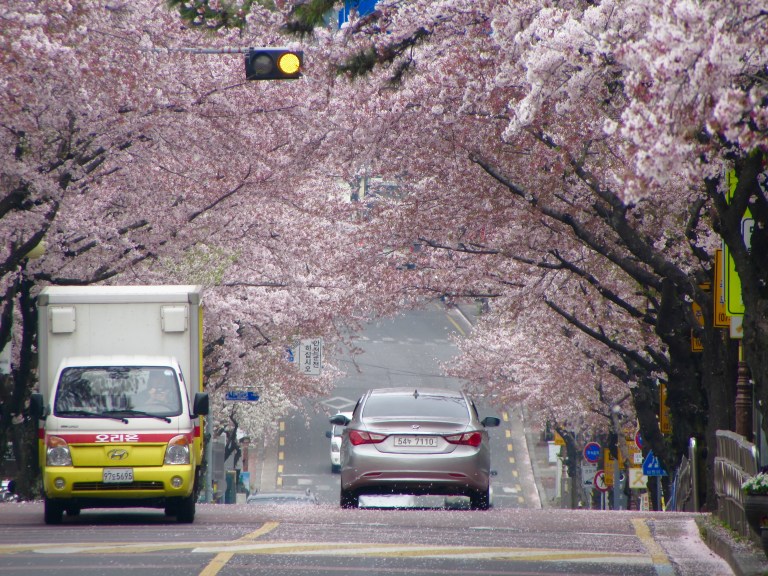
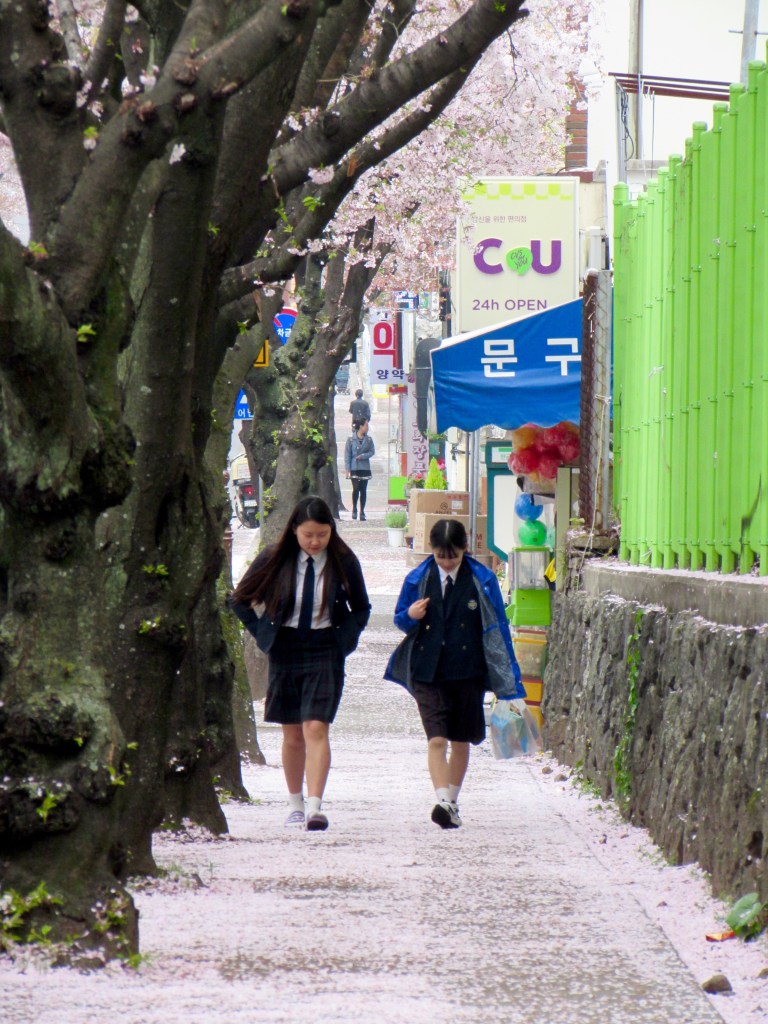
If our tone comes across as bitter, that’s because at the time it was, but there were some bright spots throughout the day (none coming from the weather) that made it worthwhile. One of these came on our way to the mountain in the morning. As we walked to the bus stop, we stumbled upon a street lined with cherry blossom trees so big and full that they formed a canopy over the road, creating a floral tunnel for the cars to drive through. On the ground below them, thousands upon thousands of tiny white petals laid scattered about, making it look like a fresh coat of snow had just fallen. For us, it was one of those unplanned moments that you can never recreate, just pure contentedness with where you are and what you’re doing.

IMG_9256
Cherry blossoms hanging over the street.
IMG_9251
Walking through the snow-like petals.

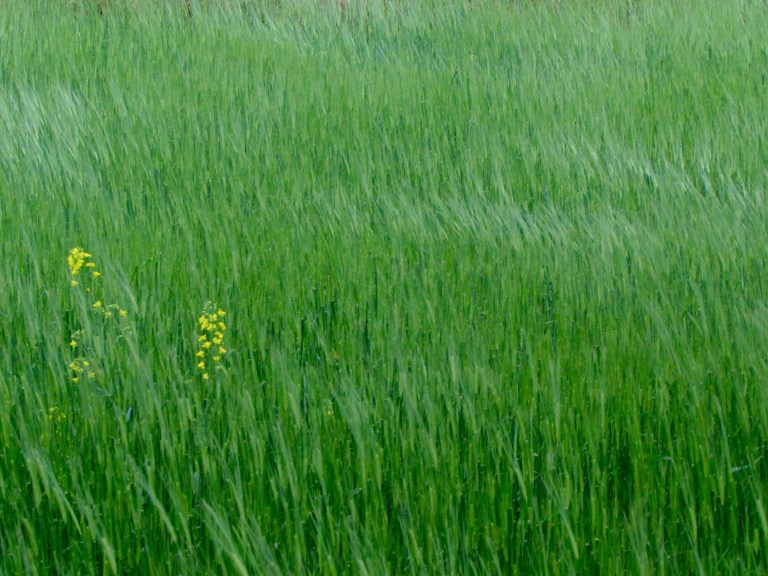
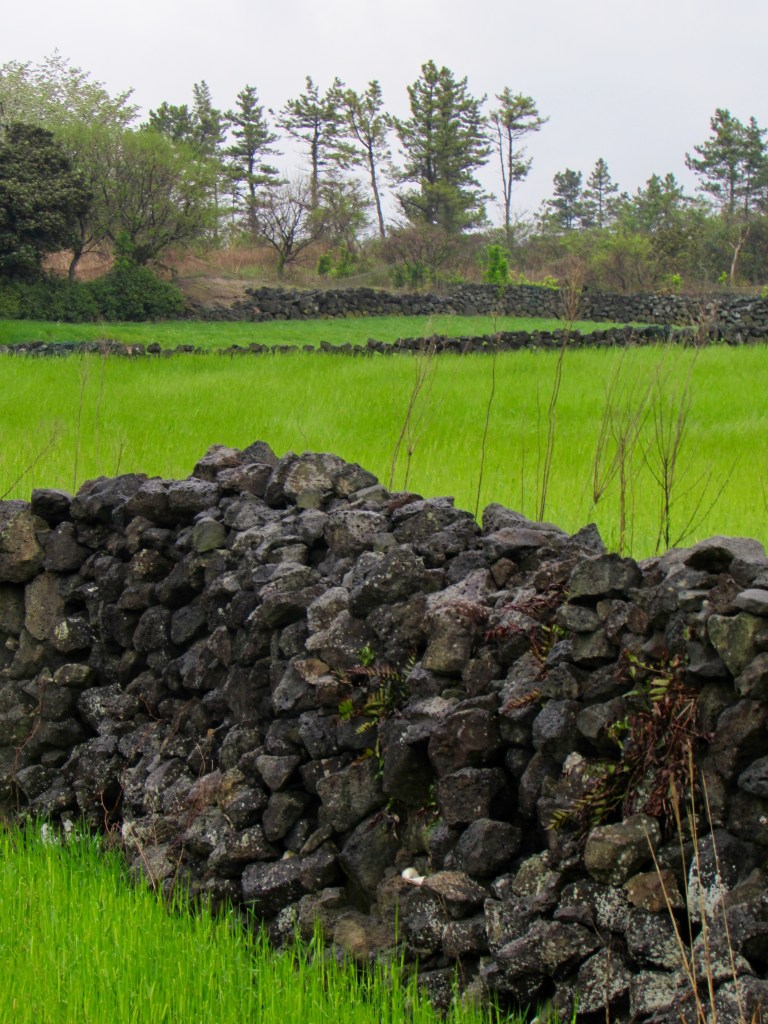
Another of these moments came as we walked back from the lava tubes after finding out they were closed. Despite every excuse to be downtrodden, we found ourselves enjoying the rain-soaked hike back to the bus stop. The rain and wind, while no friend to our shoes or pants, gave the surrounding countryside a sense of beauty that might not have existed on a sunny day. The green seemed greener in the fields of grass that swayed hypnotically in the fluctuating patterns of the wind. Yellow and purple flowers dotted the landscape. Even the humble stone walls, which cut through the entire island, were stunning in the rain, blacker than ever and serving as a neat divide to the palette of colors surrounding them. It was a scene worth walking through very slowly, which we did until the rain picked up and our pace with it until we were back at the bus stop.

IMG_9292
A field of grass along the way.
IMG_9275
The black stone walls.

We spent the next two hours in the humid interior of the bus and, after finally getting back to Seogwipo, it was safe to say that all of the satisfaction we had managed to soak up throughout the day had now been rung dry. Wanting to end our time on the island on a good note, we decided to try a black pork restaurant that would have been way out of our price range on our first day but now seemed perfectly reasonable. It was worth every penny, or won for that matter, and one of the more unique restaurant experiences we’ve ever had.

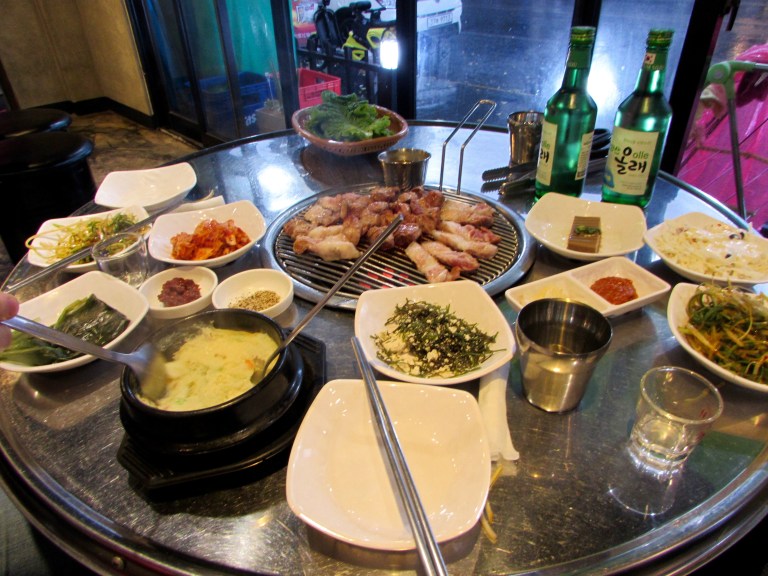
Shortly after being seated, our table, which also served as our grill, was filled with plate after plate of appetizers by the waiter who culminated his back and forth kitchen runs with two slabs of black pork on the grill. After that, the warm, orange charcoals burning underneath did the rest of the work and in no time we had a feast. For the next hour or so, we existed in a state of bliss as we delicately sampled the different tastes before us with a pair of steel chopsticks, paying extra attention to the juicy, flavor-filled strips of pork that went down like potato chips. It was the perfect meal for an imperfect day.

IMG_9304
Our black pork feast.

Our last morning didn’t consist of much. We woke up early, made a mad dash to the bus station in the pouring rain, by now as omnipresent to the island as the ocean surrounding it, and spent the remainder of our time in the airport. As we waited for our flight and reminisced about our trip, the rainy days and missed opportunities had all but washed away in our memories. Only the good things remained, and there were plenty of those.

Tokyo

Our experience of Tokyo was probably different from most others’. There were no trips up towering skyscrapers, walks through busy shopping districts, or even a viewing of sumo wrestling for that matter. In fact, before we had even come on the trip, we knew the bustling metropolis would be serving more as a base for us than a destination. Having just come from Shanghai, another one of the biggest cities in the world, we were more interested in the charms of a smaller city like Kyoto or the natural beauty of a place like Mt. Fuji. However, as we found out in our brief time there, Tokyo had a lot to offer outside of the typical sights of a city.

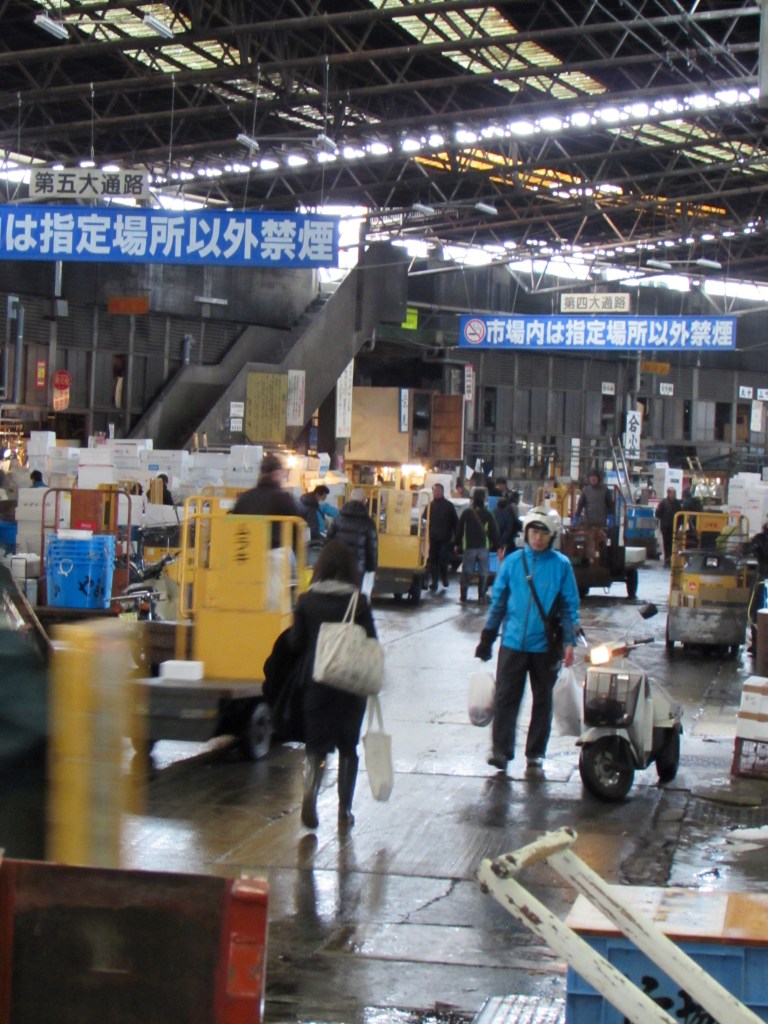
We technically had four days in the capital, but three of those consisted of trips to the train station in the morning and from it at night with an occasional meal thrown in. The only real time we had in the city was our last day there, a full one that ended with a train ride back to Osaka to catch our flight. Wanting to make the most of it, we got up early and set off to see the Tsukiji fish market, the largest in the world.

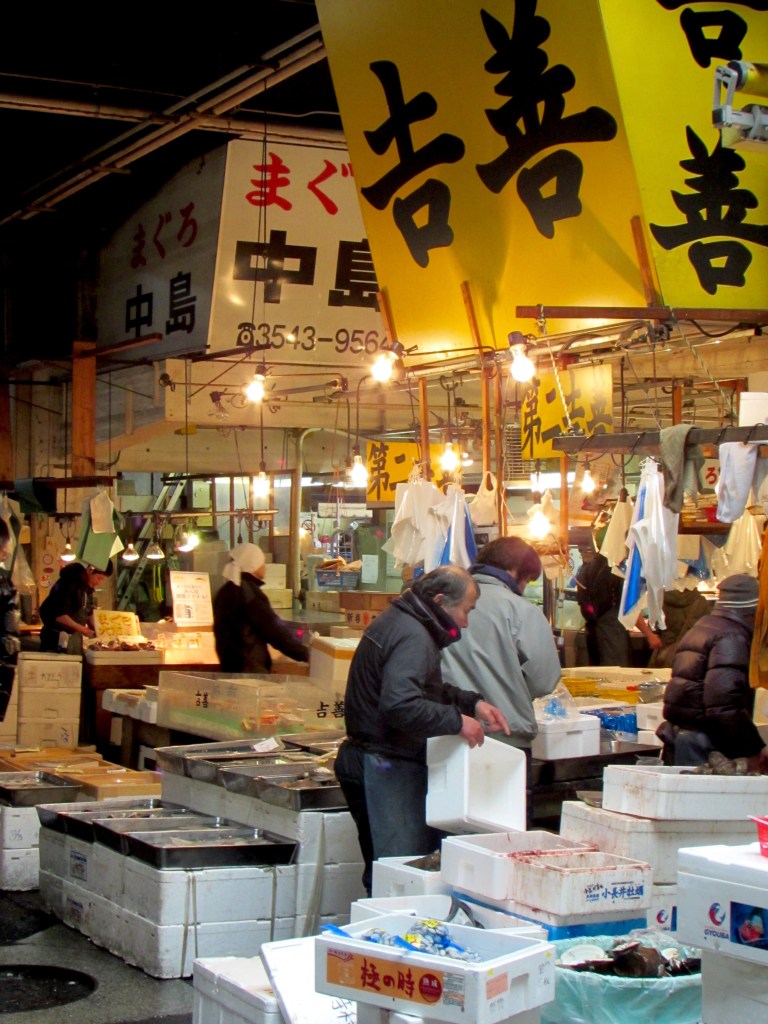
When we got to the market, the condition of the morning–cold and early–gave us and the other tourists a zombie-like pace. Bundled bodies shuffling around each other in the maze of walkways inside the market gates. Our sluggish state was by no means shared by the workers though for, while our day was just beginning, theirs was coming to an end. They zoomed around us from every direction, weaving in and out of each other like a school of fish. Perhaps the ocean wasn’t the only thing they shared with their product.

IMG_8453
The blurring pace of the fish market.

The drastic difference in pace, to our surprise, never seemed to bother the workers outside of an occasional eye roll or deep sigh. Even when we would do foolish things like stop in inconvenient locations to look at a map, pausing for long moments to try and decode the nearly illegible mixture of lines and symbols, the bodies, forklifts and trolleys would just move around us. This held true for other tourists too, but it didn’t mean that we had a happy coexistence with the market for, while it allowed us into it, it in no way changed itself to become a tourist attraction other than the slew of sushi shops sitting at its gates. Because of this, the market’s relationship with us was more of toleration than accommodation, which made the experience all the more unique and exciting.

Little by little, our bodies thawed and we migrated towards the back of the market to see where the actual fish were sold. As we made our way out of the crowds and down a dark hallway littered with dusty machinery, bright lights in the distance assured us that we were going in the right direction and, when we reached them, we entered into a world of styrofoam and ice on which laid fish of every size and color. We had read before coming that the fish were for sale only to restaurants and bulk buyers so we were largely ignored during our time there which worked to our advantage as we were able to work our way through the labyrinthine market without being pounced on by eager vendors.

IMG_8469
Some of the vendors at the market.
IMG_8505
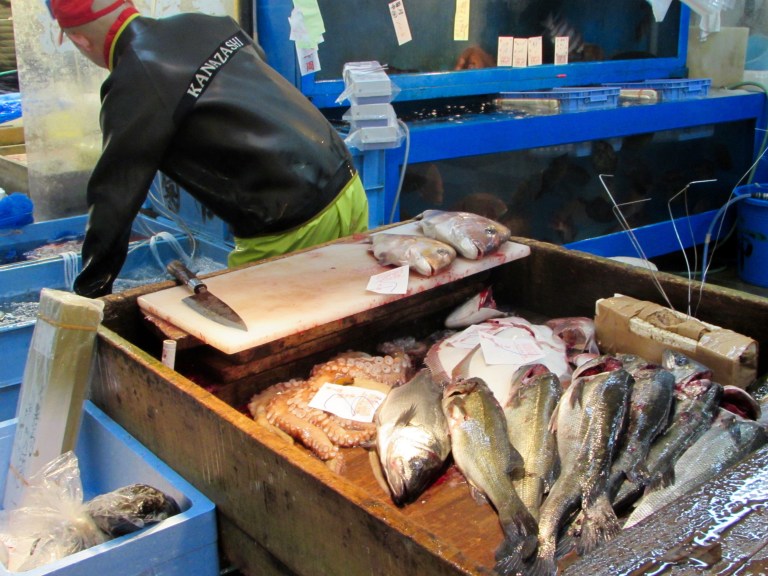
Cutting up the day’s haul.
IMG_8470
A variety crustaceans on display.

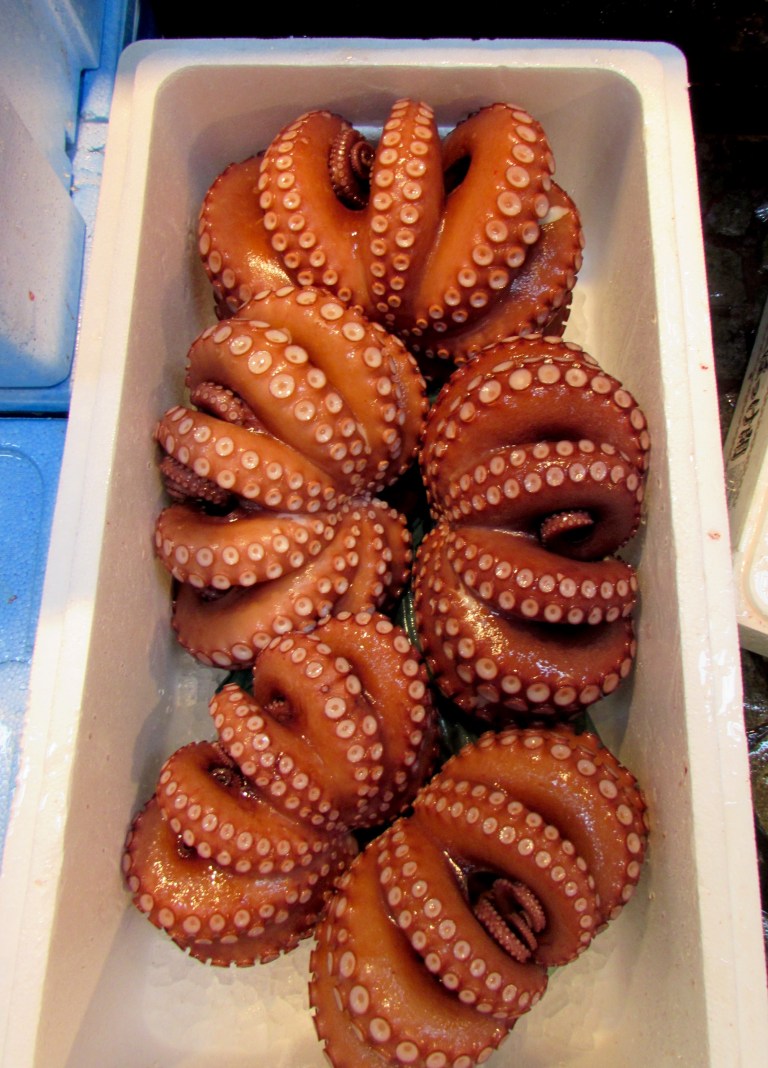
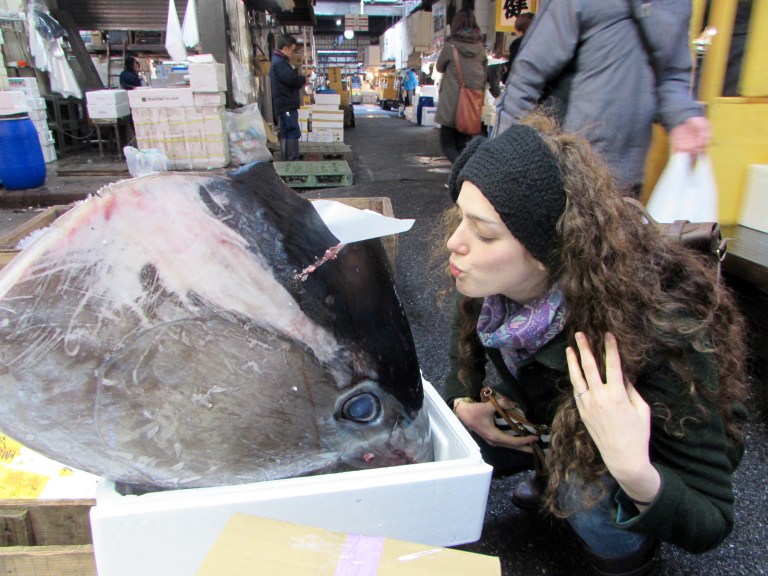
Among the bountiful variety of fish and seafood we saw lining the aisles of the market, some of the more interesting ones were: sea cucumbers, blowfish, octopi of every size (and sometimes just their tentacles), sea urchins, and tangles of crabs, most of which were still alive. Occasionally we would even come across remnants of the 4 a.m. tuna auction, giant fish heads laying on the ground whose bodies were most likely in the back of some van heading to a restaurant. Seeing all of this seafood, even the tuna heads strangely enough, reminded us of the other reason we had come to the market:  to try the sushi, which we heard would be the freshest we would ever have.

IMG_8488
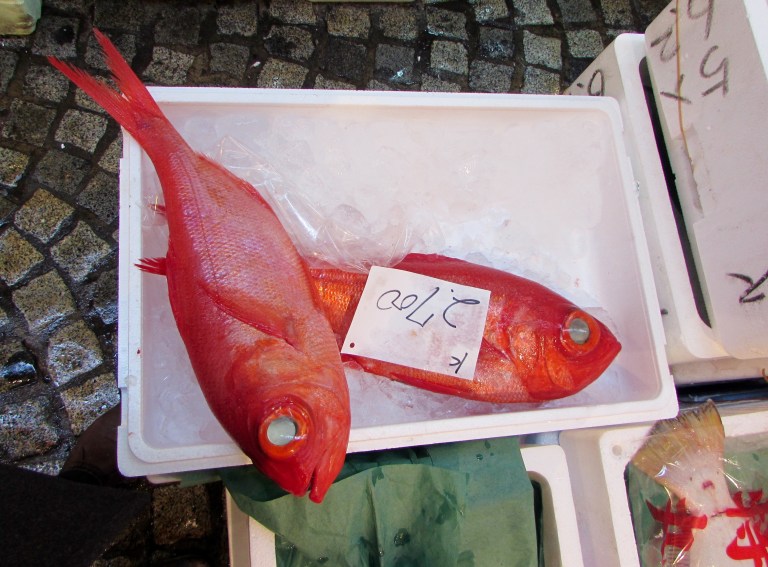
A couple of the many colorful fish we saw.
IMG_8490
Blowfish ornaments.
IMG_8504
Octopi in a box.
IMG_8507
Leaning in for a kiss with one of the tuna heads.

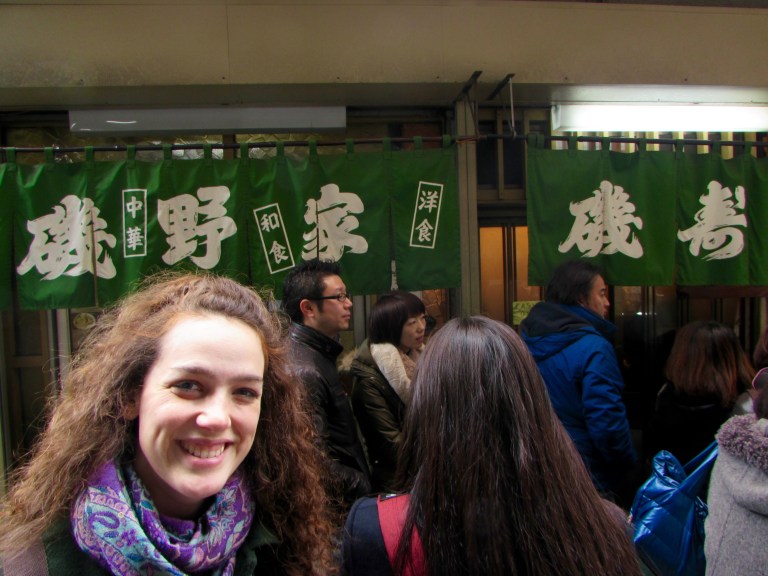
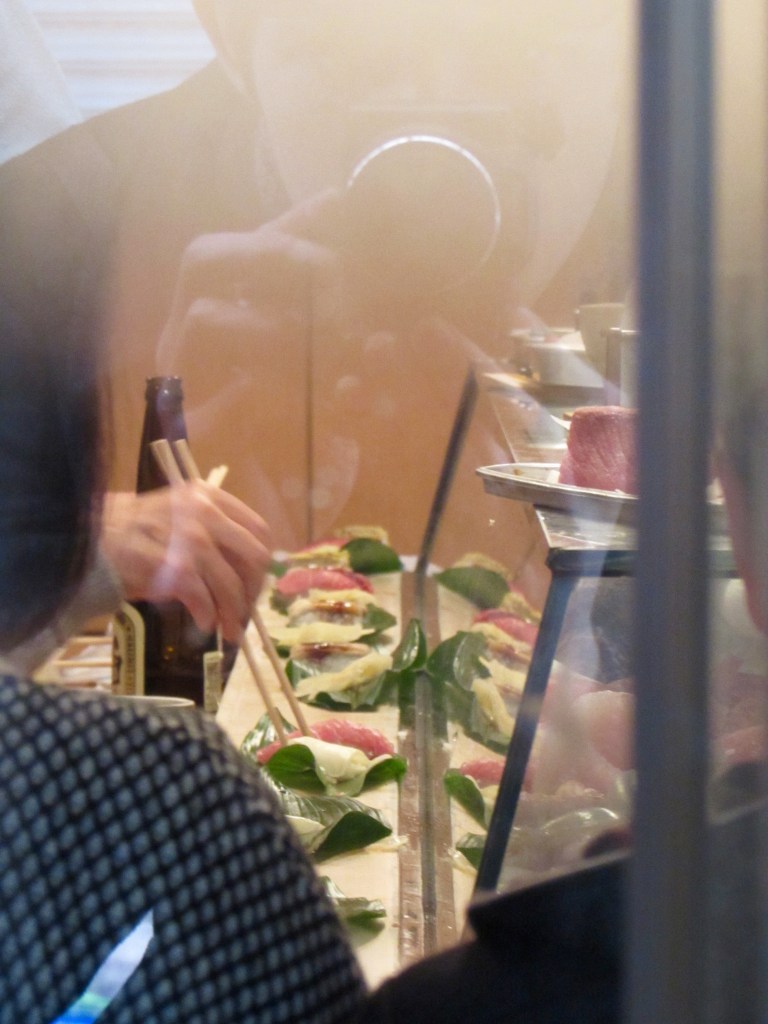
Finding a restaurant to satisfy our appetite for sushi proved easy enough, the tricky part came in choosing which one to go to as each that we passed had a line snaking out of it so long it would make an anaconda blush. This, we figured, meant that they were all equally good and we randomly chose a restaurant with a green awning that sat at the market’s entrance. After getting in line we began to creep forward little by little but our steps were too infrequent for our liking. Nonetheless, we waited, our appetites borderline ravenous as we watched satisfied face after satisfied face leave the restaurant. After over an hour, we stood at the front door, next in line to go in and hardly able to contain ourselves as we peered through the steamy windows at the people enjoying their sushi inside.

IMG_8510
Waiting in line at the sushi restaurant.
IMG_8516
Peering in at the lucky sushi patrons.

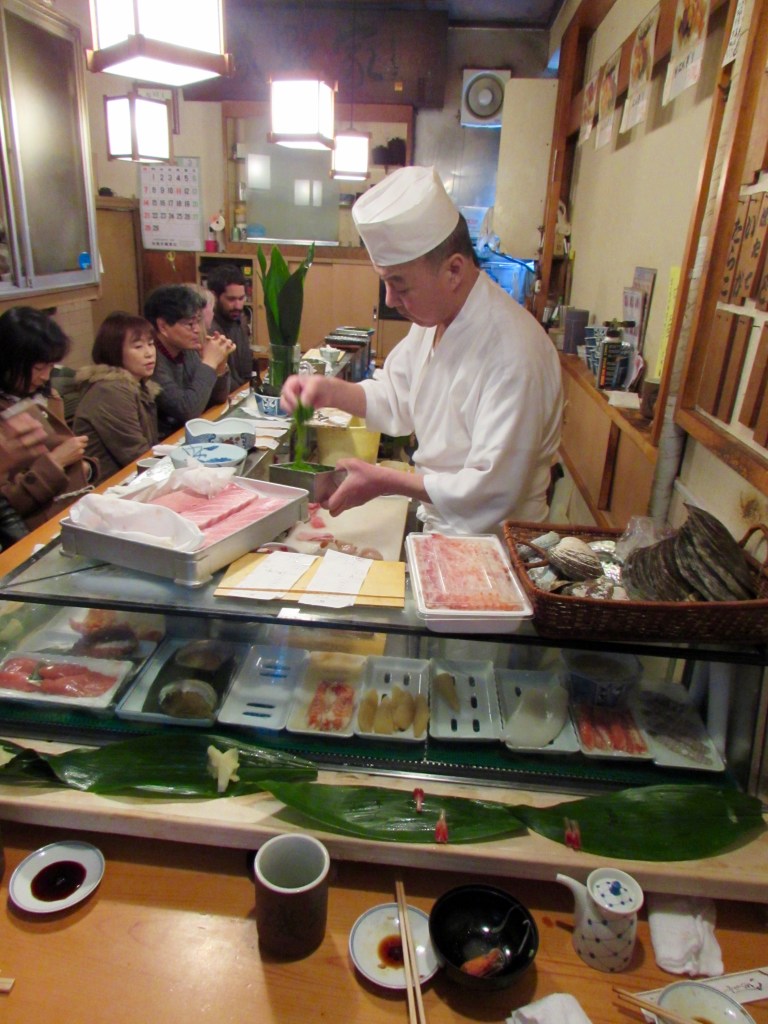
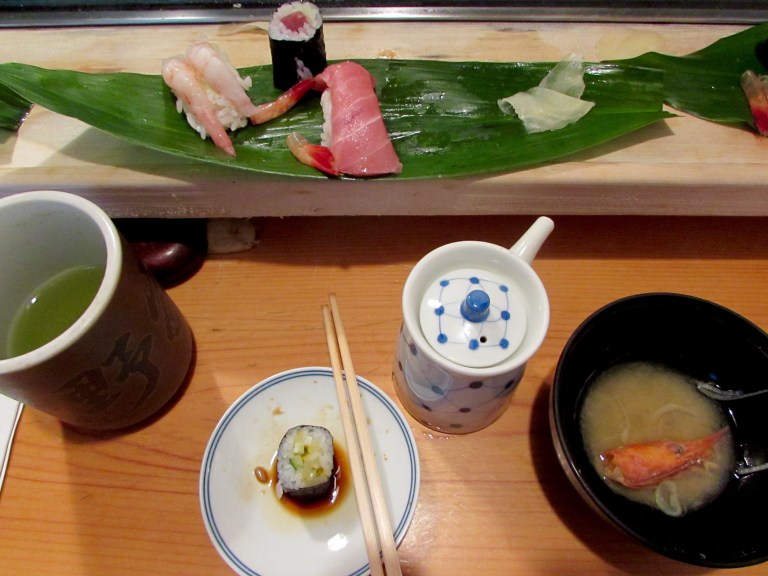
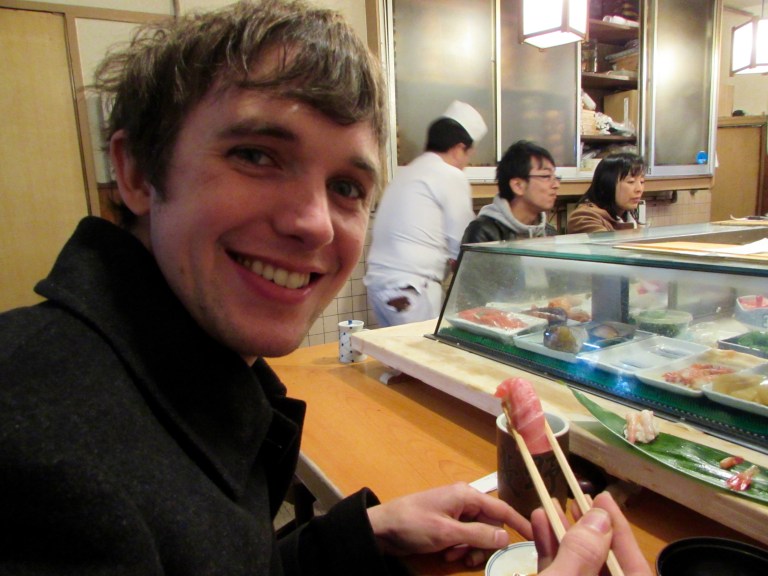
Finally, our names were called and we smugly entered, abandoning the rest of the line-dwellers to their fate in the cold. As we sat down and took in our surroundings, we found out why our wait had been so long. The interior sat fewer than a dozen and the staff consisted of one waitress, who doubled as the cashier, and two sushi chefs.  After settling in, the waitress brought us a mug of oolong tea and laid out a banana leaf before us which we knew would soon be decorated with the colorful variety of sushi we had just ordered. A bowl of shrimp head soup was added later and we filled up a dish of soy sauce in preparation. Now fully ready, we watched the chefs artistically prepare each of our rolls, slicing slivers of fish and adding pinches of wasabi to the balls of rice in their hands.

IMG_8525
Our chef preparing the sushi.
IMG_8523
Pausing from the feast for a picture.

We had heard that the process of becoming a sushi chef was an arduous one, requiring years and years of training and experience before getting certified. While we initially questioned the necessity of this, as we slid the first salmon-capped roll into our mouths, we realized it was a process we were extremely grateful for. Eel, shrimp, squid, and tuna followed along with rolls of sea urchin and fish eggs. We meticulously chewed each bite, wanting to savor each new flavor and texture we were experiencing. As we did this, the sushi, so carefully prepared, practically melted in our mouths.  We’d had sushi many times before, but this felt like we were trying it for the first time–a kind of born again sushi enthusiast.

IMG_8524
Nearing the end of our sushi experience.

After savoring our last piece and knowing that there were people waiting anxiously outside, we paid our bill and left the restaurant to a barrage of jealous stares from the faces in line. After the fish market, we debated where to go next. We had wanted to see a few more places before leaving, but after pulling out our map, we realized how poor our planning had been and just how drastically we had underestimated the size of Tokyo. For some reason we expected temples, museums, gardens, and shopping districts all to be clumped together conveniently in one place. Apparently, the zoning commissioners of the ancient city didn’t have tourism in mind when they laid it out.

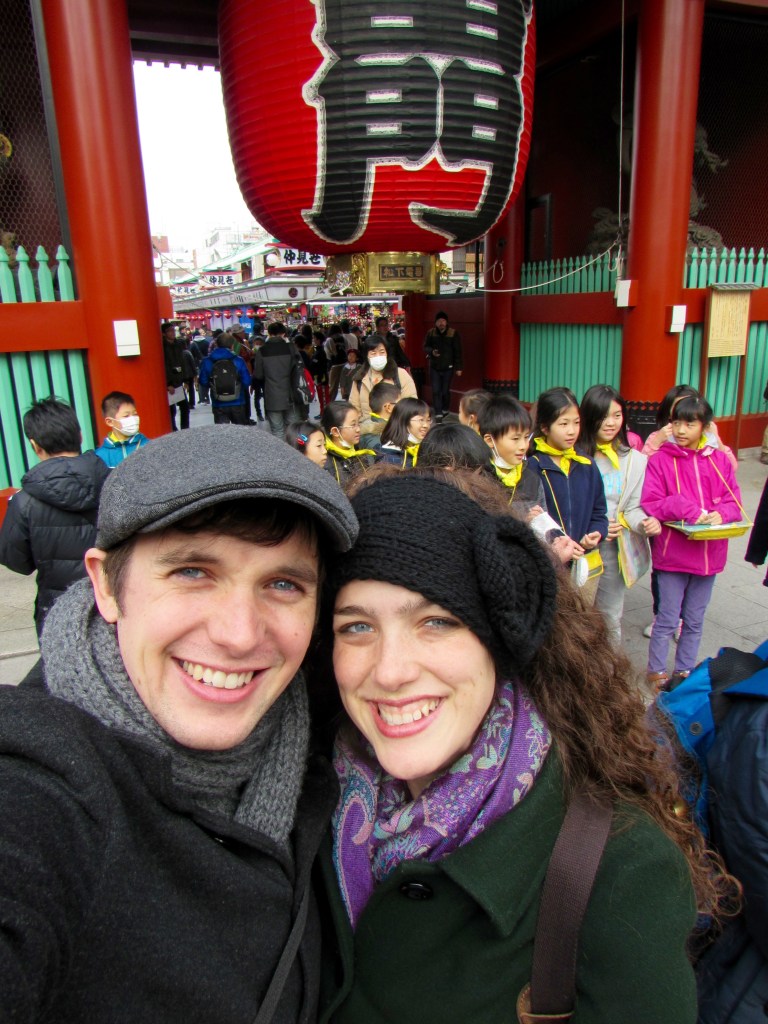
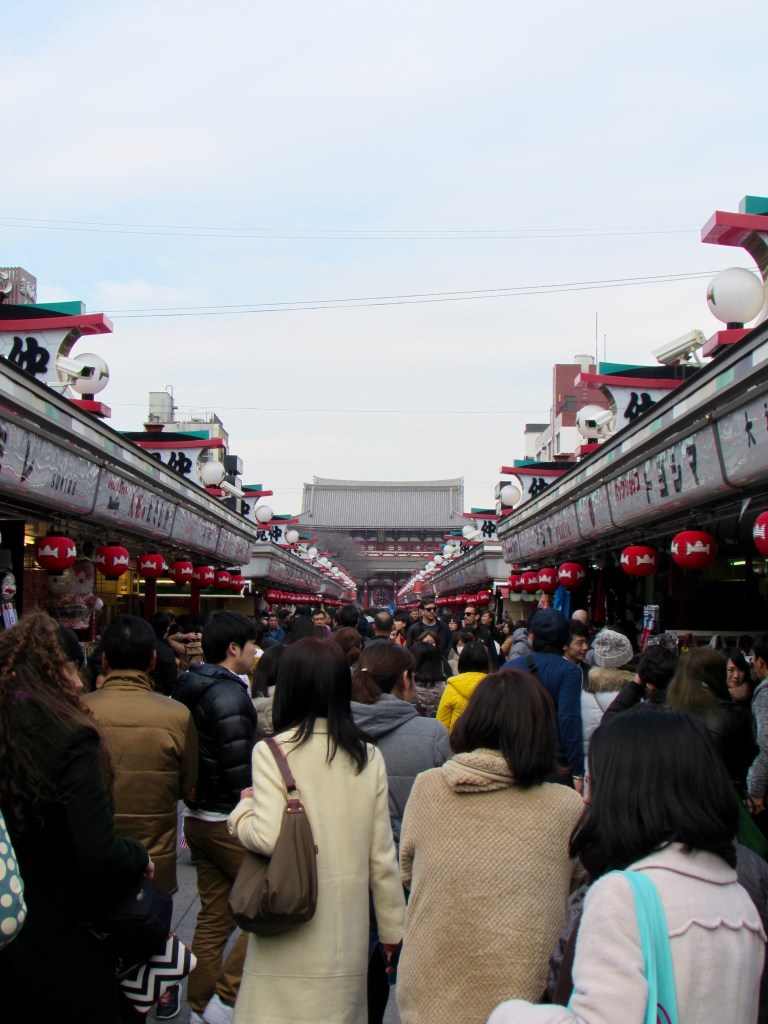
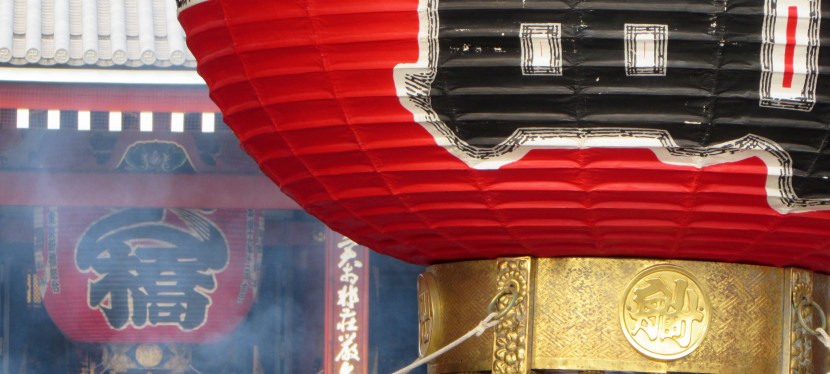
With the sights we wanted to see in different corners of the city, we realized that we would only have time to visit one and decided on the oldest temple in Tokyo: Sensoji. As we got off the subway and walked up to it’s iconic front gate, we wondered if we were going to see a temple at all. Crowds and noise exploded out of the entrance, making for a very un-templelike atmosphere, but exciting nonetheless. Eager to see what the commotion was about, we maneuvered through the people and entered the gate, passing under the giant red lantern that hung from its ceiling. As we did this, the path we were walking on became lined with rows of souvenir shops and food vendors which both eventually led to the temple itself. Looking off into the distance was like looking down a hallway with the mass of heads serving as the floor, the store fronts as the walls and the sky as the ceiling.

IMG_8540
At the front gate of Sensoji.
IMG_8545
Making our way down the hall of vendors.

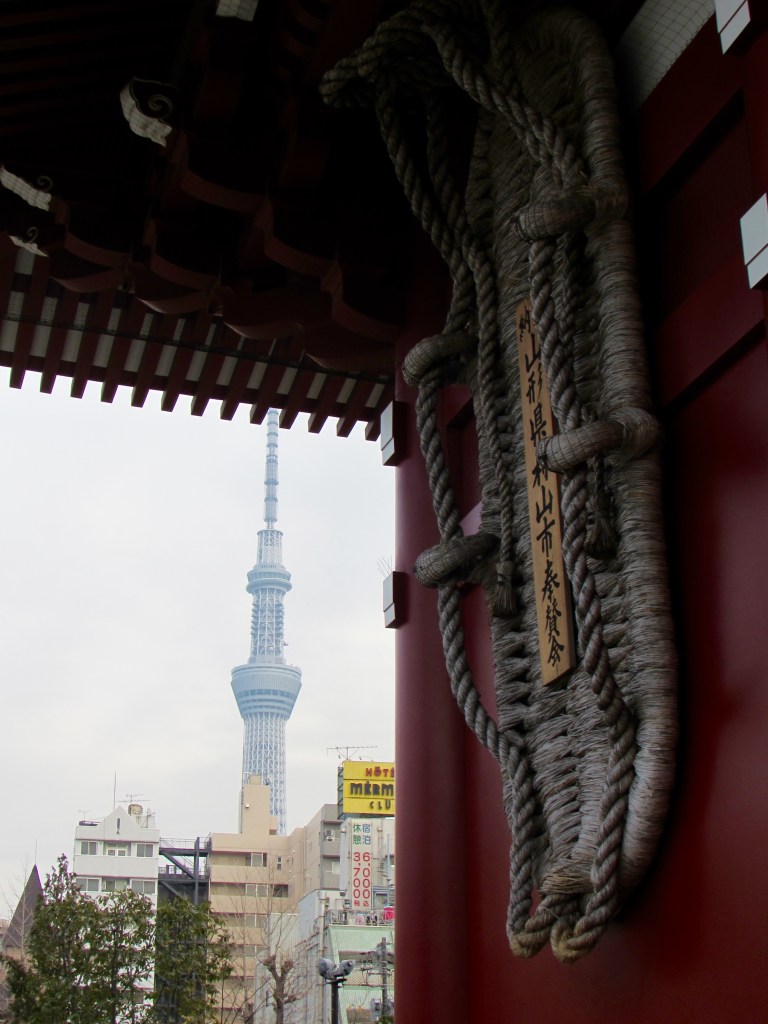
Wanting to reach a less claustrophobic space, we made our way down the path to the second gate, which looked strikingly similar to the first, and passed through it into an open plaza. The smell of incense filled the air and we gazed around, taking in the different features of the temple. A pagoda jutting out from the landscape, the main temple with a mob of people filing in and out, the Tokyo Sky Tree off in the distance, and, one of the more unique features, giant sandals mounted on the wall of the gate.

IMG_8556
Finding some breathing room inside the temple grounds.
IMG_8596
One of the giant sandals with the Sky Tree in the distance.
IMG_8605
The view from the main hall.

It was bittersweet walking around the grounds knowing that this would be our last experience of Japan outside of the interior of train cars and airports. With this in mind, we made sure to enjoy the temple to its fullest, which reduced our pace to a slow contemplative meander. Minutes turned into hours and, as the lights and lamps slowly started to flicker on around the temple, we knew the moment we had dreaded had finally come. Despite only spending a week in the country, we had grown attached to it. We were aware of course that we were experiencing everything through the all-too biased tourist goggles, where everything is new and wonderful, but we’ve been many places before and this one felt different.

Perhaps the feeling could best be summed up in one of our very last experiences in Japan. After getting a train back to Osaka late that night, we discovered that the subway trains and city buses going to the airport were no longer running. So, with no place to stay and both of us being too stubborn to pay for a taxi, we decided to just wander around the city. At about 3 a.m., after getting some coffee at a gas station, we went back to the bus stop to sit and wait for the 3:30 bus. As we sat and sipped our coffees, an old street sweeper came by and began making his rounds. After sweeping for a short while, he saw us sitting there, came over, and proceeded to carry out a conversation with the handful of English he knew.  After a few minutes of exhausting his arsenal, he gave a friendly wave and went on sweeping down the street.  Even at 3 a.m., in an unfamiliar city outside in the cold, we still felt comfortable. For us, more than the sights and tastes, this was Japan.

Jigokudani

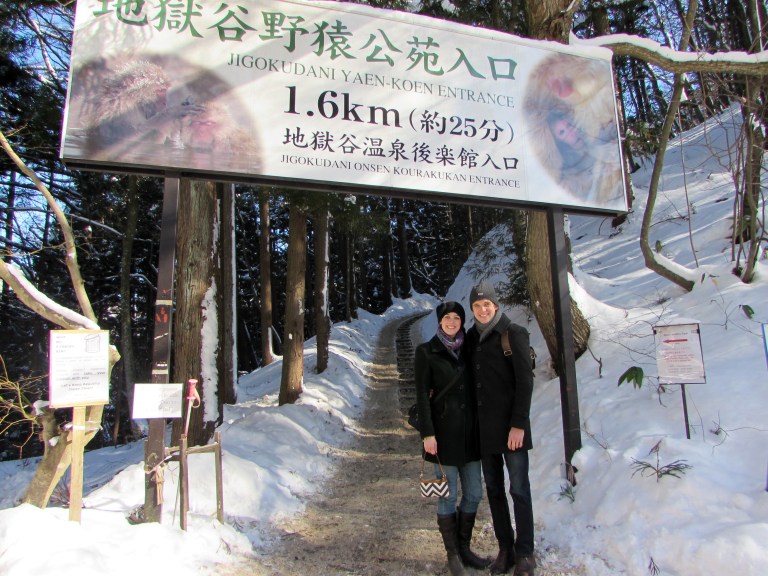
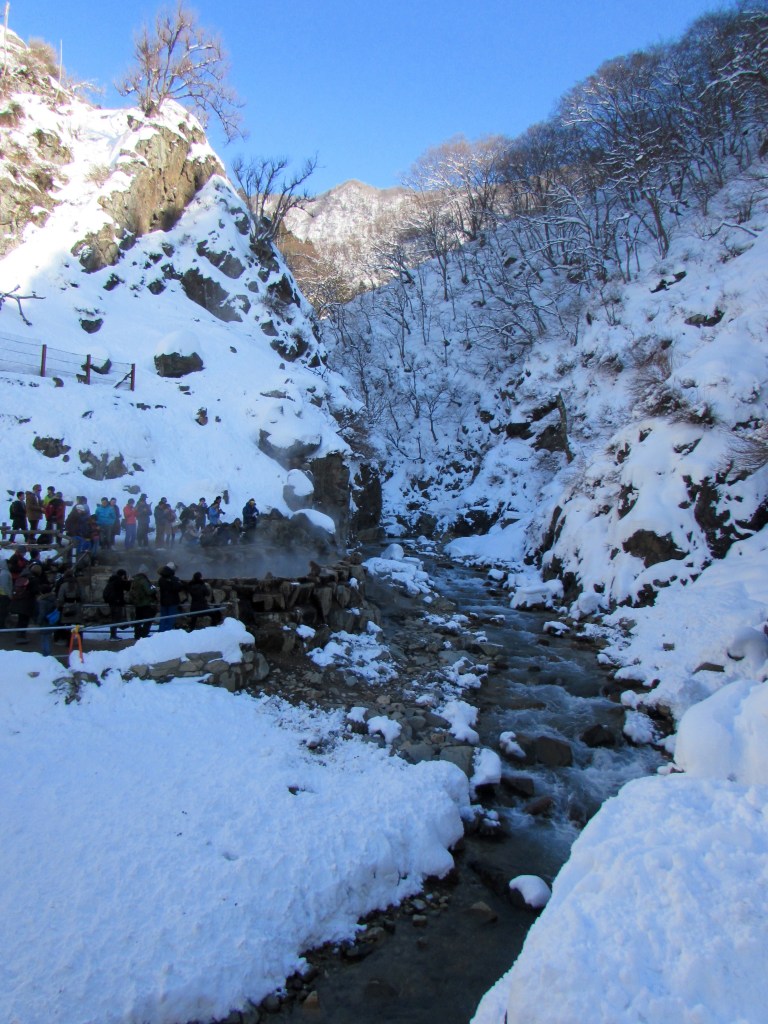
The journey to Jigokudani from Tokyo was long but enjoyable and ended as our bus rolled up a snowy hillside and came to a stop outside a small wooden shelter. The bus driver began shouting some things to the passengers and we listened attentively to the string of Japanese that ended with “snow monkeys” in broken English. At the sound of this we stood up along with everyone else and shuffled out into the cold. After looking clueless for a few moments, we were lazily pointed in the direction of the park and anxiously began making our way further up the hillside, following the signs with little pictures of smiling monkeys on them to guide us. The signs eventually led us to a steep set of stairs towered over by a big banner adorned with pictures of bathing monkeys, our official welcome to the park.

IMG_8296
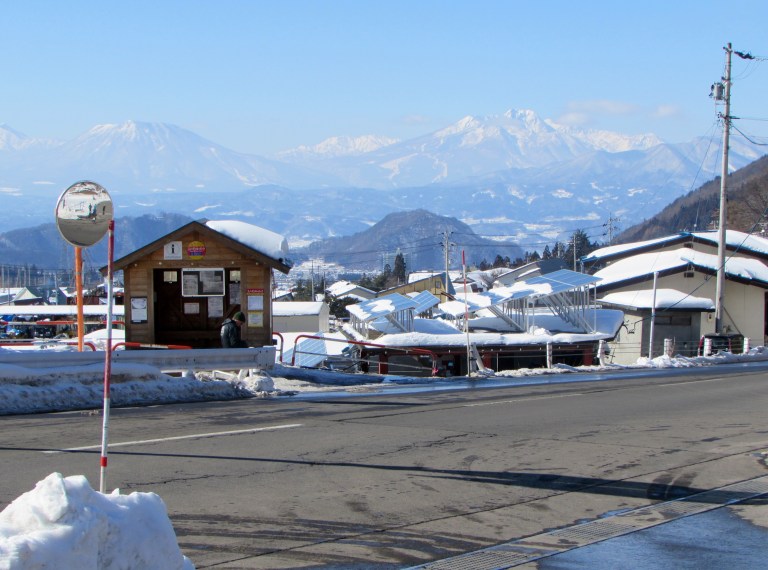
The view from the bus stop.
IMG_8303
At the entrance to the park.

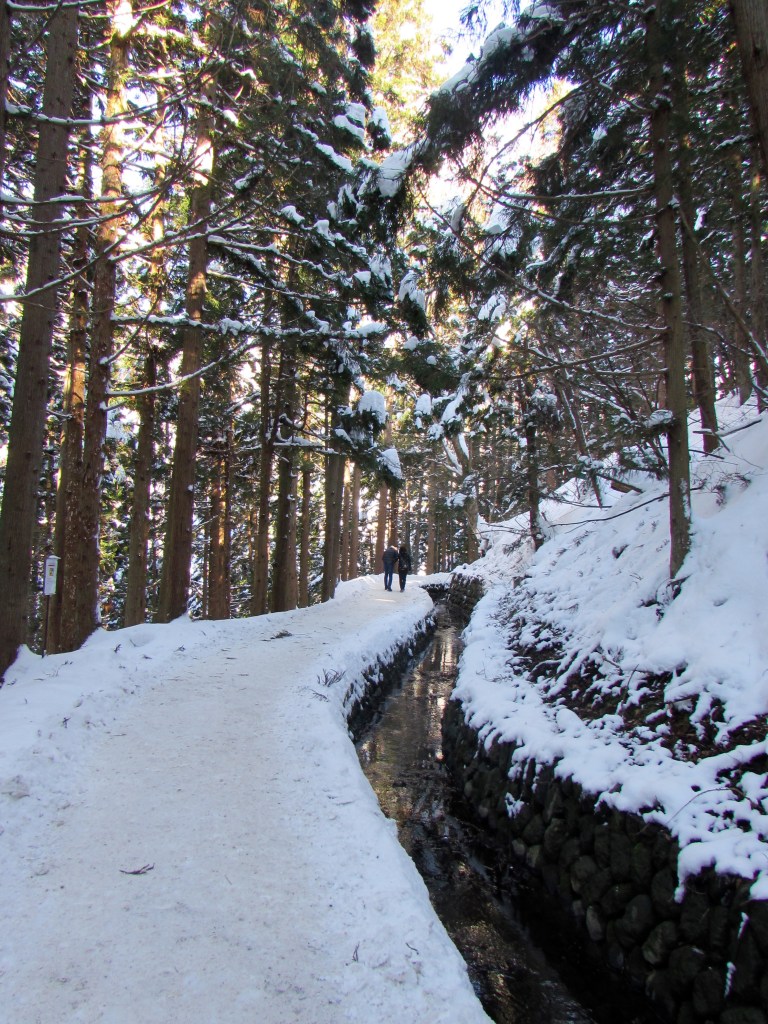
Despite the icy state of the stairs, we opted to forego the crampons being sold at the foot in the hope that our boots would be sufficient enough to carry us up. Luckily, the hill was short and a rope laid alongside the stairs, both of which served to our advantage in getting up it easily without the traction of the crampons…frugality had won out this time. Once at the top of the hill, we were met with a scene out of a Christmas greeting card. The path, now long and flat, wound into a thick forest of cedar trees, whose branches still carried the burden of the latest snowfall, some of which would occasionally fall on our heads, creating the illusion of a blizzard.

IMG_8318
The scenery along our hike.

It was exciting seeing snow again after nearly two years without it. Our enjoyment of it was aided by nostalgia and the fact that it was the kind of snow depicted in the movies, white and pure, a far cry from the gray, sloppy reality of a Midwestern winter. Without fail, snowballs were made and trees (and occasionally each other) were targeted as we slowly made our way along the path. After meandering for about 30 minutes, the forest cleared out into a valley whose edges we would zig-zag up to continue our hike through the park.

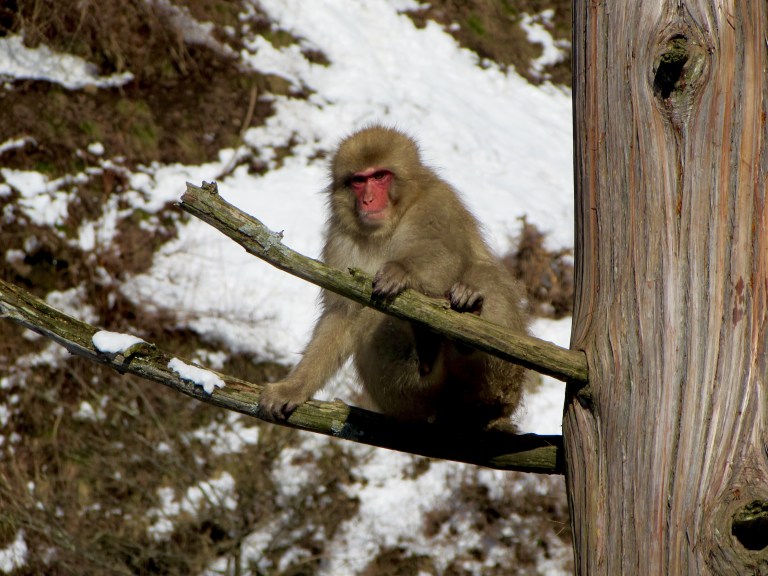
As we walked along, little by little, we would start to notice more people on the path. A person here. A family there. Some were on their way back from the park, parents clutching children who were excitedly recalling what they had both just seen. By that time, the trees and snow had become old news and our pace quickened in anticipation of what we knew was so near. Finally, we came to an area where a small crowd of people were huddled under a tree. As we followed their gazes up it, we got our first sight of the macaque monkeys that gave the park its fame.

IMG_8331
Our first sighting.
IMG_8335
Basking in the sun.

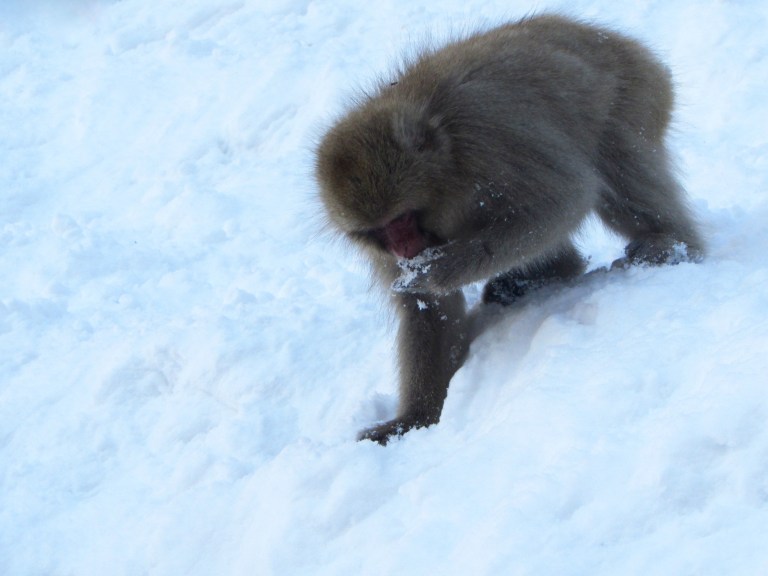
As excited as we were to see it sitting perched in the tree, our attention was quickly diverted because another monkey would brush our leg, or walk by on the railing beside us. Everywhere we looked there were monkeys and as interested as we were in them, they couldn’t have cared less about us. An obstacle in their everyday life. If the rice that they snacked on wasn’t thrown from human hands, who knows if we would have been tolerated at all. For our sake though, we were, and not only that but able to interact with them in a way we had never been able to with wild animals before.

Determined not to overstep our boundaries though, we kept our distance, appreciating the monkeys from afar while on the lookout for the onsen, a Japanese hot spring, where the monkeys famously bathed. We only had to look as far as the crowd of people mushrooming out from a steaming cluster of rocks in the distance to know where to go.

IMG_8338
The onsen on the left among the crowd of people.

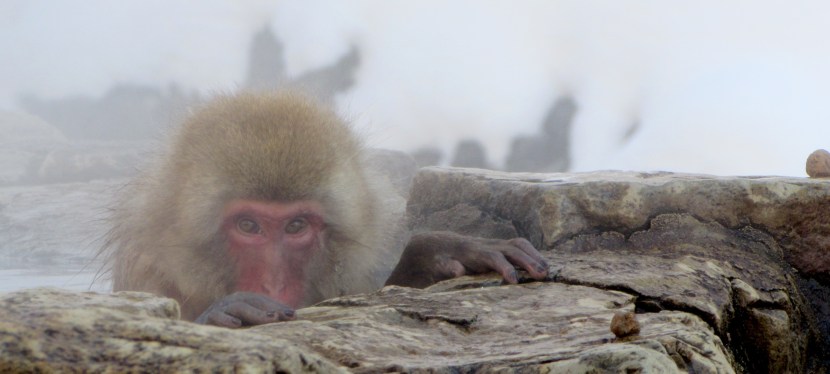
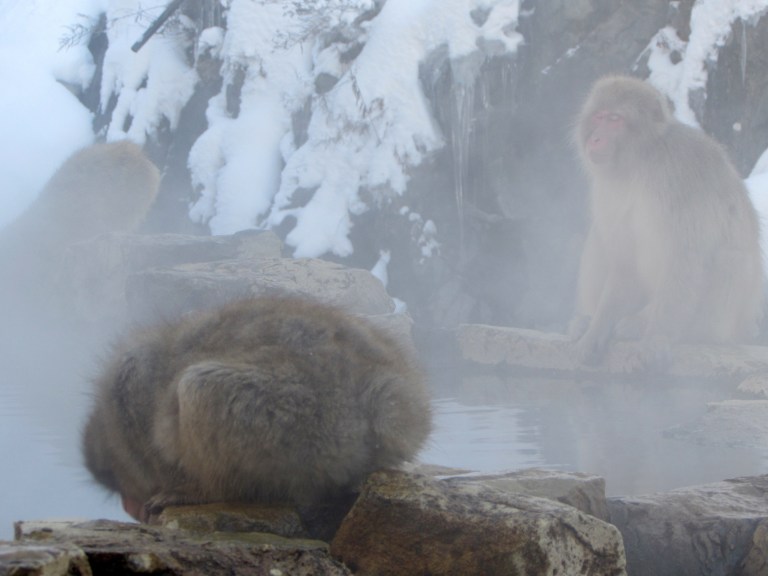
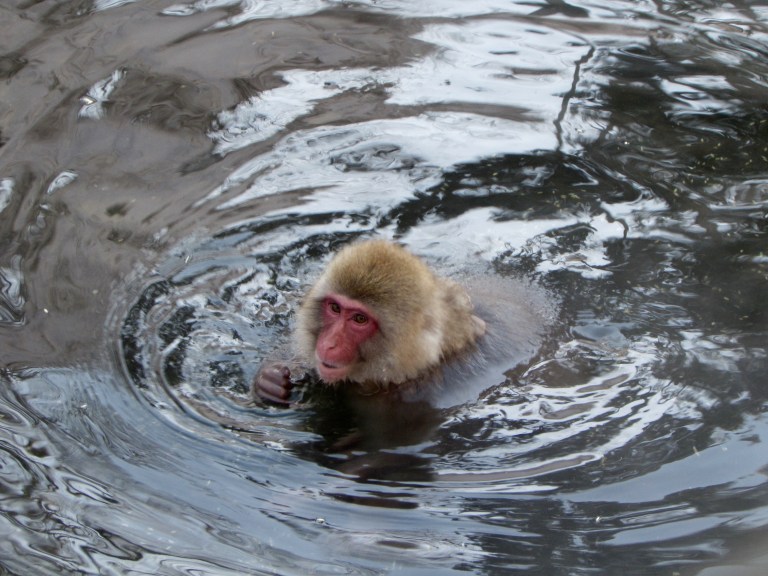
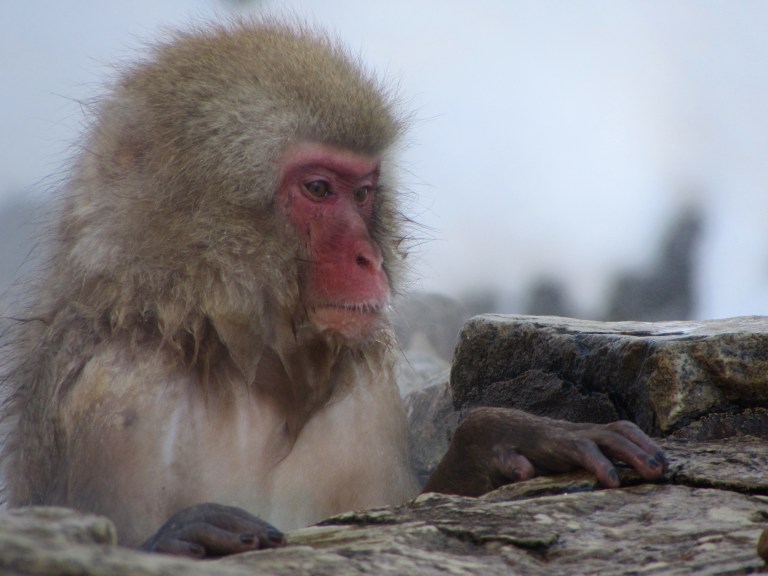
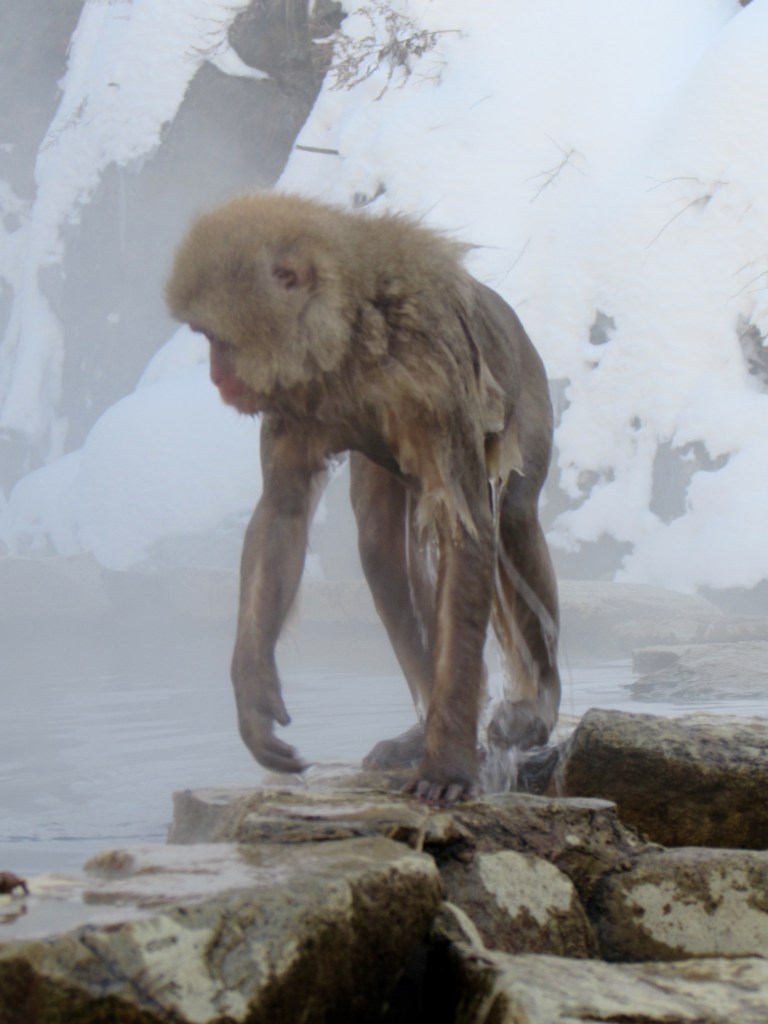
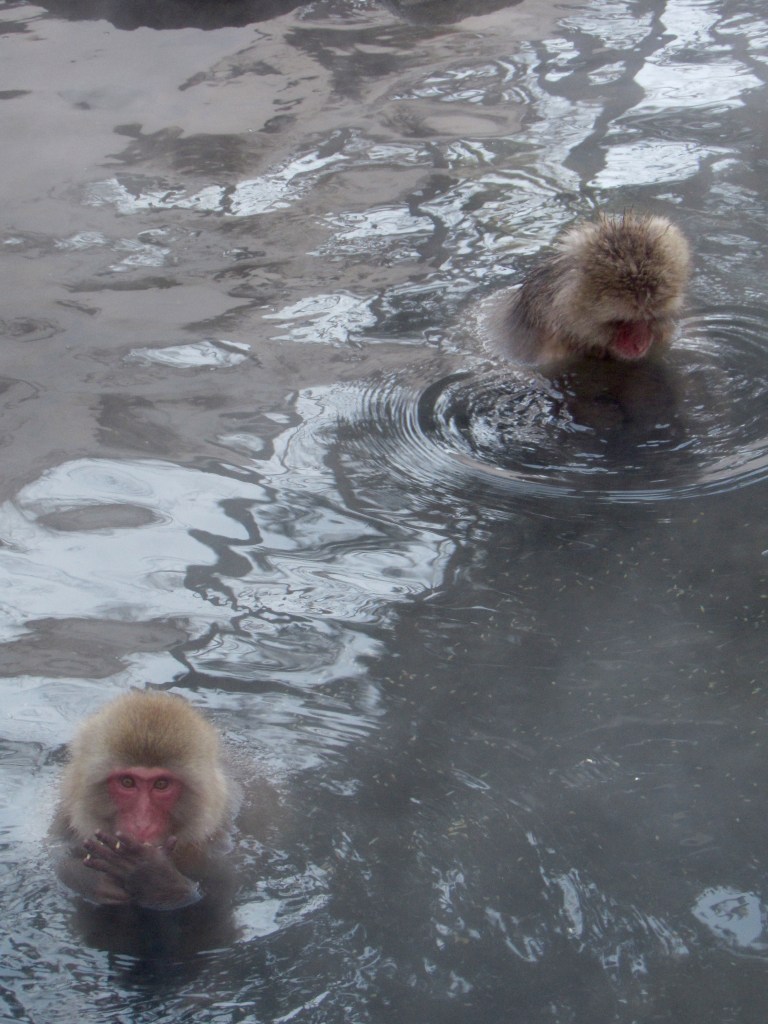
Walking up to the onsen was like walking through the TV screen into a National Geographic special. All around the hot spring, monkeys lounged around in different states of indulgence. Some partook in gluttony, lapping up water and picking bugs, others in sloth, sitting on the rocks surrounding the water and soaking in the steam. Perhaps the smartest and most blissful looking of all though were the ones physically in the pool, most of them with their eyes closed, tuning out the world around them. Having just been to an onsen ourselves the night before, we felt a bit like voyeurs gazing in. This feeling wouldn’t last long however as the smell of monkey feces carried to our nostrils by the hot spring’s steam put an end to any trace of jealousy we were feeling.

IMG_8388
Monkeys enjoying their spa treatment.
IMG_8414
One of the monkeys swimming around the onsen.
IMG_8373
Relaxing in the pool.

Occasionally, a monkey would grow tired of the hot spring and climb out, fur soaked and steaming, and make its way through the crowd, which consisted of a slew of paparazzi, cameras ready and hanging on their every movement. Each time a monkey would do this, or anything that resembled exertion, a chorus of oohs and ahhs would accompany it. Despite this and our constant crowding around them, blocking their paths, and shoving cameras in their faces, the monkeys, for the most part, kept to themselves, scoffing at the attention being showered down on them.

IMG_8378
Leaving the pool.
IMG_8365
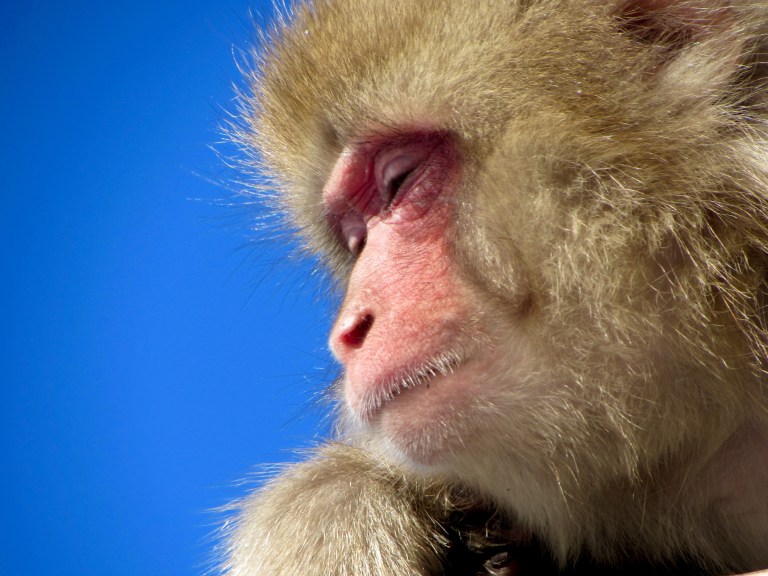
Glamour shot.

This wasn’t always the case though, as Kate found out first hand what happens when the line of tolerance is crossed. Leaning in to take a picture of one particular monkey whose privacy had apparently been invaded too much that day, Kate was swiped at by the monkey who then proceeded to jump on to her and climb up her leg. As this happened, those around her were much more concerned in extending their camera lenses than a helping hand, leaving Kate to fend for herself. Luckily though, the monkey’s efforts to retrieve the camera were abandoned rather quickly as it lost interest and moved on to its next endeavor.

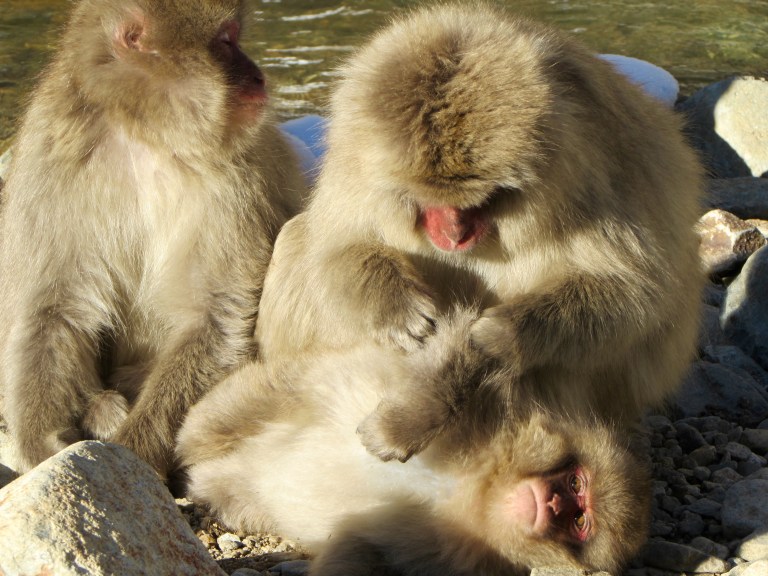
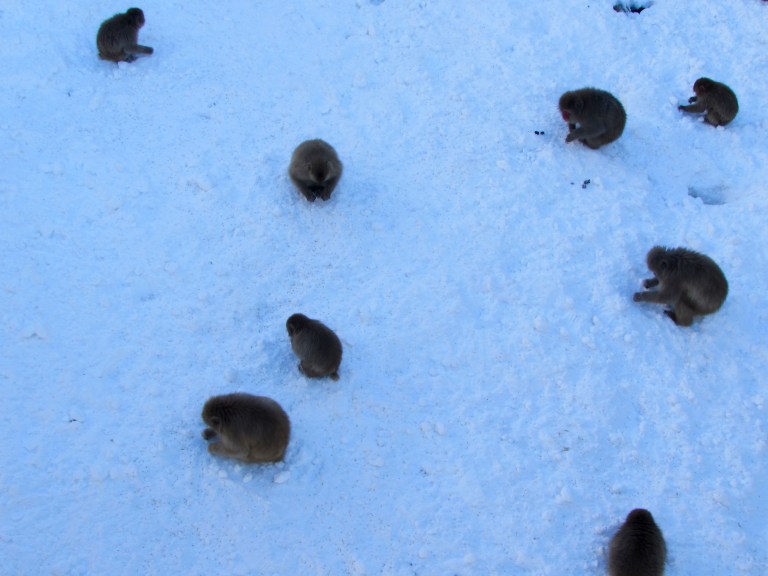
Taking the hint, we moved on from the hot springs, following the river that flowed alongside it to a more open area where the simian-sapien ratio wasn’t as human heavy. Among the abundance of monkeys lounging along the banks, we chose to sit by three who were picking bugs out of each other’s fur. Shortly after we sat down, the monkeys heads shot up and they and nearly all of the other ones around them began hurrying over to the hot springs. Curious to find the cause of commotion, we followed the migration to a group of park rangers throwing a dinner of rice grains into the hot springs and surrounding snow banks. The bugs, we supposed, had been their appetizer.

IMG_8408
Hors d’oeuvres
IMG_8415
Snacking on some rice.
IMG_8411
Foraging…
IMG_8357
…and more foraging.

Oddly enough, as we watched the monkeys forage though the snow and water in search of the rice we were reminded of our own hunger and decided to bid farewell to our newfound friends, making our way back through the forest and down the hillside until finally reaching the bus stop to take us back to Tokyo.

Hakone

It wasn’t a matter of if but how. Long before itineraries were made or hostels booked, we knew that our trip to Japan wouldn’t be complete without a visit to it’s iconic centerpiece: Mt. Fuji. We had read of train rides that ran by the mountain, offering spectacular views, and of a base camp near its foot where climbers journeying to the peak began their trek, but neither of these had the experience of Mt. Fuji that we were looking for. We craved more than a glimpse from a train car and certainly had no intention of doing any climbing in the dead of winter. Instead, we wanted a place to quietly contemplate it from afar and we found this in Hakone, a small town perched on the shores of Lake Ashi.

Upon arriving in Hakone, we couldn’t help but notice the unmistakeable lake-town vibe it had. The small buildings scattered across the landscape, clear blue skies, cool, crisp air blowing in off the lake, and, perhaps best of all after having just been in Tokyo, a slow and quiet lifestyle. Anxious to take part in the latter, we found a bench near the lake to enjoy a picnic and take in the scenery, which, apart from the beautiful view of Lake Ashi, gave us our first glimpse of Mt. Fuji. From that angle though, it was just a sliver of white peeking out from the surrounding hills.

IMG_8134
The view from our picnic bench.

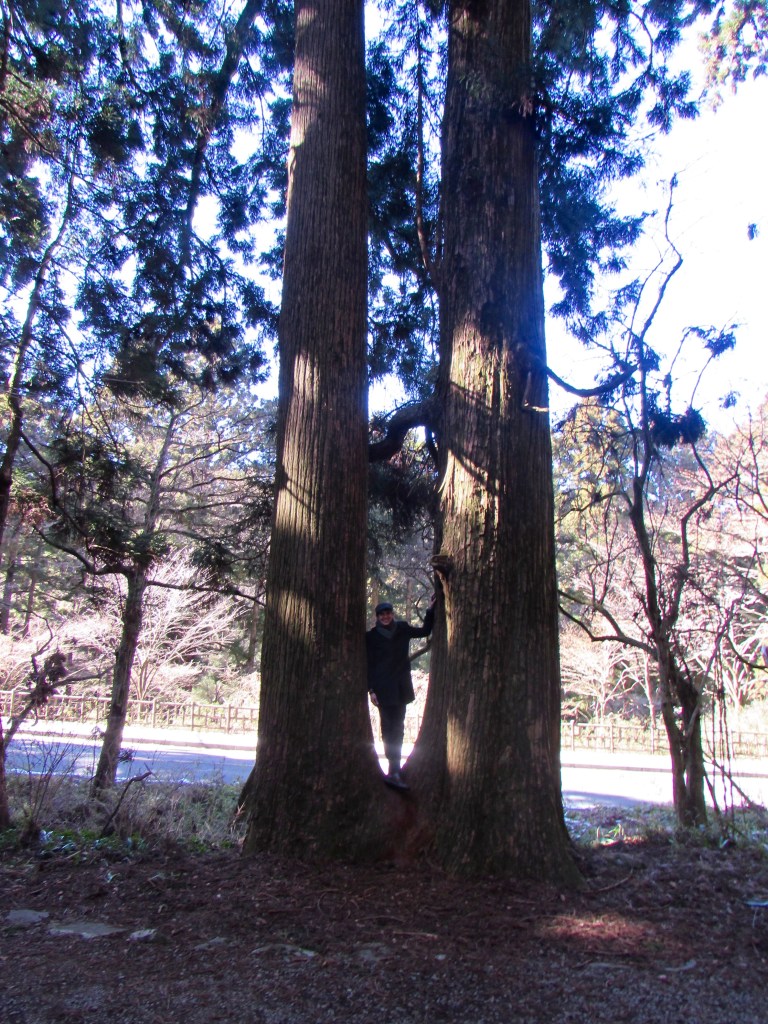
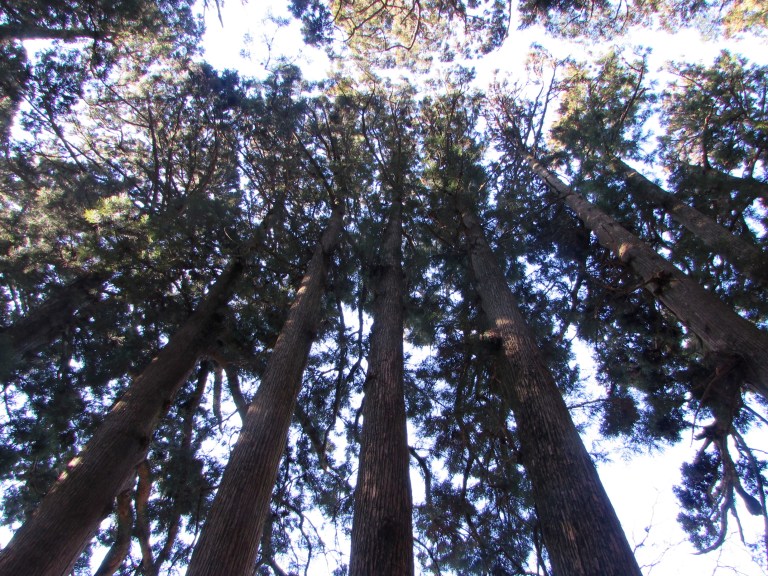
Eager for a full view, we began working our way around the lake. Along our walk, we went through a centuries-old cedar forest, which, despite being alongside one of the busier roads in the town, was incredibly peaceful. As we passed through the forest, massive trunk after massive trunk sat perfectly aligned along the curves of the road. Tall and straight, they looked almost like ancient Roman columns, only rather than holding up giant marble roofs, these appeared to hold up the sky.

IMG_8144
Ryan standing in between two of the cedar trees.
IMG_8149
Natural columns
IMG_8156
Kate hugging one of the trunks to show how big they are.

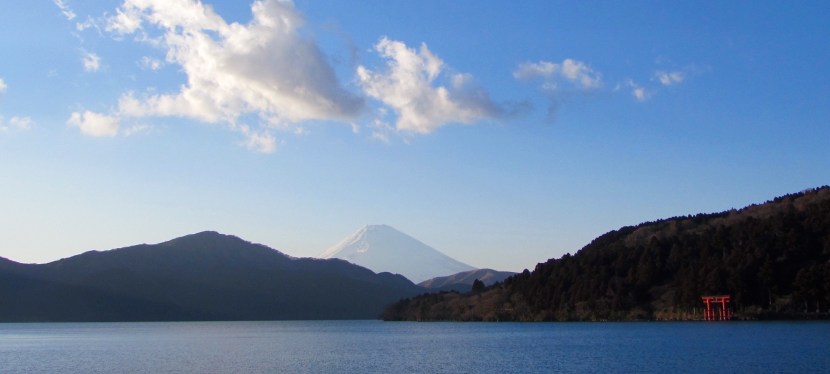
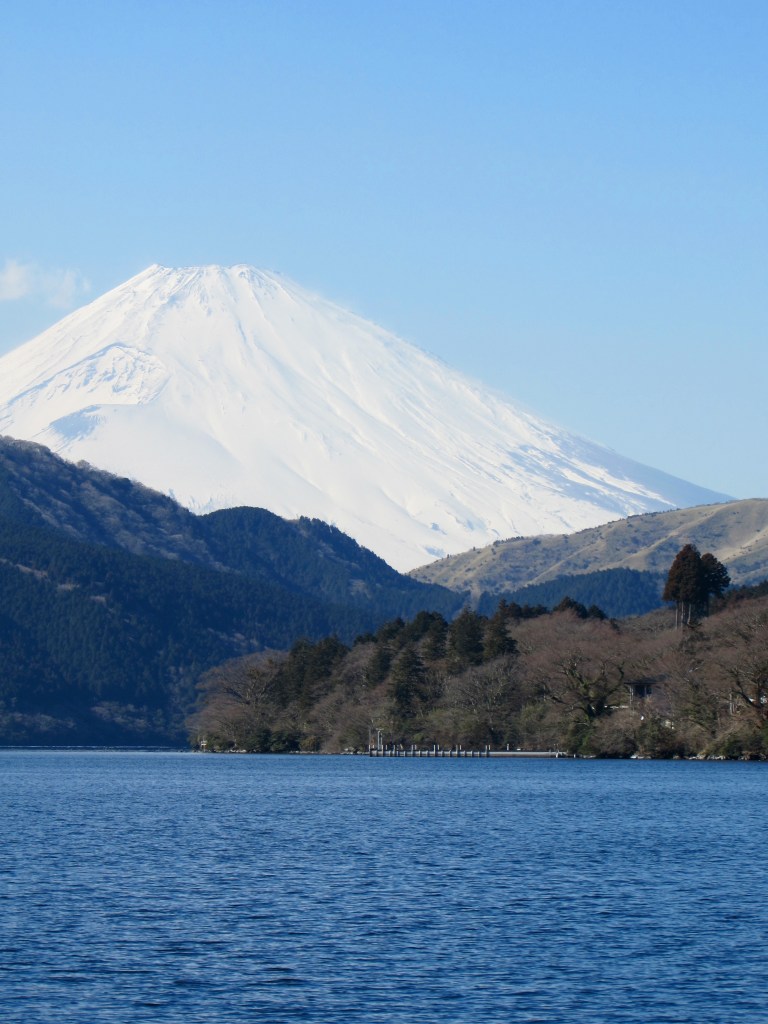
Before coming on the trip we had read about the “shyness” of Mt. Fuji and how it’s often obscured by clouds, but, as we emerged from the forest, the reality of our first full view of the mountain couldn’t have been further from this. The peak, nearly perfectly symmetrical, was as clear and detailed to us being miles away as the hills just a few hundred yards away. It was so clear in fact that we could see the veins of black that coursed through the snow capping the peak. The whiteness of it clashing beautifully with the expanse of blue sky.

IMG_8165
Our first view of Mt. Fuji after coming out of the forest.

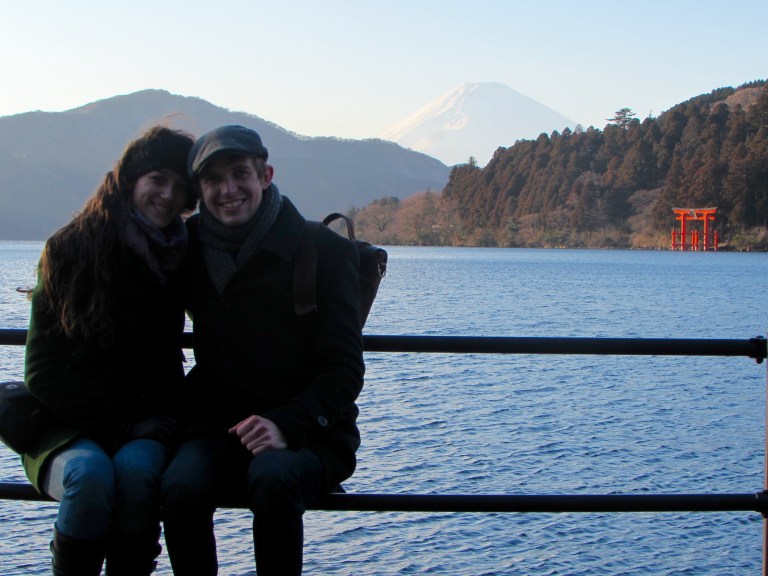
Even though the scenery wasn’t going anywhere, we decided that we would have to sit for a while to take it all in and fully appreciate the beauty of it. So, we chose a spot along the lake, which was perfect because, apart from Mt. Fuji in the distance and the lake itself, there were plenty of other things to look at. Small, humble hills dotted the shores of the lake, worn rowboats bobbed on the water, and a lone orange torii gate sat partially submerged in the lake. It was like looking out at a painting. An entire story preserved in one scene.

IMG_8193
A quintessential Japanese scene we enjoyed from the shore of Lake Ashi.
IMG_8204
Boats floating on the lake

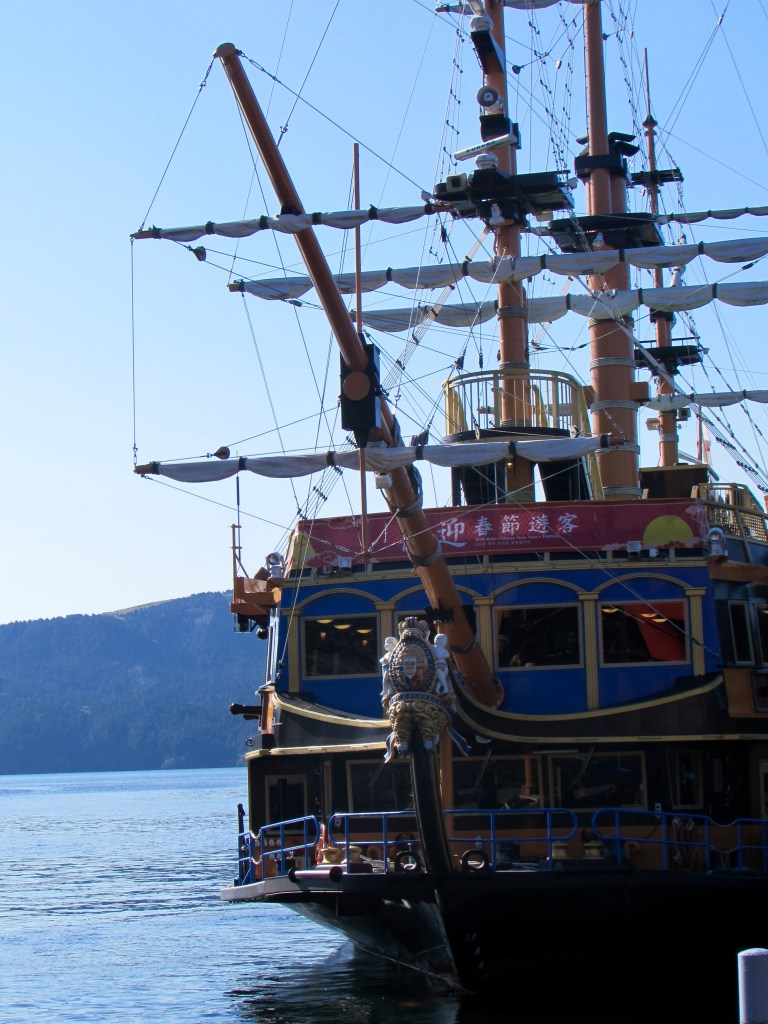
After nearly an hour of looking out at the view, the first deterrence from the stillness of the scene before us came when a large ship sailed across the water towards a small port out of our view. This was our signal to move on as riding on the ship to the other side of the lake was one of the activities we had been looking forward to doing in the town.

IMG_8205
The pirate ship we rode across the lake.


IMG_8209
Kate on the ship

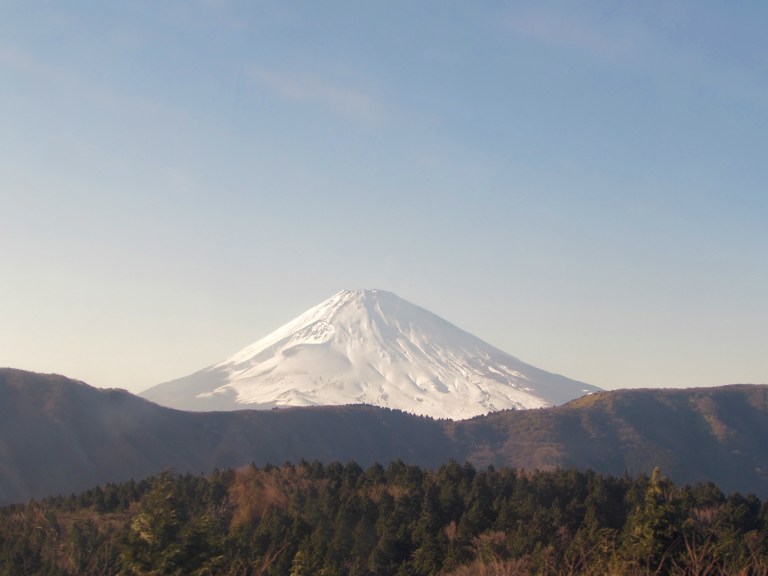
So, we made our way to the port and boarded the ship, which, for some reason, resembled a pirate ship right down to the elaborately dressed captain walking around the docks taking pictures with people. The ride on the boat, while extremely cold and windy, was enjoyable and gave us a different perspective of the lake and Mt. Fuji. After about a 30-minute ride, we got off on the other side of the lake where we discovered that the cable car we had planned to take to the top of one of the hills was partially closed due to volcanic activity. Curious as to how far we were allowed to go and what scenery awaited us there, we took the cable car as far up as they would allow us, which was worth it because along the way we got a uniquely spectacular view of Mt. Fuji.

IMG_8236
The view of Mt. Fuji from our cable car.

With little to do around the cable car station itself and running out of daylight, we decided to start making our way back to the train station, taking the cable car back down the hill and boarding the ship to take us back across the lake. Somehow, with just an hour or so separating us from our last ride, the trip was exponentially colder and windier, making it more a trip of endurance than enjoyment.

IMG_8280
Taking in the view one last time before heading back.

Back on solid ground, we began retracing our steps back to the station. Once back, the setting sun announced it was time to return to Tokyo, but our watches, which only read 6:00, told us otherwise. Determined not to be fooled into an early departure by the premature dusk, we began our search for an onsen, a natural hot spring popular in the hotels and resorts around Hakone.

Because of their popularity, we only had to venture across the river that ran alongside the station to find one. Never having gone to an onsen before, we were clueless as to what to expect, though we anticipated something similar to an outdoor hot tub; however, the experience was so much more than that, being an almost ritualistic experience where there were clear rules and guidelines about what to do and how to act.

The first of these guidelines was that bathing suits weren’t allowed so, naturally, the second one was that we had to go our separate ways. Despite being in different areas for the entirety of our time there, we later found that our onsen experience was pretty similar. As we entered the changing rooms, our first order of business was to remove our clothes. Piece by piece, we removed each article as reluctantly as in a game of strip poker. As we did this, we noticed that we seemed to be the only ones with inhibitions about public nudity as naked children ran around the room followed by equally naked octogenarians.

Being clear outliers in our uneasiness, we quickly dropped it and headed to the indoor pool, the next step in the process that culminated in the outdoor hot springs. Before getting into the steaming water, we had to first stop at a bathing station where we showered our bodies and hair while sitting on a short stool. After our bath, and a quick dip in the indoor pool, we were finally able to head outside into the freezing cold and slide into the onsen’s soothing water. The experience was purely natural, down to the stone interior of the pools, the wooden huts standing over them, and the bamboo forest surrounding it. We laid our heads back, closed our eyes and enjoyed every minute of it.

Unfortunately though, the minutes faded away as quickly as the steam into the frigid nighttime air and, after an hour and half of pure relaxation, we decided it was time to go. As we entered the changing room, we put on our clothes as reluctantly as we had taken them off, headed back to the train station, and boarded our train for Tokyo.

Kyoto

The lines leading up to the opening subway doors were neat and orderly and, after all the departing passengers had left, we patiently filed into the car, making our way to one of the many plush red velvet seats available to us. As we nestled ourselves in to the seats, which also happened to be heated, and lazily gazed around the car, it became very clear that we weren’t in China anymore. Sure the faces looked the same and the buzz of a big city was still ringing in our ears, but there were also sounds of birds and wildlife being played over the subway speaker system. This was Kyoto, it was different, and we liked it.

Our home base for the trip was Khaosan Kyoto Guesthouse, which was tucked away in an alley just off of one of the main shopping streets in the city. We arrived late in the afternoon so, wanting to make the most of the little time we had in a city of 2,000 temples, we made a brief stop to drop off our bags before heading off to the Arashiyama district in the outskirts of the city.

After arriving in the district, we wondered if we had gone to the right place. Temples, bamboo forests and monkeys were the attraction, but as we exited the subway station, our eyes were met instead with a surrounding of tree-blanketed hills roller-coastering their way around the skyline and a clear, gentle river running in between. Unsure of where to go, we decided to follow the scattered clusters of people meandering towards a bridge that crossed to a small town just over the river. As we crossed the bridge, the tranquil atmosphere that accompanied the walk up to it soon disappeared into a bustling one as we entered the enclave of one and two story buildings. The streets buzzed with tourists scrambling to try the wide array of new things awaiting them (which were many) ranging from fried seafood on a stick to rickshaw rides.

We decided to save the commotion for later and settled on a buffet which was a unique experience unto itself. The buffet featured an assortment of bite-size dishes that included everything from steamed pumpkin to fried potatoes to pieces of colorful tofu molded into little flowers, with all of it being served up in small baskets placed around the room. Our plates, large and square with nine separate sections indented into them, were ingeniously designed to accommodate the bountiful selection before us. We were allotted 60 minutes for the buffet but, despite our valiant efforts to fill each of the minutes as fully as we had each of the sections of our plate, our stomachs waved the white flag at just 45 minutes and we decided to leave early. In need of a good walk after this, we headed to Tenryu-ji, one of the main temples in the area.

IMG_7558
The first of several plates.

Before coming to Japan a student had asked Ryan why he was going through all the hassle of going to another country to see temples and mountains when he could see both of those right in China. The answer to that became clear as we entered the temple. It undoubtedly shared many similarities with temples we had seen in China, but there were just enough differences to make it feel like we were touring a temple for the first time. Many of the buildings’ roofs were not tiled, as they are in China, but thatched, the walls were paper, and the gardens designed to an aesthetic uniformity. So much so in fact that as we walked through them we felt as if we were walking through a miniature set where each tree and bush had been placed exactly where they were meant to be by giant hands from above.

IMG_7592
Garden landscape at Tenryu-ji.
IMG_7615
Walking through the bamboo forest.

The grounds of this temple were small however and we soon found ourselves at the exit, which conveniently sat at the entrance of the sight that we had traveled to the area to see: the bamboo forest. In the pictures we had seen of it before the trip, each one appeared to be dipped in green with the only deterrence from the different shades of the hue being the brown dirt path running down the middle. But, as we walked up to the forest, the dim light of the late afternoon gave it a more ominous feel than the bright colors we had seen in the pictures. The only sunlight that made it into the forest shined down in slivers that had managed to slip through the thick canopy of leaves sitting on top of the stalks. This, and the cool air we felt as we entered the forest, gave it an eerie feeling. As we walked down the dirt path further into the endless stretch of bamboo stalks, the strange feeling that accompanied our entrance quickly became one of fascination as we took in row after row of thick bamboo trunks shooting up into the sky. To take everything in, we walked back and forth through the forest several times before leaving for good and crossing the river again to head back to our hostel.

IMG_7633
Looking up at the bamboo stalks.
IMG_7618
Stopping for a picture in the forest.

Our second day started early as we wanted to beat the crowds to our first destination: Kinkaku-ji, or the Golden Pavilion, one of the most visited sights in the city. As we entered the grounds though, we were disappointed to find hordes of tour groups wandering about, rendering our efforts of early arrival moot. Eager for a view of picturesque gardens rather than a sea of like-colored hats, we maneuvered our way through the crowd, finally coming to a stop at the edge of a small pond where we had a beautiful sweeping view of the temple’s scenery. Dominating the view was the appropriately named Golden Pavilion, which warranted the crowds moving around it with its completely gold exterior which was duplicated almost perfectly in the mirror-like reflection in the pond below.

IMG_7662
Our first view of Kinkaku-ji and the Golden Pavilion.
IMG_7685
Enjoying the views.

As our trip to Japan was in early February, the landscapes we saw were not filled with cherry blossom trees or the rich foliage of autumn, but rather the bareness of winter. Though this couldn’t compare with what we imagined the other scenes to be, it still had its own beauty and the colors that did exist were more striking amidst the dull browns and whites of the trees. Of these colors, that of the moss blanketing the surrounding hillsides stuck out the most, taking on an almost lime green shade as the sunlight reflected off of it.

IMG_7711
Another view of the pavilion from inside the gardens.

As we made our way around the grounds we noticed a group of students eyeing us intently and soon after their professor approached us wanting to know if we’d be willing to answer a few of their questions for a school project. This would be the first of many encounters with students looking to complete their school work, with most of them being scripted and very few of them being based in any sort of interest in what we had to say. Regardless, they were sweet and we had fun talking with them.

IMG_7703
One of the school groups that interviewed us.

After Kinkaku-ji, we grabbed a bite to eat around our next stop, Nijo Castle. The food at the restaurant wasn’t anything special, but the experience we had there was. Upon entering, instead of a waitress taking orders, we went to a vending machine, chose a picture of what meal we wanted, slipped a bill into the machine, and took the two tickets that popped out. Tickets in hand, we sat down and gave them to the waitress who brought our food out shortly after. It’s funny how what’s the most mundane of tasks for some people can be so exotic for others.

IMG_7749
The elaborate main gate of Nijo Castle.  We thought it resembled a dragon’s mouth.

With full stomachs, we headed to the castle, which was different from any concept of a castle we had ever known apart from the moat that surrounded it. Rather than tall spires reaching into the sky, the structure stretched outward with curve-tipped eaves. Inside the walls, the many rooms contained minimal furniture or decorations, making it difficult to imagine a luxurious royal lifestyle ever taking place there. The one exception to the humble interior design was the beautiful murals adorning the walls of the different rooms, with each scene being different from the next. Of all those that we saw, the one that stuck out to us the most was of tigers lounging under a shade tree. What made them unique was that the paintings weren’t based on any first-hand knowledge of tigers by the artists, but rather of descriptions they had heard through stories. Because of this, the tigers took on a stocky, muscular look, slightly different from the sleek versions that we are familiar with.

The aesthetics of simplicity didn’t just stop with the visuals though, the air in the castle halls was still and cool, the smell clean, and the sound, aside from the soft murmurs of visitors in the distance, consisted of only the creaking of the wooden floors. This, as we found out, was no accident as the creaking was designed to make sure that any intruder looking to off an imperial would not be able to do so quietly. Because of the bird-like sound of the creaking that accompanied each step, the floorboards were dubbed “nightingale floors.”

IMG_7770
The crowds leading up to Kiyomizu-dera.

After the castle, we made our way to Kiyomizu-dera, a temple whose crowded, bustling atmosphere was a world apart from the peaceful one we had just visited. The temple was perched atop a hill and to get to it we had to walk up a crowded street full of vendors. The atmosphere, which would have triggered a fit of hair pulling in Shanghai, was comparatively charming being on vacation and we strolled up the hill to reach the temple’s main pagoda. The first thing that caught our eye as we approached it was the white and orange adorning the exterior of the different buildings which seemed to glow in the light of the setting sun.

IMG_7819
The bright orange of the temple’s buildings.
IMG_7777
Standing at the entrance of the temple.

As we explored the different corners of the grounds, we came across what we thought to be one of the more unique parts of the temple: the “Love Walk.” As legend has it, if you can walk from one of the small rocks marking the start of the path to the other at the end with your eyes closed, you have found your true love. The area, naturally, was populated by packs of giddy teens who we pushed through to partake in the testament of love. Ryan, who went first, quickly and confidently made it from one stone to the other. Kate however, veered off course rather quickly and ended far away from either stone.

IMG_7851
Kate sending a clear cosmic message.

With our future together now in question, we decided to move on. The rest of our time in the temple was spent wandering around the grounds, taking in views of the city slowly darkening below and the landscape obscured by twilight. As street lamps slowly flickered on around us, we decided to move on and begin our hunt for dinner.

IMG_7814
View of the city.
IMG_7829
A pagoda holding on to the last traces of sunlight.
IMG_7848
Sunset at the temple.

Our search took us to a restaurant where they made a dish called issen-yosyoku, which could best be described as Japanese tacos, and the only dish they served. We took this, along with the fact that the restaurant was packed, to mean that the mad concoction of ingredients we watched the cooks stuff into the tacos was worth trying. After nibbling at first, unsure of the questionable combination of ingredients, we were happy to find that our assumptions of deliciousness were correct and we devoured the tacos.

IMG_7892
Chefs making the issen-yosyoku.
IMG_0149
Ryan eating his Japanese taco–the first time ever with chopsticks!
IMG_0151
Ingredient list.

Our last day in Kyoto started as the previous one had, with some yogurt, muesli and a cup of coffee in our hostel’s common room, though the feeling was much different as we knew that we would soon be leaving one of the most comfortable and beautiful cities we had ever visited. Anxious to make the most of the time left to us before our train left for Tokyo, we headed to the Shinto shrine of Fushimi-Inari, one of the sites we had been looking forward to seeing the most.

After going basically from temple to temple over the course of the past two days, we were worried that the all-too-familiar temple fatigue (the point when the sights and sounds of different temples start to bleed together into one, losing their allure) would set in and diminish our appreciation of the place. This worry was quickly replaced by one of excitement though as we walked up an alleyway to the temple through a haze of odorous smoke emanating from the various fried food vendors lining it. After somehow managing to elude the temptation to try one of the many delicious-looking treats, we emerged from the alley and were met with the first of what would be thousands of orange torii gates, the unignorable symbol of the temple that lined the surrounding hillsides in an endless fashion.

IMG_7924
Crowds entering the torii gates.

As we began to explore the grounds more it was hard for us to imagine the temple as a place of worship for some as any sign of tranquility was lost amidst the mob of tourists weaving in and out of each other. For us it was exciting but a meditating monk might think otherwise. One thing we noticed in our exploration was the various statues of foxes scattered around the grounds and sitting in front of the different shrines and buildings the way lions do in China. We later learned that the foxes represent messengers to Inari, the god of grain and business. This helped give some context to the torii gates too, as each one was individually donated to the shrine as an offering to Inari for good fortune in their financial endeavors.

IMG_7914
One of the many foxes in the temple, this one holding a key to the granary in its mouth.

Before entering the maze of torii gates that began where the temple grounds transitioned into forest, we stopped off at a mouth-rinsing station where we used a large bamboo ladle to rinse out the inside of our mouths as was custom for visitors to the temple. Because sincerity is a fundamental aspect of Shintoism, the mouth-rinsing represented a purification of the heart.

IMG_7906
Kate purifying her heart…finally.

With clean mouths (and hearts!), we entered the stretch of gates which made for a kind of hallway that would serve as our guide up and eventually back down the hillside. The gates were packed together pretty tightly so as we walked through them, it created an illusion of walking down an orange painted tunnel that extended as far as the curves of the hillside would allow. At some points, where the stretch ahead of us was flat, the gates created a miniature hallway effect, where the people walking by us would gradually shrink as they walked on, eventually disappearing into the tiny square of light waiting at the end.

IMG_7958
Walking through the torii gates.
IMG_7937
A rare crowdless view.

We walked on and on, waiting for a break in the gates, but it rarely came and when it did, it was brief. Some of the gaps included small shrines with the familiar fox statues adorning them, an area with tiny huts that families could reserve and go to to make offerings, and, of most use to us, large maps that always reminded us that we had not walked nearly as far as we thought we had.

IMG_8049
One of the family shrines.
IMG_8042
On our descent.

After walking for an hour and a half, we realized that at least another hour of climbing awaited us before reaching the hill’s summit. So, with our departure to Tokyo looming ever closer and one more temple to visit on our list, we reluctantly decided to turn around and begin our descent. After winding back down the mountain and emerging from the gates to the main temple grounds again, we succumbed to the array of fried foods that had tempted us on the way in. As we examined the food more closely, we realized that our choices were basically a variation of either meat on a stick or seafood on a stick. We tried both, which were equally delicious, along with some of the dessert options and then made our way to our last stop in Kyoto: Nanzen-ji.

IMG_8061
Kate eating her seafood corndog.
IMG_8065
Ryan eating a custard-filled fish pastry.

The temple, quiet and secluded, offered us a nice retreat from the crowds of Fushimi-Inari and a peaceful end to our tour of the city. Walking up to the temple, we were met with a massive 500-year-old gate that was unrestored, a rarity in Asia we’ve found, as most temples we come across are restorations due to their wooden nature. Another feature of the temple that we had been looking forward to seeing was the aqueduct running alongside it, which looked very European and seemed out of place in the Japanese landscape. The temple, nearly void of tourists, was fairly free range and we were able to climb up on top of the aqueduct and walk along it through the forest ahead. Looking to avoid a mad dash to the train station that seems to be a trademark of all of our trips, we didn’t walk too far or for that matter spend too much time at the temple. After leaving, we grabbed our bags from the hostel and boarded our train for the nation’s capital.

IMG_8072
Kate outside the main gate at Nanzen-ji.
IMG_8082
The aqueduct.

Our time in Kyoto was far too short but, despite barely grazing the surface of the abundance of sights and culture packed into the metropolis, undoubtedly one of the more enjoyable experiences we’ve had in our travels.

Yuanyang

Our journey to see the rice terraces of Yuanyang, which took an exhausting 17 hours to get to, officially began as our minivan rolled into the village of Duoyishu, which sits in the south of the Yunnan province near the border of Vietnam. Being nighttime when we arrived and in the middle of rural China, we opted to have an ayi (which literally means “auntie”) from Jacky’s Guesthouse meet us as we got out of the minivan. We were thankful to have her as our guide as we were led through a labyrinth of dimly-lit streets, dodging piles of water buffalo dung along the way, before arriving at the guesthouse, a destination we most likely would not have reached on our own and most definitely would not have reached with clean shoes without the help of the ayi. Upon entering the hostel we were met with a candle-lit common room and were told that the village had no electricity that night. The warm glow of the candles created an enchanting atmosphere and gave us a feeling of escape from modernity that we had wanted from this trip.

The dinner was a sampling of Yunnan cuisine, something we were excited for as our favorite restaurants in Shanghai feature food from the region. We were not disappointed as the ayis brought us dish after dish of heaping platters of delicious food that included vegetables, chicken and, of course, rice. We were convinced that one of the dishes served to us, which had a rubbery texture and meaty taste, was either a foreign meat we had never tried before like water buffalo or an organ. Out of curiosity (but mostly politeness) we picked away at the mysterious brown strips, though most of it was left uneaten as we returned the plate to the kitchen. After dinner, exhausted from our day, we retired to bed, anticipating the scenery that we would be seeing the next day.

For those who aren’t aware, China has a single time zone across the whole country, which would be like San Francisco and New York sharing the same time. This, however strange, worked to our advantage as what would normally have been a 5:00 in the morning, drag-ourselves-out-of-bed experience to see the sunrise, ended up being a pleasant 7:00 alarm. A point even more important as our first morning was obscured by fog and rain, rendering the terrace-filled horizon in front of us nearly invisible. After realizing that neither were going away any time soon, we ate our breakfast of instant taro oatmeal packets and headed out to explore the village, whose feeling of timelessness was furthered by the presence of the fog.

IMG_7110
Duoyishu, the village we stayed in
IMG_7144
Village streets on a foggy morning

The pathways of the village, narrow and barely removed from being dirt roads, wound through the mushroom-topped buildings in no discernible pattern and were bordered by narrow and gushing canals of water making their way to the terraces. As for the village inhabitants, they seemed to consist mostly of farm animals. For every adult you would see, chickens, roosters, ducks, pigs, dogs and an occasional water buffalo would amble after, roaming freely through the streets. Amidst the animals were groups of children, most of them playing in the first floors of their homes which also served as the family barn. The game of choice for them was some form of marbles that used stones, which served doubly as ammunition to repel foreigners whose curiosity drew them in too close. One girl, wary of throwing rocks, resorted to spitting on us. Both sent a clear message to move on, which we did, shifting our focus to the terraces as they had become visible again.

IMG_7185
Taking the water buffalo for a walk
IMG_7177
Children playing in their house

All throughout our first day, like clockwork the fog would slowly creep up the mountainside, absorbing the village and the scenery around it before receding soon after, making the valley seem alive as the rhythmic rise and fall of the fog gave the illusion of the valley breathing. As it began to inhale once more, we made our way back to the hostel and were glad to find Jacky there as we had some pending questions, among them what to do if we were fortunate enough to have clear weather the next day. We discussed these as well as his long list of travel experiences (which included a 3-year UNESCO photography project that took him from Barcelona to Bangkok and everywhere in between) over some flaky rose-filled pastries and coffee around the resident wood-burning stove.

We also asked him about the mystery meat from the night before. We were surprised to find that it wasn’t meat at all, but a root (most similar to cassava) that Jacky and the ayis had painstakingly sought it out on the mountain several days prior to us arriving and dug it out of the ground with their own hands over the course of several hours. A feat they were extremely proud of as it was heavily documented in photographs. The more the story carried on, the lower we sunk in our seats out of shame for leaving it uneaten. For the rest of our meals, we practically licked every last grain of rice from the plate.

As our rose cake and coffee supply dwindled along with our conversation, due to more guests arriving, we were told of a secluded outlook to watch the sunrise, which we decided to map out on foot that evening before the little daylight we had left ran out. The route took us out of our village and to the outskirts of another, where, at the edge of a cliff, we were given a sweeping view of the valley, which was flooded with terraces out with mountains climbing out of them in the distance. If the weather was cooperative the next day, we knew the sunrise would be a memorable one.

IMG_7204
A farmer making his way back home as the sun sets

Back at the guesthouse, we were welcomed with sweet potatoes roasted in the wood-burning oven that we had sat around earlier. About halfway into our first potato, a Taiwanese couple joined us and, through our broken Chinese and their unfailing patience, we somehow managed to carry out a conversation that lasted all the way through dinner. Afterwards, to the amusement of the ayis, we played a couple card games to soak in the heat of the stove a bit longer before retiring to our ice box of a room, anxiously awaiting the next day.

IMG_7219
Remnants of sweet potatoes on the wood-burning stove
IMG_7220
Eating dinner with the Taiwanese couple, our patient new friends

We set out in the dark with only a small flashlight to guide us down rain-slicked paths to the outlook for the sunrise. Periodically, out of the darkness, beams of light in the distance would slowly materialize into schoolchildren as they passed us on their way to school. Each was holding a metal pail filled with noodles, rural China’s version of breakfast on the go. Along the walk, to our dismay, the fog swallowed the valley whole which made us dubious about our prospects of seeing the sunrise. Nonetheless, we continued and, once off the beaten path, we trudged through patches of mud on a narrow trail before making it to the cliff we had mapped out the evening before. As we looked out, trees not even 10 yards in front of us, let alone the valley of terraces below, were barely visible due to the clinging darkness and shrouding fog that had, for us, become synonymous with the early mornings of the village.

Just as we were beginning to lose hope of seeing the sunrise, the fog began to recede, revealing the faint outlines of the terraces below. Shortly after, although the sun stayed behind the clouds, the valley slowly began to illuminate. As the light made first contact with each pool of water, the valley became an artist’s palette of dark blue and silver pastels with one transitioning to the next until the entire valley seemed to glow. At that point, the only detail separating the sky from the terraces were the black veins of clay running along each pool of water.

IMG_7256
The terraces at dawn
IMG_7245
Taking in the views

Our appreciation of the beauty playing out before us was interrupted by an intoxicated villager, reeking of cheap alcohol, who stumbled up to us and tried to charge us for watching the sunrise. A crumpled piece of paper pulled from his pocket with Chinese characters scribbled on it was clear justification for this. When we wouldn’t pay he began shouting at us until we begrudgingly left the spot and moved down another hundred yards or so where we were pleased to find the scenery was unchanged. The solitude of our newfound location dwindled however, so we decided to return to the guesthouse for breakfast before embarking on the long day ahead of us. Once back, we were faced with two choices, taro oatmeal in a glass cup or homemade noodle soup. Although we debated briefly, our choice was obvious and we ordered two bowls of tomato and egg soup, which were complimented surprisingly well by a cup of coffee.

Our day’s agenda consisted of trekking through the countryside along the edges of the terraced valley following a hand-drawn map Jacky had given us the night before. Our route started at a local market, which was an experience unto itself as all of the inhabitants of the surrounding villages descended onto one street to sell their goods, which included everything from fruits and vegetables to live ducks to freshly slaughtered pigs whose heads still sat perched on the tables where the rest of their body was being sold (it may be a while until we eat bacon again!). Perhaps the most interesting part of the market though were the people, dressed in their traditional clothes and carrying on with their traditional lives, with only minor traces of the modern world woven into them. It was not uncommon to see a woman walk by with a basket on her back filled with live chickens and large vegetables. Nor was it uncommon to see groups of men (who, it should be noted, do not like to have their picture taken) huddled around each other smoking tobacco out of aluminum bongs. For us, everything was so foreign, but for them it was simply life.

IMG_7305
Local women lining up at the butcher’s counter
IMG_7307
This little piggy went to market…
IMG_7312
Pigs on a leash
IMG_7513
Local man smoking tobacco

As the region was still fairly new to the tourist scene and well-marked roads quickly disappeared into overgrown dirt paths, we stuck closely to Jacky’s hand-drawn maps to guide us along the way. We soon found out that, however charming and personal the map was, it didn’t quite live up to our expectations of reliability, which was crucial given that we were in an area more accustomed to taking the water buffalo for a walk than interacting with tourists. After about an hour of walking and not seeing anything that resembled the checkpoints on the map, we realized that, in our excitement to begin the trek, we had confidently marched off in the complete opposite direction from where we should have gone. So, we backtracked our steps all the way to the market where, to our relief, we saw the first checkpoint, a large red sign literally pointing us in the right direction. We swallowed our pride and, after winding down a road for nearly half an hour, made it to our next checkpoint: a cliff overlooking an unobstructed view of some terraces.

IMG_7369
Midday rest after finally finding the correct path

We perched ourselves on one of the cliff rocks and looked down into the valley, following the seemingly endless levels of terraces climb up the side of the mountain where they eventually disappeared into the sunlight. Each pool of water took a different form from the next, fitting together like a puzzle to fill the landscape. The water that filled them also followed no particular pattern as the color they reflected was determined by how the light touched them. Some glistened in the direct rays of the sun, while others took on the appearance of a mirror, an opaque silver reflecting the sky above. As we drew our gaze inward to the more minute details, an occasional stable would dot the valley and we could even see a farmer and his water buffalo toiling away in the water, unaware that we were watching his everyday life in amazement. With an abundance of other details waiting to be discovered, we decided that there was as good of place as any to have our lunch, which humbly consisted of some oranges bought at the market and a pack of crackers.

IMG_7362
View of the terraces from the cliff
IMG_7413
A stable among the terraces
IMG_7374
One last picture before continuing

After finishing, we put the terraced valley behind us and began wandering from small village to smaller village. Most of our energy along the way was used to decipher Jacky’s map, which was equal parts adventurous and frustrating as some of the checkpoints included things like “two trees” and “a large rock.” Luckily for us, a friendly local would point us in the right direction every few hundred yards or so and we soon arrived at the next major spot on our trek: the Bada terraces.

Although the terraces looked no different from the two we had seen before, it was still easy to lose ourselves in their intricate patterns. By now, the sun was beginning to set and the pools that it’s light hit stood out even more drastically than the rest, emitting a bright white glow. The waning sunlight nudged us along as we began making our way through the quickly diminishing remains of our journey. For the next hour we were taken down overgrown dirt paths clinging to the hillside where we would pass women collecting twigs for their nightly fire, over the terraces themselves, balancing on the narrow, slippery clay mounds that separated each pool, along mud strewn paths where it was difficult to discern between water buffalo dung and mud, and through the roads of a small village which eventually led up to the area’s main road, marking our last checkpoint on the map and, sadly, the end of our journey.

IMG_7410
The Bada terraces
IMG_7424
The waning sunlight reflecting off of the pools
IMG_7409
Nearing the end of our trip

For us though, our long day hadn’t been long enough and, with an hour left until sunset, we hailed a minivan to take us back to the Bada terraces where we found a secluded spot and watched the light slowly recede from the valley. The day, and entire trip for that matter, had given us everything we wanted: a complete and peaceful seclusion from the world around us. The scarce person we would see along our walks seemed to be just as anxious to get away from us as we were from them. It was the perfect escape, making it all the more difficult to say goodbye as our minivan pulled away from the village the next morning.

Suzhou

For our inaugural blog post, we decided to highlight our most recent trip to the city of Suzhou, an ancient city located in the suburbs of Shanghai (if such thing as a 4 million person suburb exists!) The city, filled with narrow canals and lush gardens, offered us a glimpse into China’s rich past, which is something that’s hard to come by in the ultra modern and always changing Shanghai.

Our journey started as always with an early morning trip to the railway station. To punctuate the enormity of the city we’ve come to call home, our commute to the train station was twice as long as our ride from Shanghai to Suzhou! When we arrived, we traded a train seat for a subway seat and began our search for Mingtown Youth Hostel, which took a little trial and error to find (and holding the map right side up!). Luckily for us though, it sat on one of the most famous streets in the city: Pingjiang Lu, a cobbled lane that stretched along one the city’s many canals. After dropping our things off and taking a quick nap, we were on our way exploring the city.

IMG_6720
Some of the white-(not so) washed buildings that sat along Pingjiang Lu

Upon leaving the hostel it didn’t take long for us to discover the charms of Suzhou while we walked down Pingjiang Lu, taking in the beautiful scenery it created on the way to our first stop: the Humble Administrator’s Garden, which was humble in name only as one could spend hours exploring its sprawling grounds filled with flawless landscaping. The garden, much like many of the temples we have visited during our time here, offered us a rare shot at tranquility and an escape from the daily grind of the city. Upon entering the grounds, we were met with several different routes for exploration. The first path we chose, a secluded stone walkway snaking into a bamboo forest, led us directly to…a bathroom. To its credit, it was in a beautiful old building, but our second route was chosen more wisely.

IMG_6741
Entrance to Humble Administrator’s Garden

Shortly after starting down this path, we found ourselves in a quintessential Chinese scene: a pagoda rising up from the horizon in the distance, traditional gazebos dotting the hills of the grounds, and a pond criss-crossed with stone bridges, all surrounded by a nature-filled landscape dominated by weeping willows swaying in the breeze. We were brought back to reality by a sign that warned us of the looming danger of civilization, which, if you’ve lived in China before, you know is a fair warning! To fully enjoy the scene we perched ourselves on some pond-side stones, where we ate our lunch and watched as the falling autumn leaves collected in the water.

IMG_6755

IMG_6753
A picturesque scene in the garden

Our lunch was followed by a slow wander through the rest of the garden, making detours off the beaten path for different points of interest, among them a bonsai tree garden where each tree was its own optical illusion. To look at them was to expect a scale of enormity, but in reality they only climbed a mere two feet. Aiding in the illusion were small rocks made to look like mountains, a theme that carried on throughout the grounds even after the bonsai trees ended. After nearly two hours in the garden, our meandering eventually led us back to where we started, so we decided to move on to our next site—the Lion’s Forest Garden.

IMG_6795
One of the bonsai trees

Although both shared the title of garden, the two were completely different. The latter was more compact and featured an area filled with large rocks; despite the numerous signs against it, we and many other tourists used the rocks as a personal playground to pose for pictures as the opportunities were too good to pass up. After getting our fill of pictures, we descended into the jagged hallway created by the rocks and emerged to find ourselves alongside a small pond. One great feature of the Chinese gardens we’ve seen so far is that they don’t follow any rules or pattern in terms of layout or architecture. We were hard pressed to find a window that was square, a door that was rectangular or a wall that stretched straight into the distance. This garden was no exception, as each turn offered something new and unexpected.

IMG_6899
Sitting amidst the forest of rocks at Lion’s Forest Garden
IMG_6935
Kate peeking out of a misshapen window

Though the beauty of the park didn’t wear off as we continued to explore, our energy level did and we decided to take advantage of the waning light with a boat ride down the canal near our hostel. The dim light of the twilight hours ended up creating the perfect atmosphere for the ride and a feeling of complete detachment from the world moving around us. About halfway into the boat ride, our “captain” began loudly singing Chinese folk songs. Though we couldn’t understand anything about the songs and the singing was more of a screeching cat than a serenading Sinatra, it added to the charm of the experience. After 40 minutes, we were steered ashore and embarked on our hunt for dinner.

IMG_6963.jpg
View of the canal from our boat ride

The restaurant we settled on sat alongside the canal with a beautiful view of the waterway which slowly began to fill with ripples from the oncoming rain as we watched it from within, which created a warm atmosphere for our dinner of dumplings and vegetables. As we stepped out into the night, the rain became less enchanting and more of a nuisance as we had to scurry back to our hostel without an umbrella. After getting back and suffering through an ice cold shower, we layered ourselves into bed and waited for the next day to begin.

IMG_7006
Eating dumplings while looking out at the canal

Our first stop on our second day in Suzhou was to Tiger Hill. Before going, we were hesitant to go to any place that featured ‘hill” in it’s name, fearing any sort of incline as our last trip took us up the side of an entire mountain at Huashan. A city bus dropped us off at the foot of the hill and we were welcomed with the sight of a 1,000-year-old pagoda that made the site a popular tourist attraction. As we approached the hill, our path was lined by trees whose leaves were seemingly stuck between their transition from summer green to autumnal yellow, giving them an almost lime green shade. The leaves framed the pagoda, which foreshadowed our entire experience in the park: a seamless coexistence between nature and man-made structures making it hard to imagine one being there without the other. One element that added to this mystique was the damp air and wet ground that had been a result of a recent rain shower that had passed just before we arrived.

IMG_7031
View of the pagoda through the trees
IMG_7054
The overgrown foliage at Tiger Hill

As we worked our way further into the park, we came upon a large, open area with a lily pad-strewn pond in its center surrounded by moss-covered rocks towering above. Among the many things to look at was a bridge that had perched itself on two of these rocks, creating a beautiful scene to accompany our hike to the top of the hill, which was surprisingly shorter than we had anticipated. Before we knew it, we were were gazing up at the pagoda, which we were pleased to find out was an original, not having been destroyed and reconstructed like countless other temples and pagodas throughout the country. It’s originality came at a cost though, as the wear and tear of time caused the tower to lean (like in Pisa), displacing it’s top by 2.5 meters from its base. A feature of it that became very obvious as we stood at the foot of the tower, staring slantedly up at it.

IMG_7069
Standing in front of the bridge
IMG_7087
A good picture showing the pagoda’s lean

After giving the tower its due contemplation, we slowly made our way back down the hill, soaking up the scenery once more as we descended. Once back in the city, we sought out a place for lunch. The search for the perfect place became drug out and, although we wanted something new, we settled for the restaurant where we had had dinner the night before. We were saved from the disappointment of repetition by a rather large and leggy centipede that scuttled out of our menu’s binding as we opened it. We left the restaurant as fast as our swift-footed friend had, which turned out to be a blessing in disguise as we found a great dumpling restaurant a little further down the the road whose menu thankfully featured a larger assortment of dumplings than insects.

After filling up on various varieties of jiao zi, we made our way through the rain to the Suzhou Museum. Sadly, our trip there was short-lived due to a combination of lethargy and a lack of exposure throughout our life to Chinese culture and history. While living in Spain, it was easier to digest the mountains of information packed into each museum and put everything we saw into a context having been brought up learning about Western history and culture. In China though, without that exposure, we’ve found the appreciation of it all to be much more difficult to come by. However short-lived our visit was, we still enjoyed the museum and all it had to offer outside of the traditional concept of a history museum such as it’s large, outdoor koi pond.

Our remaining time in Suzhou was spent napping on a table in our hostel’s common room waiting to leave for the train station. Walking along the canal for the last time on our way there, we knew we were going to miss the charms of the city. Living in Shanghai makes it difficult to experience the concept of traditional China. In Suzhou however, with its white-washed building walls accompanying tree-lined canals, rain-slicked cobblestone streets, and old buildings seemingly forgotten by time, the city made this concept infinitely more attainable.

IMG_6926
At Lion’s Forest Garden